
Are you trying to get more people to visit your website? Do you want your business to show up when people search on Google?
Then you need to understand keyword research.
Keyword research is one of the most important parts of getting found online. It helps you understand what words people type into search engines when they’re looking for businesses like yours.
In this guide, we’ll explain keyword research in simple terms. You’ll learn what it is, why it matters, and exactly how to do it yourself.
What Is Keyword Research?
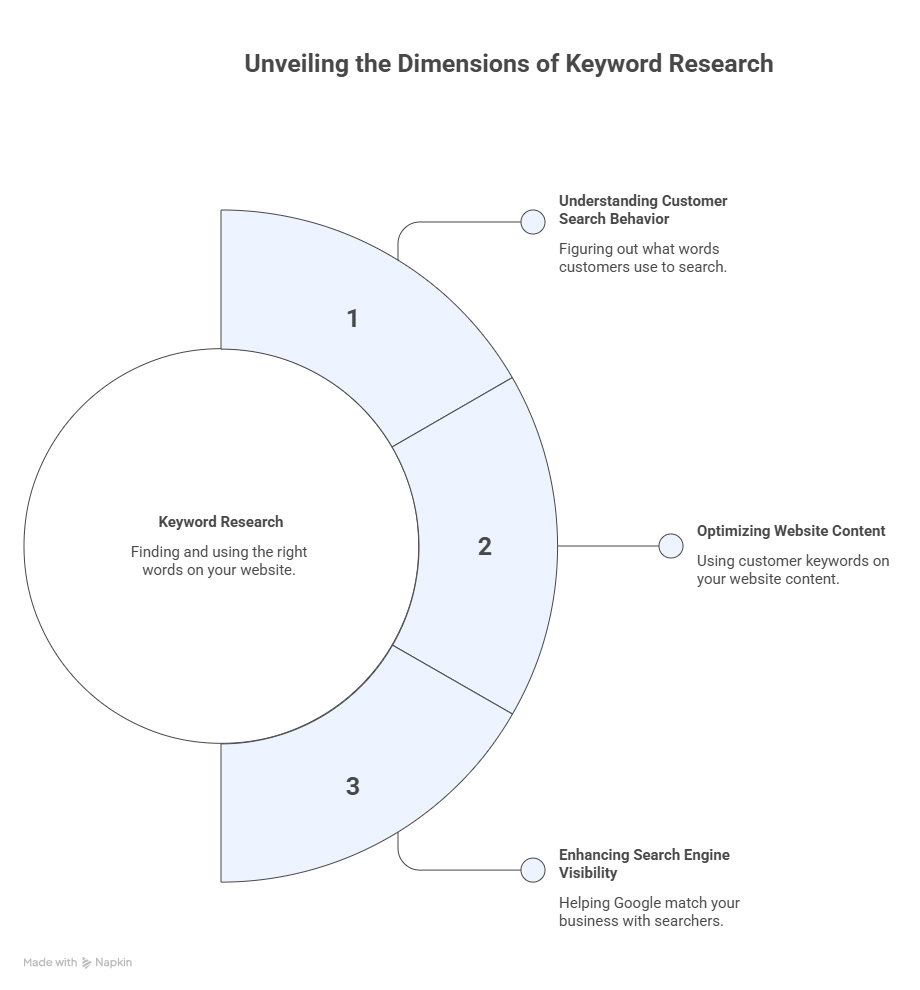
Keyword research is the process of finding and choosing the right words to use on your website.
Think of it like this: When someone wants to find a pizza place, they might type “pizza near me” into Google. Those words – “pizza near me” – are keywords.
Your job is to figure out which keywords your customers are using. Then you use those same words on your website. This helps Google match your business with people who are searching.
It’s really that simple!
Why Keywords Matter
Imagine you own a dog grooming business in Miami. You create a beautiful website. But if you only talk about “pet beautification services,” you have a problem.
Why? Because people don’t search for “pet beautification services.” They search for:
- “dog grooming Miami”
- “dog haircut near me”
- “where to groom my dog”
If you don’t use the words people actually search for, they’ll never find you. Your competitors who DO use the right words will get all the customers.
This is why keyword research is so important. It helps you speak the same language as your customers.
How Keyword Research Has Changed in 2026
Keyword research used to be simple. You’d find popular words and stuff them into your website as many times as possible.
That doesn’t work anymore!
Search engines got smarter. They now understand what people really mean when they search. And there’s something new to think about: AI search tools.
The Rise of AI Search
In 2026, people don’t just use Google anymore. They also ask questions to:
- ChatGPT
- Perplexity
- Google’s AI features
When someone asks ChatGPT “What’s the best Italian restaurant in Boston?”, the AI gives them an answer. If your restaurant isn’t mentioned, you lose that customer.
This means your keyword research needs to work for both regular Google searches AND AI search tools.
Long-Tail Keywords Are King
Here’s an important fact: Most searches are now very specific.
Instead of searching “shoes,” people search “comfortable running shoes for flat feet under $100.”
These longer, more specific phrases are called “long-tail keywords.” And they’re incredibly valuable because:
- They have less competition
- People who use them know exactly what they want
- They’re more likely to buy something
Research shows that 91.8% of all searches are long-tail keywords. They also convert 2.5 times better than short, general keywords.
This is huge! It means you should focus on specific phrases, not just popular words.
The Two Types of Keywords You Need to Know
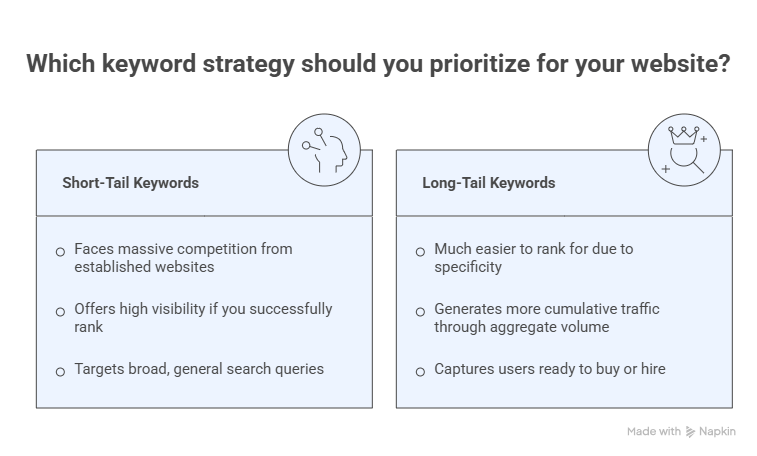
Not all keywords are the same. Let’s look at the two main types.
Short-Tail Keywords
These are short, broad words or phrases. Usually just 1-2 words.
Examples:
- “pizza”
- “lawyer”
- “running shoes”
The problem: Everyone wants to rank for these words. The competition is massive. A new website has almost no chance of ranking for these terms.
The benefit: If you DO rank, lots of people will see you.
Long-Tail Keywords
These are longer, more specific phrases. Usually 3 or more words.
Examples:
- “gluten-free pizza delivery in Austin”
- “divorce lawyer for small business owners”
- “best running shoes for marathon training”
The benefit: Much easier to rank for. People using these searches are ready to buy or hire someone. They have clear intent.
The “problem”: Fewer people search for each specific phrase. But when you add up hundreds of long-tail keywords, they bring MORE traffic than short-tail keywords!
For small businesses and anyone starting out, long-tail keywords are your best friend.
Understanding Search Intent
Here’s something important: people search for different reasons.
Understanding WHY someone searches for a keyword helps you give them what they want.
There are four main types of search intent:
1. Informational Intent
The person wants to learn something.
Examples:
- “how to train a puppy”
- “what causes headaches”
- “when to plant tomatoes”
What to give them: Educational content like blog posts, guides, and how-to articles.
2. Navigational Intent
The person wants to find a specific website.
Examples:
- “Facebook login”
- “Amazon customer service”
- “Nike store near me”
What to give them: Clear paths to what they’re looking for.
3. Commercial Investigation Intent
The person is researching before buying.
Examples:
- “best laptops 2026”
- “iPhone vs Android”
- “top rated plumbers in Denver”
What to give them: Comparisons, reviews, and detailed information about your services.
4. Transactional Intent
The person is ready to buy NOW.
Examples:
- “buy iPhone 15”
- “book hotel Miami Beach”
- “order pizza online”
What to give them: Easy ways to buy, sign up, or contact you immediately.
Understanding intent helps you create the right content for each keyword. This is part of effective search engine marketing for small business.
How to Do Keyword Research: Step by Step
Now let’s get into the actual process. Here’s how to find great keywords for your business.
Step 1: List Your Main Topics
Start by brainstorming the main topics related to your business.
If you run a bakery, your main topics might be:
- Wedding cakes
- Birthday cakes
- Cupcakes
- Bread
- Pastries
These are your “seed keywords.” They’re broad topics you’ll expand on later.
Step 2: Use Free Tools to Find Keywords
You don’t need expensive tools to start. Here are some free ways to find keywords:
Google Autocomplete
Type your seed keyword into Google but don’t press enter. Google will show you popular searches that start with those words.
Try typing “wedding cakes” and see what appears. You’ll see suggestions like:
- “wedding cakes near me”
- “wedding cakes prices”
- “wedding cakes for small weddings”
These are all real searches people make!
People Also Ask
When you search on Google, you’ll often see a “People Also Ask” box. This shows questions people ask about your topic.
These questions are GOLD for keyword research. They tell you exactly what people want to know.
Google Trends
Go to trends.google.com and type in your keywords. This free tool shows you:
- How popular a keyword is over time
- Related searches people make
- Where people search for this term
This helps you spot trending topics before your competitors do.
Step 3: Look at Your Competitors
What keywords are your competitors using?
Visit their websites and look at:
- Their page titles
- Their headings
- The topics they write about
This gives you ideas for keywords you might have missed. If several competitors all target the same keyword, it’s probably worth targeting.
Step 4: Think About Questions
People ask a LOT of questions when they search. These make excellent keywords.
For every topic, think about common questions:
- “How do I…?”
- “What is…?”
- “Where can I find…?”
- “Why does…?”
- “When should I…?”
For a bakery, this might be:
- “How do I order a custom cake?”
- “What flavors do wedding cakes come in?”
- “Where can I find gluten-free cupcakes?”
These question-based keywords are perfect for 2026 because people ask these same questions to AI tools like ChatGPT.
Step 5: Choose Keywords You Can Actually Rank For
Not every keyword is a good fit for your business. Here’s how to choose:
Consider Competition
Is the keyword super competitive? If huge companies with massive budgets are all targeting it, you probably can’t compete.
Look for keywords where smaller businesses like yours are ranking. These are your opportunities.
Match Search Volume with Reality
Don’t ignore keywords just because they have low search volume. A keyword with only 20 searches per month might seem worthless. But if those 20 people are all ready to buy, it’s incredibly valuable!
This is especially true for local businesses and specialized services.
Make Sure It Matches Your Business
Only choose keywords that are relevant to what you actually do. Don’t try to rank for something just because it’s popular if it doesn’t match your business.
Creating Content Around Keywords
Once you have your keywords, you need to use them correctly.
Don’t Stuff Keywords
The old way was to repeat your keyword over and over on a page. This is called “keyword stuffing” and it doesn’t work anymore.
Google actually penalizes websites that do this. It looks spammy and provides a bad experience for readers.
Use Keywords Naturally
Instead, write naturally for humans. Include your keyword in:
- Your page title
- At least one heading
- The first paragraph
- A few times throughout the content
- Your meta description
But always make it sound natural. If you’re writing and a keyword feels forced, don’t use it.
Create Complete, Helpful Content
Here’s what matters most in 2026: Does your content actually help people?
Google and AI tools both favor content that:
- Answers questions completely
- Includes real experience and expertise
- Gets regularly updated with fresh information
- Uses clear, organized formatting
One piece of really helpful content beats ten pieces of keyword-stuffed garbage every single time.
Keyword Research for Paid Ads
Keyword research isn’t just for organic SEO. It’s also crucial for paid advertising.
If you’re running Google Ads, the right keywords can save you tons of money and bring better results. Professional PPC Management For Small Business relies heavily on smart keyword research.
For paid ads, you want keywords that:
- Show clear buying intent
- Aren’t too expensive
- Match your ad and landing page
The same long-tail strategy works here. Specific keywords cost less and convert better.
Tools to Help You
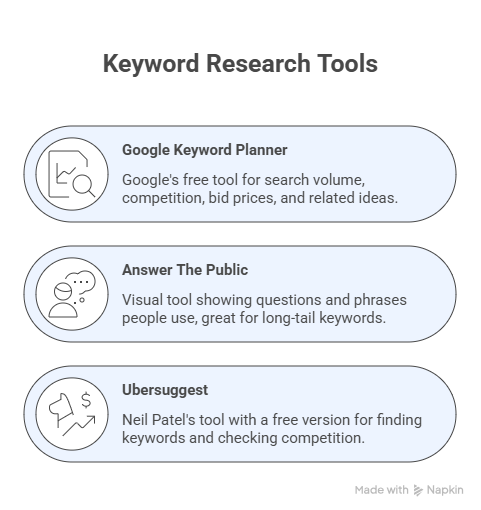
While you can do keyword research for free, some paid tools make it easier:
Google Keyword Planner
This is Google’s own tool. It’s free if you have a Google Ads account. It shows:
- Search volume for keywords
- How competitive they are
- Suggested bid prices for ads
- Related keyword ideas
Answer The Public
This tool shows you questions and phrases people use. It’s visual and easy to understand. Great for finding long-tail keywords.
Ubersuggest
Created by marketing expert Neil Patel, this tool offers a free version with useful features. It helps you find keywords and check competition.
You can learn more about keyword tools from Google’s official keyword research guide.
Common Keyword Research Mistakes to Avoid
Don’t make these errors that hurt your results:
Mistake 1: Only Focusing on High-Volume Keywords
Just because a keyword has lots of searches doesn’t mean it’s right for you. Those keywords are usually too competitive.
Focus on keywords you can actually rank for, even if they have lower volume.
Mistake 2: Ignoring Long-Tail Keywords
We’ve said it before, but it’s worth repeating: long-tail keywords are where small businesses win.
Don’t skip them just because each one has low volume. Together, they add up to serious traffic.
Mistake 3: Not Updating Your Keywords
Search trends change. What people searched for last year might be different this year.
Review and update your keyword research every few months. Stay current with what people are actually searching for.
Mistake 4: Forgetting About AI Search
In 2026, you can’t ignore AI search tools anymore. A huge portion of searches now happen through ChatGPT, Perplexity, and similar tools.
Make sure your content can be found and cited by these AI tools, not just traditional search engines.
Mistake 5: Not Tracking Results
After you optimize for keywords, track what happens. Which keywords bring traffic? Which ones lead to sales or phone calls?
Use Google Analytics and Google Search Console to see what’s working. Double down on successful keywords and drop the ones that don’t perform.
Getting Started Today
Keyword research might seem overwhelming at first. But you don’t need to do everything at once.
Start small:
- Pick 3-5 main topics for your business
- Use free tools to find 10-20 long-tail keywords
- Create one great piece of content using those keywords
- Track your results
- Repeat the process
Over time, you’ll build up a library of content targeting dozens or hundreds of valuable keywords for your website. This brings steady traffic to your website without paying for ads.
Final Thoughts
Keyword research is the foundation of getting found online. It tells you:
- What your customers are searching for
- What content to create
- How to speak your customers’ language
The good news? You don’t need to be an expert or spend lots of money to do effective keyword research.
Here’s what to remember:
- Focus on long-tail keywords (specific 3+ word phrases)
- Think about what people really want when they search
- Use free tools to get started
- Create helpful content, not keyword-stuffed pages
- Optimize for both Google and AI search tools
- Track your results and keep improving
Start with just a few keywords. Test and learn. Pay attention to what works. Over time, you’ll develop a keyword strategy that brings more customers to your business.
The businesses that succeed online are the ones that understand their customers’ language. Keyword research is how you learn that language.
Ready to start bringing more customers to your business? Begin your keyword research service today!