
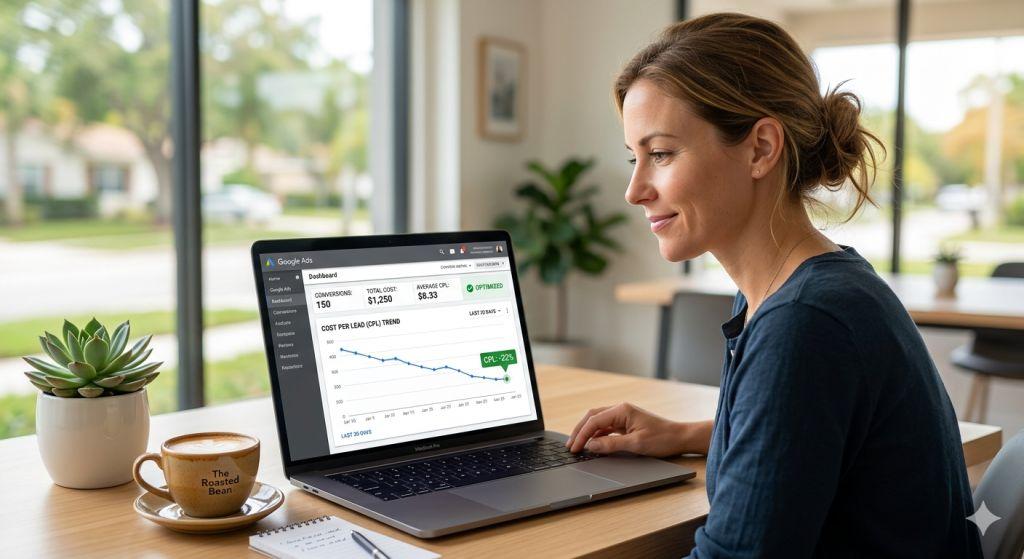
If you’ve ever run a Google ad and wondered, “Am I paying too much for this?” — you’re not alone. One of the most common questions small business owners ask is: how much does a lead from Google Ads actually cost?
The answer isn’t one simple number. It depends on your industry, your location, how your ads are set up, and a few other things we’re going to break down right here. By the end of this article, you’ll know exactly what to expect — and what you can do to get more leads without spending more money.
Let’s dig in.
What Is Google Ads Cost Per Lead?
Before we look at numbers, let’s make sure we understand what we’re talking about.
Cost per lead (CPL) is how much money you spend on Google Ads to get one person to contact you — by filling out a google form, calling your phone number, or sending a message. It’s one of the most important numbers in your advertising.
Here’s the simple math:
CPL = Total Ad Spend ÷ Number of Leads
So if you spend $500 on Google Ads and get 10 leads, your cost per lead is $50.
Simple, right? The tricky part is knowing whether $50 is a good number or a bad number — and that depends entirely on your industry and what a new customer is worth to your business.
What Is the Average Google Ads Cost Per Lead in 2026?
Here’s the big question everyone wants answered.
According to WordStream’s 2026 benchmark report — which studied over 13,000 ad campaigns across 23 different industries — the average Google Ads cost per lead is $66.69. Other benchmark sources put the number slightly higher, closer to $70.
Here’s some genuinely good news: this is the first time in five years that the average cost per lead has gone DOWN. For years, costs kept climbing. In 2026, they finally stabilized and even dropped a little — great news for advertisers.
That said, looking at the overall average doesn’t tell the full story. Costs vary wildly depending on what industry you’re in.
Google Ads Cost Per Lead by Industry
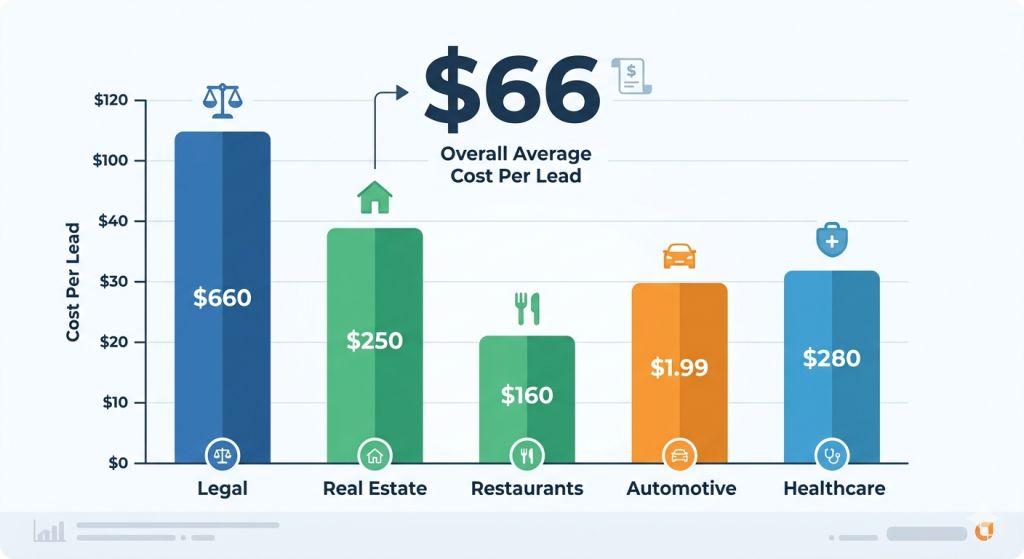
This is where things get really interesting. Not all businesses pay the same amount for a lead — not even close.
Here are the industries with the highest cost per lead in 2026:
- Attorneys & Legal Services — $131.63 per lead
- Furniture — $106.70 per lead
- Real Estate — $102.51 per lead
And here are the industries with the lowest cost per lead:
- Arts & Entertainment — $26.84 per lead
- Automotive Repair & Service — $29.96 per lead
- Restaurants & Food — $30.57 per lead
Why such a big difference? It mostly comes down to competition and customer value. A law firm might earn $10,000 or more from a single client — so spending $131 to get one lead is completely worth it. A restaurant, on the other hand, earns much less per customer, so leads need to be a lot cheaper to make sense.
Other notable ranges in 2026 include:
- Healthcare & Medical — $20 to $80 per lead
- Home Services (plumbers, roofers, HVAC) — $20 to $80 per lead
- B2B & Business Services — $50 to $200 per lead
- E-commerce — around $48 per lead
Understanding where your industry falls helps you set realistic expectations. If you’re running Google Ads lead generation campaigns, knowing your industry benchmark is the first step to knowing if your campaigns are actually working.
Why Do Google Ads Costs Keep Changing?
If you’ve been running ads for a while, you’ve probably noticed that costs don’t stay the same. Here’s why CPL goes up and down.
More Competition
More businesses are advertising on Google every year. When more advertisers compete for the same keywords, prices go up. Industries like legal services and home improvement are especially competitive.
AI Overviews Are Eating Organic Clicks
Google now shows AI-generated answers at the top of search results. This has reduced the number of people clicking on regular organic (non-paid) search results by 15–20%. That means more advertisers are fighting over fewer paid clicks — which pushes prices higher.
Privacy Changes
When web browsers stopped allowing as many tracking cookies, it became harder for Google to target the right people precisely. When targeting gets less accurate, advertisers sometimes have to spend more to reach the same number of qualified customers.
Your Account Structure Matters
Here’s a big one that often gets overlooked: how your campaigns are set up directly affects what you pay. Poorly organized campaigns with broad keywords, weak landing pages, and bad conversion tracking will always cost more per lead than well-structured campaigns.
How Does Google Ads Compare to Facebook Ads for Cost Per Lead?
A lot of business owners run ads on both platforms and wonder which one is cheaper.
In 2026, Meta (Facebook and Instagram) Ads deliver about 23% lower average CPLs than Google Ads across most industries. That sounds like a clear win for Facebook — but it’s not that simple.
Google Ads leads tend to be higher quality in industries where people are actively searching for a solution. Think about it: someone who Googles “emergency plumber near me” is ready to hire someone right now. Someone who sees a plumbing ad on Facebook while scrolling through vacation photos might not need a plumber at all.
The smartest approach? Use both. A good rule of thumb is to put 60–70% of your budget toward the platform with the lower CPL in your industry, and the remaining 30–40% on the other platform for additional reach.
For a comprehensive paid search strategy that works for your specific business, explore search engine marketing for small business with a team that knows both platforms inside and out.
What Is a “Good” Cost Per Lead?
This is the question behind the question. The honest answer is: it depends on your numbers.
A good CPL is one where the cost of getting a customer (CPL divided by your close rate) stays below 25–30% of what that customer is worth to you in their first year.
Here’s a simple example: if you charge $2,000 for a home renovation project and you close 1 in 4 leads, your cost to get one customer is 4 × CPL. If your CPL is $80, your cost per customer is $320 — which is only 16% of the project value. That’s a very healthy number.
The key is to stop thinking about CPL alone and start thinking about cost per customer. One expensive lead that closes is worth far more than ten cheap leads that ghost you.
5 Proven Ways to Lower Your Google Ads Cost Per Lead
Here’s the part you’ve been waiting for. These are real, practical strategies that work in 2026.
1. Improve Your Quality Score
Google grades every ad and keyword on a scale of 1 to 10 called Quality Score. The higher your score, the less you pay per click. A keyword with a Quality Score of 10 can cost 50% less per click than the same keyword with a score of 5. You improve Quality Score by making sure your ads, keywords, and landing pages are all closely related to each other.
2. Use Exact Match and Phrase Match Keywords
Broad match keywords show your ad to all kinds of people — including many who will never buy from you. Switching to phrase match or exact match keywords means your ads show up only when someone searches for something very close to what you offer. Fewer wasted clicks = lower CPL.
3. Build Better Landing Pages
Sending traffic to your homepage is one of the most expensive mistakes in Google Ads. Every ad should lead to a dedicated landing page or google form extension built around one specific offer. The page should be fast, easy to read on mobile, and have one clear call to action. This alone can dramatically improve your conversion rate and lower your CPL.
4. Use Smart Bidding (The Right Way)
Google’s AI-powered Smart Bidding can reduce your cost per lead by 15–35% within 60 days — but only if it’s set up correctly. Start with a Target CPA (cost per action) that’s about 10–15% above your current average CPL, let the system learn for 2–3 weeks, then gradually lower the target as performance improves. Don’t panic if volume fluctuates early — that’s just the algorithm learning.
5. Add Negative Keywords
Every week, check your search terms report. You’ll often find your ads showing up for searches that have nothing to do with your business — things like “free,” “DIY,” “jobs,” or “how to.” Adding these as negative keywords tells Google to stop showing your ad for those searches. This cuts wasted spend fast.
For hands-on help putting these strategies to work, PPC Management for Small Business gives you an experienced team managing your campaigns so you’re not guessing.
The Bottom Line
Google Ads cost per lead in 2026 averages around $66–$70 across all industries — but what matters most is not the industry average. What matters is your number, compared to the value of a customer in your business.
The good news is that for the first time in years, average CPLs are trending down. Businesses that invest in better campaign structure, smarter bidding, and quality landing pages are seeing real improvements in lead costs without cutting their ad budgets and getting real customers not fake leads.
For a deeper dive into how Google defines and tracks invalid traffic in your campaigns, visit Google’s official invalid traffic guidance — it’s a useful resource for understanding what’s being filtered and what isn’t.
The businesses winning at Google Ads in 2026 aren’t necessarily the ones spending the most. They’re the ones spending the smartest.