

PPC for Beginners – So you’ve heard people talk about PPC and you’re thinking — what exactly is that, and can it actually help my business? The answer is yes. And it’s a lot simpler than you might think.
Whether you run a small shop, offer a service, or are just starting to figure out online marketing, this guide to PPC for beginners will walk you through everything step by step. No confusing tech terms. No overwhelming details. Just clear, simple information to help you understand one of the most powerful tools in digital marketing today.
By the end of this article, you’ll know exactly what PPC is, how it works, how much it costs, and how to get started the smart way. Let’s go!
First Things First — What Is PPC?
PPC stands for Pay-Per-Click. It’s a type of online advertising where you only pay when someone actually clicks on your ad. You don’t pay for people who simply see it — only for the ones who click and visit your website.
You’ve seen PPC ads before, even if you didn’t know what they were. Next time you search something on Google, look at the very top of the results page. See those listings with a small “Sponsored” label? Those are PPC ads. The businesses behind those ads are paying each time someone clicks on them.
PPC ads show up in a lot of places — Google, YouTube, Facebook, Instagram, and Microsoft Bing. But for most beginners, Google Ads is the best starting point because it puts your business in front of people who are already searching for exactly what you offer.
Here’s an encouraging fact: Google reports that businesses earn an average of $2 for every $1 they spend on Google Ads. That means a well-run PPC campaign can more than pay for itself.
How Is PPC Different From Regular Search Results?
When you search on Google, there are two types of results — paid results (PPC ads) and free results (called organic or SEO results). The paid results appear at the very top with a “Sponsored” tag. The free results appear below them.
Getting into the free results through SEO is great — but it takes months or even years of consistent work. PPC is different. Your ad can appear at the top of Google the same day you turn it on. That speed is one of the biggest reasons beginners love PPC — it delivers results fast while your long-term SEO strategy is still building.
Think of it this way: SEO is like planting a garden. PPC is like going to the farmer’s market and buying vegetables today. Both are valuable — but only one gets you results right now.
How Does PPC Actually Work?
Every time someone types something into Google, a tiny, lightning-fast auction happens behind the scenes. Businesses compete to show their ads for that search. Here’s the simple version of how it works:
- You choose keywords — These are the words or phrases you want your ad to appear for. A dog groomer might pick “dog grooming near me” or “puppy haircut appointment.”
- You write an ad — A short, compelling message that tells people why they should click. Your headline, description, and call to action all matter here.
- You set a budget — You decide the most you’re willing to pay for each click, and the most you want to spend per day.
- Google runs the auction — Google looks at your bid AND the quality of your ad. A better, more relevant ad can actually beat a competitor who bids more money!
- Your ad appears — If your ad wins the auction, it shows up at the top of the search results page.
- Someone clicks — you pay — You only pay when a real person clicks on your ad and lands on your website.
This whole process happens in less than a second — millions of times every single day across the internet.
PPC for Beginners: The Key Terms You Need to Know
Before you launch your first campaign, let’s cover the most important PPC vocabulary — explained in plain English:
- Keyword: The word or phrase someone types into Google that triggers your ad to appear.
- CPC (Cost Per Click): The amount you pay each time someone clicks on your ad. The average across all industries is around $5.42.
- CTR (Click-Through Rate): The percentage of people who see your ad and actually click on it. A strong Google Search CTR is between 3% and 5%, though great ads can hit 10% or higher.
- Quality Score: Google’s 1–10 rating of how relevant and useful your ad is. A higher score means better placement and lower costs.
- Conversion: When a visitor takes the action you wanted — calling you, buying something, or filling out a form.
- Landing Page: The page on your website where people go after clicking your ad. It needs to be fast, clear, and easy to use.
- Negative Keyword: A word you tell Google to not show your ad for — protecting your budget from irrelevant clicks.
- Impression: Every time your ad is shown to someone on a search results page, even if they don’t click.
How Much Does PPC Cost for Beginners?
One of the best things about PPC for beginners is that you can start as small as you want. There’s no minimum spend required to open a Google Ads account. Most beginners start with $5 to $10 per day — or about $150 to $300 per month — to test the waters and see what works.
As you learn more and find what’s bringing in customers, you can slowly increase your budget with confidence. The most important rule: never increase your budget until you’re tracking your results. Spending more money on a campaign you can’t measure is like throwing money out the window.
When you’re ready to scale up or hand things over to a team of experts, professional PPC Management For Small Business can help you get more out of every dollar you spend — without the guesswork.
How to Set Up Your First PPC Campaign
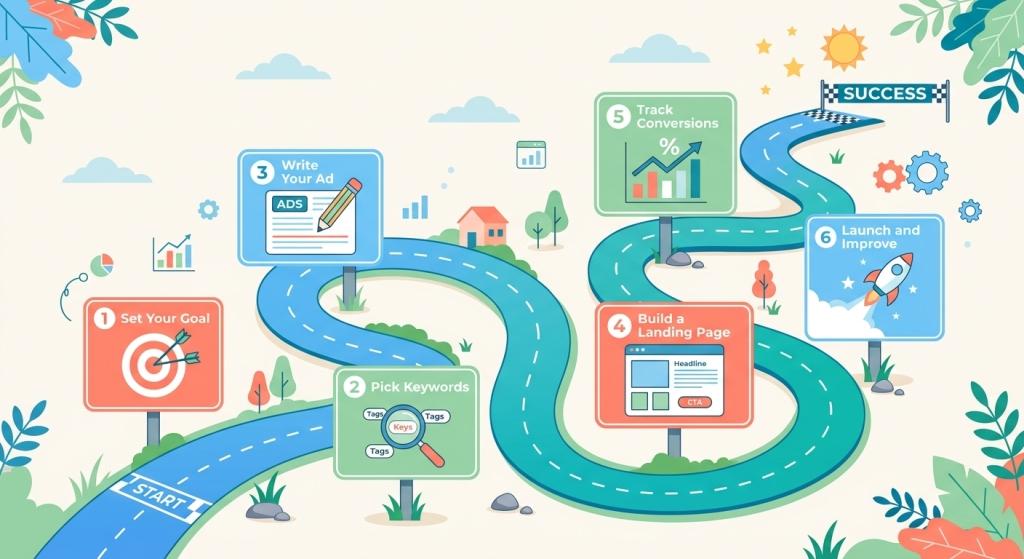
Ready to try it? Here’s a simple, beginner-friendly framework to launch your first campaign the right way:
Step 1: Define Your Goal
What do you want people to do after clicking your ad? Call you? Buy something? Fill out a contact form? Pick one clear goal before you do anything else. Your entire campaign should be built around that one action.
Step 2: Research Your Keywords
Use Google’s free Keyword Planner tool inside Google Ads to find the words and phrases your ideal customers are searching for. Focus on high-intent keywords — phrases that show someone is ready to take action right now, like “buy,” “near me,” “hire,” or “get a quote.” Avoid keywords that are too broad or vague — they attract browsers, not buyers.
Step 3: Build a Negative Keyword List
From day one, add negative keywords to your campaign. These are words that should never trigger your ad. For example, if you sell premium handmade candles, you’d add “cheap,” “free,” and “DIY” as negative keywords so your ad doesn’t show up for people who aren’t your target customer.
Step 4: Write a Great Ad
Your headline is the most important part. Mirror the exact language your customer is using — if they search “affordable roof repair,” your headline should speak directly to that. Use every available feature Google offers — like sitelinks, callout extensions, and phone numbers — because Google rewards ads that use more of the available space with better placement.
Step 5: Build a Focused Landing Page
Don’t send people who click your ad to your homepage. Build a dedicated landing page that delivers exactly what your ad promised. It should load fast, look great on phones, and make it super easy to take action — call, buy, or sign up. Every mismatch between your ad and your landing page costs you money.
Step 6: Set Up Conversion Tracking
This step is non-negotiable. Before your ad goes live, connect Google Analytics 4 to your Google Ads account and set up conversion tracking. This tells you which ads are actually bringing in customers — not just clicks. Without it, you’re flying completely blind.
Step 7: Launch, Watch, and Improve
Go live with a small budget, let the campaign run for at least two weeks to collect real data, and then make decisions based on what you see. Pause what isn’t working. Put more budget behind what is. This simple cycle of testing and improving is the secret behind every successful PPC campaign.
AI and Smart Bidding: What Beginners Should Know in 2026
In 2026, Google’s artificial intelligence plays a bigger role in PPC than ever before. Smart Bidding uses machine learning to automatically adjust your bids in real time — factoring in signals like the searcher’s location, device, time of day, and how likely they are to convert.
For beginners, automated strategies like “Maximize Conversions” are a great option once you have some data coming in. But here’s the important catch: AI only works well when it has clean, meaningful data to learn from. That’s why setting up proper conversion tracking before launch is so critical.
If you’re brand new, start with “Maximize Clicks” to build up your data first. Once you’re seeing at least 30 conversions per month, you can switch to a smarter, conversion-focused bidding strategy.
And remember — AI is a helper, not a hands-off solution. Check your campaigns weekly, review your search terms, and keep refining your negative keyword list. The best results always come from a smart combination of AI automation and human oversight.
Beginner Mistakes to Avoid
Every beginner makes mistakes — but knowing these common ones in advance can save you a lot of money:
- ❌ Skipping conversion tracking — You can’t improve what you can’t measure.
- ❌ Using only broad match keywords — Without negative keywords, your budget gets eaten up by irrelevant searches fast.
- ❌ Sending clicks to your homepage — Always use a dedicated landing page that matches your ad.
- ❌ Never testing different ads — Write at least two or three versions of every ad and see which one people respond to best.
- ❌ Quitting too soon — PPC campaigns need time and data to improve. Give them at least two full weeks before drawing any conclusions.
- ❌ Ignoring your Quality Score — A low Quality Score means you’re paying more for worse placement. Improve your ad relevance and landing page to fix it.
Where to Learn More About PPC
The good news is that there are fantastic free resources available to help you keep learning. Google offers a free training platform called Google Skillshop where you can take official Google Ads courses and even earn certifications — all at your own pace and completely free of charge. It’s one of the best places for anyone learning PPC for beginners to build real, practical knowledge.
You can also explore our deeper guide on PPC advertising for beginners for a more detailed look at topics like keyword match types, ad copy best practices, and how to read your campaign data like a pro.
You’re Ready to Get Started
PPC for beginners doesn’t have to be scary or complicated. At its heart, it’s about one simple idea: show the right message to the right person at the right moment — and only pay when they show interest. Start small, track everything honestly, keep testing, and keep improving.
The businesses winning with PPC in 2026 aren’t always the ones with the biggest budgets. They’re the ones who started smart, learned fast, and never stopped optimizing.
If you want to understand how PPC fits into a bigger online marketing picture, a great next step is exploring search engine marketing for small business — where paid ads, SEO, and other strategies all work together to help your business grow.
And when you’re ready to hand things over to a trusted team who can manage your campaigns, maximize your budget, and bring in real results, professional PPC Management For Small Business is here to help you every step of the way.