
You’ve probably heard people talk about PPC marketing and thought — that sounds complicated. But here’s the truth: once you understand the basics, PPC marketing is one of the most straightforward and rewarding tools you can use to grow your business online.
In fact, millions of small businesses, solo entrepreneurs, and first-time advertisers use PPC marketing every single day — and many of them started exactly where you are right now. Curious. A little unsure. But ready to learn.
This complete guide to PPC marketing for beginners will walk you through everything you need to know — what it is, how it works, what it costs, what mistakes to avoid, and exactly how to set up your first campaign with confidence. We’ll keep things simple, honest, and practical the whole way through.
Ready? Let’s start from the very beginning.
What Is PPC Marketing?
PPC stands for Pay-Per-Click. PPC marketing is a type of online advertising where you create ads that appear on platforms like Google, YouTube, Facebook, and Instagram — and you only pay when someone actually clicks on your ad. You don’t pay for people who simply see it. You only pay for real interest.
Think about the last time you searched for something on Google. At the very top of the results page, before the regular listings, you probably saw a few results with a small “Sponsored” label. Those are PPC ads. The businesses behind those ads are paying Google a small fee each time someone clicks on them.
PPC marketing is also closely related to what’s known as search engine marketing for small business — a broader strategy that combines paid ads, keyword targeting, and audience research to help businesses get found online by the right people at the right time.
The best part about PPC marketing for beginners? You can start with any budget, you stay in complete control of your spending, and you can see real results within days — not months.
Why PPC Marketing Works So Well
Before we get into the how-to details, let’s talk about why PPC marketing is worth your time and attention. Here are the biggest reasons beginners fall in love with it:
⚡ Speed — Results Start Immediately
Getting your website to rank in Google’s free search results through SEO (Search Engine Optimization) can take months or even years of consistent effort. PPC marketing is the opposite. Your ad can appear at the very top of Google the same day you turn it on. A brand new business can start reaching potential customers within hours of launching their first campaign.
💰 Control — You Set the Budget
With PPC marketing, you are always in control of how much you spend. You set a daily budget limit, and Google will never charge you more than that. If you want to spend $10 a day, you spend $10 a day. If you want to pause everything while you’re on vacation, you can do that too — with one click. No contracts. No minimums. No surprises.
🎯 Precision — You Reach the Right People
PPC marketing lets you target your ads based on what people are searching for, where they live, what device they’re using, what time of day it is, and much more. This means your ad reaches the people most likely to become your customers — not just anyone scrolling by.
📊 Clarity — You See Exactly What’s Working
PPC gives you real numbers in real time. You can see how many people saw your ad, how many clicked, and how many turned into actual customers. This level of transparency makes it easy to figure out what’s working, what needs fixing, and where to invest more of your budget.
📈 Reliability — It Doesn’t Change Overnight
Google’s free search rankings can shift dramatically when Google updates its algorithm — sometimes without warning. PPC marketing is not affected by those updates. As long as your campaign is running and your budget is active, your ads keep showing up. That kind of reliability is incredibly valuable for a growing business.
Google reports that businesses earn an average of $2 for every $1 they spend on Google Ads. That means a well-managed PPC campaign doesn’t just cost money — it makes money.
PPC Marketing for Beginners: The Key Terms You Need to Know
Every new skill comes with its own vocabulary, and PPC marketing is no different. Here are the most important terms — explained simply so you can use them with confidence:
- Keyword: A word or phrase that triggers your ad to appear when someone searches for it on Google. Choosing the right keywords is one of the most important parts of PPC marketing.
- CPC (Cost Per Click): The amount you pay each time someone clicks your ad. The average CPC across all industries is around $5.42, but it varies widely depending on your niche and competition.
- CTR (Click-Through Rate): The percentage of people who see your ad and actually click on it. A strong Google Search CTR is 3–5%. Great ads can hit 10% or higher.
- Quality Score: Google’s rating of your ad on a scale of 1 to 10. It measures how relevant your ad, keywords, and landing page are to what someone searched for. A higher Quality Score means better ad placement at a lower cost.
- Conversion: When someone clicks your ad and then takes the action you wanted — like calling you, buying a product, or filling out a contact form.
- Landing Page: The specific page on your website that people arrive at after clicking your ad. It needs to be fast, clear, and designed to turn visitors into customers.
- Negative Keyword: A word you tell Google to not show your ad for. For example, if you sell luxury candles, you’d add “cheap” or “free” as negative keywords so your ad doesn’t show up for bargain hunters.
- Impression: Every time your ad is displayed on a search results page, that counts as one impression — even if nobody clicks on it.
- ROAS (Return on Ad Spend): How much revenue you earn for every dollar spent on ads. A ROAS of 4 means you earned $4 for every $1 you spent.
- Smart Bidding: An automated bidding strategy powered by Google’s AI that adjusts your bids in real time based on who is searching and how likely they are to convert.
How PPC Marketing Actually Works — Step by Step
Now that you know the vocabulary, let’s walk through exactly how a PPC marketing campaign works from beginning to end. Every time someone types a query into Google, a lightning-fast auction happens — in less than a second — to decide which ads appear and in what order. Here’s your part in that process:
- Choose your keywords — Pick the words and phrases your ideal customers are typing into Google when they need what you offer.
- Write a compelling ad — Create a short, persuasive message with a clear headline and a call to action that makes people want to click.
- Set your budget and bid — Decide how much you’re willing to pay per click and how much you want to spend each day.
- Google runs the auction — Google evaluates your bid and your Quality Score together. A better, more relevant ad can beat a competitor who spends more money.
- Your ad appears — If your ad wins the auction, it shows up at the top of the search results page with a “Sponsored” label.
- Someone clicks — you pay — You only pay when a real person clicks your ad and visits your website. No clicks, no charge.
- Measure and improve — Review your results, see what’s working, and keep refining your campaign to get better and better returns over time.
How Much Does PPC Marketing Cost for Beginners?
One of the most common questions beginners ask is: how much do I need to spend? The honest answer is — it depends on your industry and your goals. But here’s a practical starting point:
Most beginners start with $5 to $10 per day, or roughly $150 to $300 per month. This is enough to start gathering real data about which keywords and ads are working. As you learn and gain confidence, you can gradually increase your budget based on what you see working.
Small businesses typically spend between $1,000 and $10,000 per month once they’re up and running and have proven their campaigns work. But you absolutely do not need to start there. Start small, learn fast, and grow your budget only when your data tells you it’s time.
The golden rule of PPC marketing for beginners: never increase your budget on a campaign you aren’t tracking. Spending more on an unmeasured campaign is one of the fastest ways to waste money in digital marketing.
When you’re ready to grow and want expert help making the most of your budget, PPC Management For Small Business offers professional campaign management designed to stretch every dollar further and bring in real, measurable results.
Choosing the Right Keywords: The Heart of PPC Marketing
Your keywords are the foundation of your entire PPC marketing campaign. Choose the wrong ones and you’ll burn through your budget without a single sale. Choose the right ones and you’ll reach people who are ready to buy.
Here’s how to think about keyword selection as a beginner:
Focus on High-Intent Keywords
High-intent keywords are phrases that show someone is ready to take action — not just browsing. Words like “buy,” “hire,” “near me,” “get a quote,” and “book an appointment” signal strong intent. Compare “running shoes” (browsing) to “buy women’s running shoes size 8 near me” (ready to purchase). The second keyword costs more per click — but converts far better.
Understand Keyword Match Types
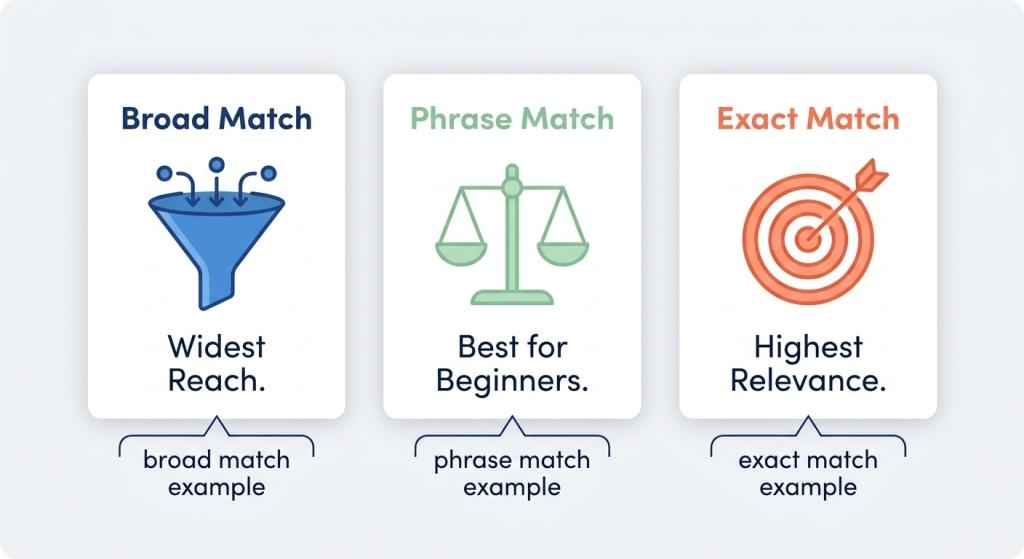
In 2026, Google offers three keyword match types that control how closely someone’s search needs to match your keyword before your ad shows up:
- Broad Match: Your ad can show for searches related to your keyword, even loosely. Widest reach, but can attract irrelevant traffic without careful negative keyword management.
- Phrase Match: Your ad shows for searches that include the meaning of your keyword. A smart middle ground — good reach with better control. Great starting point for beginners.
- Exact Match: Your ad only shows for very close variations of your exact keyword. Lowest reach, but highest relevance and usually the best conversion rates.
As a beginner, start with Phrase Match and Exact Match keywords, and build your negative keyword list from day one. This combination gives you control over your spend while you’re still learning the ropes.
Landing Pages: Where Clicks Become Customers
Your ad is only half the battle. The page someone lands on after clicking your ad — called the landing page — is where the real magic happens. And it’s also where a lot of beginners make costly mistakes.
Here’s the most important rule: your landing page must deliver exactly what your ad promised. If your ad says “Free Roof Inspection — Book Today,” your landing page better be all about booking a free roof inspection. Any mismatch between your ad and your landing page costs you money and hurts your Quality Score.
A great beginner landing page should:
- ✅ Load in under 3 seconds on mobile devices
- ✅ Have a clear, benefit-focused headline at the top
- ✅ Show one clear call to action (call, buy, or sign up — not all three)
- ✅ Build trust with reviews, credentials, or a simple guarantee
- ✅ Make it easy to contact you on both desktop and mobile
Never send paid traffic to your homepage. Always build a dedicated landing page for each campaign or ad group. This single change alone can dramatically improve your conversion rates.
AI and Smart Bidding in 2026: What Beginners Should Know
One of the biggest changes in PPC marketing for beginners in 2026 is how much artificial intelligence now does behind the scenes. Google’s Smart Bidding uses machine learning to automatically adjust how much you bid for each click in real time — based on who is searching, what device they’re on, their location, the time of day, and how likely they are to become a customer.
This sounds amazing — and it genuinely is, once you have enough data. But here’s the important beginner’s caveat: AI only optimizes toward what it’s been taught to value. If your conversion tracking isn’t set up correctly, the AI has nothing meaningful to learn from — and it will make decisions based on incomplete information.
For beginners, here’s the recommended path:
- Start with “Maximize Clicks” to drive traffic and collect data.
- Once you’re seeing at least 30 conversions per month, switch to “Maximize Conversions” or “Target CPA” to let the AI optimize for results.
- Always check your campaigns weekly. AI is a powerful helper — but it still needs a human keeping watch.
The Biggest PPC Marketing Mistakes Beginners Make
Learning what not to do is just as valuable as learning what to do. Here are the most common beginner mistakes in PPC marketing — and how to avoid them:
- ❌ Not setting up conversion tracking first — This is the single biggest mistake. You cannot improve a campaign you can’t measure. Set up Google Analytics 4 and conversion tracking before your first ad goes live.
- ❌ Using only Broad Match keywords without negatives — Your budget will disappear fast on irrelevant searches. Always pair Broad Match with a strong negative keyword list.
- ❌ Sending traffic to your homepage — Build a dedicated landing page for every campaign. Always.
- ❌ Writing only one version of your ad — Write at least two or three variations per ad group and test them against each other. Small headline changes can lead to big improvements in CTR.
- ❌ Quitting before the data comes in — PPC campaigns need time to learn and optimize. Give every campaign at least two full weeks before drawing any serious conclusions.
- ❌ Ignoring your Quality Score — A low Quality Score means you’re paying more for worse results. Improve your ad relevance, strengthen your landing page, and watch your costs drop.
- ❌ Trusting AI without checking it — Automation is powerful, but it needs human oversight. Review your campaigns every week and make sure the data makes sense.
Where to Learn More and Keep Growing
The learning doesn’t stop here. PPC marketing is a skill that gets sharper the more you practice it — and there are some excellent free resources to help you keep growing.
Google offers free, official training through Google Skillshop — a platform where you can take self-paced courses on Google Ads, earn certifications, and build real, practical knowledge at no cost. It’s one of the best investments of time a beginner can make.
For a deeper dive into the core foundations of paid advertising, our complete guide on PPC basics for small businesses covers everything from how the Google auction works to smart budgeting strategies and the best tools for tracking your results.
You’re More Ready Than You Think
Here’s the thing about PPC marketing for beginners — the hardest part is just getting started. Once you launch your first campaign, see your first click come in, and track your first conversion, everything starts to click into place. The data becomes your guide, the strategy becomes clearer, and the results become real.
The businesses winning with PPC marketing in 2026 aren’t always the biggest or the most experienced. They’re the ones who started smart, stayed curious, tracked everything, and never stopped improving. That can be you.
Start with a clear goal. Pick focused keywords. Build a great landing page. Set up your tracking. Launch small. Learn fast. And keep growing.
When you’re ready to hand things over to a trusted team who knows exactly how to make every dollar count, professional PPC Management For Small Business is here to help you scale up with confidence — and turn your ad spend into real, lasting business growth.