

Imagine your favorite sports team wins a big game. Who gets the credit — the player who scored the final point, or the teammates who set everything up? The coach who called the plays? The training staff?
In advertising, we face the same question every single day.
When a customer finally buys from you after clicking three different ads over two weeks, which ad gets the credit? That question is exactly what an attribution model in Google Ads is designed to answer. And if you are getting it wrong — or just using whatever Google picked for you by default — it could be quietly costing you a lot of money.
Let’s break it all down in plain language.
What Is an Attribution Model in Google Ads?
When someone buys from you after seeing your ads, they rarely click just one ad and immediately purchase. Most people take a longer journey. They might click a general search ad while researching, see a display ad a few days later, and then click a branded ad a week after that before finally buying.
An attribution model Google Ads setting determines how much credit each of those ad interactions gets for the final sale. It is the rule — or in the case of modern Google Ads, the AI-powered calculation — that decides which ads deserve recognition for driving your conversions.
Get this right, and your bidding system knows which ads to invest in. Get it wrong, and Google might be quietly cutting your best-performing campaigns while pouring money into ones that just happened to be in the right place at the finish line.
The Six Old Models (And Why Four of Them Are Gone)
For years, Google offered six different attribution models. It helps to know what they were, even if most are no longer available, because they show you how differently credit can be assigned.
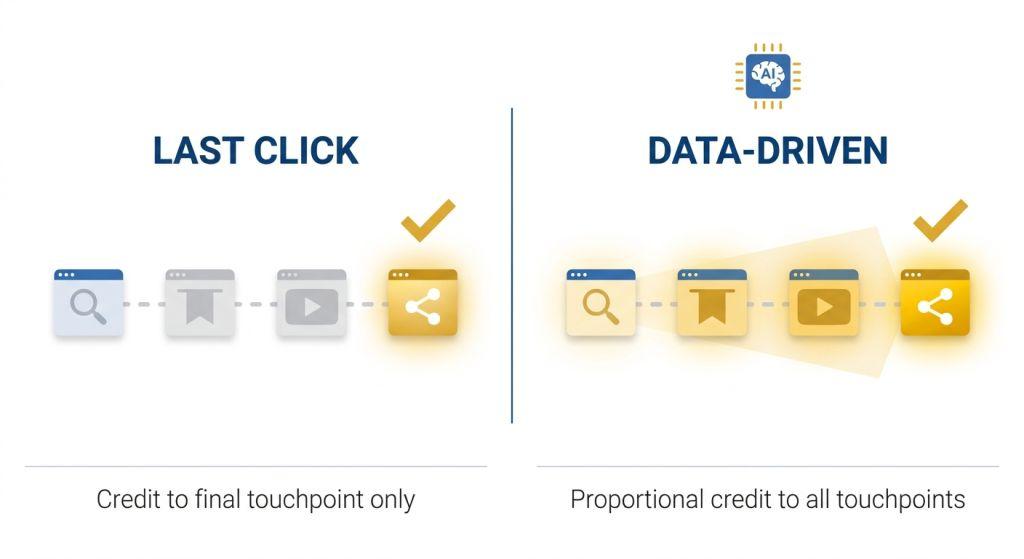
Last Click gave 100% of the credit to the very last ad someone clicked before converting. Simple, easy to understand, but it ignores everything that came before — like giving the trophy to the person who scored the final goal while forgetting everyone who passed the ball.
First Click did the opposite — 100% of the credit went to the very first ad someone ever clicked. Great for understanding how people first discovered your business, but it ignored everything that happened after.
Linear split the credit equally across every ad touchpoint in the journey. If someone clicked four ads, each got 25% of the credit. Fair on the surface, but it treated every interaction as equally important, which is rarely true.
Time Decay gave more credit to the ads clicked closest to the conversion, and less to the ones clicked earlier. The idea was that more recent interactions matter more.
Position-Based gave 40% of the credit to the first click, 40% to the last click, and split the remaining 20% among everything in between — recognizing both discovery and closing without ignoring the middle.
Data-Driven Attribution used Google’s machine learning to figure out how much credit each touchpoint actually deserved, based on your real account data.
Here is what happened: Google removed the first four models — First Click, Linear, Time Decay, and Position-Based — in 2023. Why? Because fewer than 3% of Google Ads conversions were using them, and Data-Driven Attribution had become so much more accurate that the old rule-based models simply could not keep up.
Today, you have two choices: Data-Driven Attribution or Last Click. That is it. And for most businesses, the right answer is clear.
Data-Driven Attribution: The New Standard
Data-Driven Attribution — often called DDA — is now the default attribution model in Google Ads, and it is the one Google recommends for almost everyone.
Instead of following a rigid rule like “give all the credit to the last click,” DDA uses machine learning to look at your actual account history. It studies the paths of customers who converted and compares them to the paths of people who clicked your ads but did not convert. It looks at factors like what device someone used, how much time passed between clicks, what order the ads appeared in, and how many touchpoints were involved.
If the data shows that people who clicked a certain keyword early in their journey were 25% more likely to eventually buy — even though they did not click that keyword right before purchasing — DDA gives that keyword partial credit. It reflects reality instead of a simple rule.
Big news from November 2025: Google removed the minimum data requirement for DDA. Previously, you needed at least 300 conversions per month for DDA to work. Now, even smaller accounts with lower conversion volumes can benefit from the smarter model. This is a major win for small businesses.
The practical impact is huge. When DDA is paired with Google’s Smart Bidding — tools like Target CPA or Target ROAS — your bids become sharper and more informed. Google is not just guessing where to spend your money; it is using a complete picture of your customer journey to make every dollar work harder.
Why Last Click Attribution Can Be Dangerous
Last Click is still available in Google Ads, and there are situations where it makes sense — like when you want a simple, consistent baseline to explain results to a client or stakeholder, or when your account is brand new and DDA has not yet collected enough history to be reliable.
But relying on Last Click as your primary model carries a real risk that many advertisers do not see until it is too late.
Here is a scenario to make it concrete: a customer first discovers your business by clicking a broad keyword ad like “marketing agency near me.” A few days later they click a display retargeting ad. Then a week later they search directly for your business name and click your branded ad — and that is when they convert.
Under Last Click, 100% of the credit goes to the branded keyword. Your reporting shows branded campaigns have amazing results. Your Smart Bidding system starts bidding more aggressively on branded keywords and less aggressively on the broad keyword campaigns that first introduced you to that customer. Over time, you are cutting the ads that fuel your pipeline because the last-click data makes them look useless.
This is one of the most common — and most expensive — mistakes in Google Ads. Good Google Ads conversion tracking combined with the right attribution model is what prevents this from happening silently in your account.
What Changed in 2026: New Reporting Tools
Google has been making attribution smarter and more transparent this year.
In January 2026, Google launched cross-channel budgeting and a new conversion attribution analysis report inside Google Analytics — giving advertisers a clearer view of how their budget performs across different marketing channels, not just within Google Ads.
In February 2026, Google released the Conversion Attribution Analysis Report in beta inside GA4. This new report shows the full customer journey — including “assisted conversions,” which are the touchpoints that helped lead to a conversion but were not the final click. It categorizes touchpoints into Early, Mid, and Late funnel stages using data-driven attribution, so you can finally see which campaigns are planting seeds, which are nurturing interest, and which are closing deals.
In April 2026, Google restructured how GA4 handles attribution and conversion reporting, making it more flexible and better connected to your Google Ads account. This means the data flowing between GA4 and Google Ads is more aligned and more useful than it has ever been.
Also significant: Google officially ended its Privacy Sandbox initiative in October 2025 after six years of development. Third-party cookies still exist in Chrome, but the overall direction of the industry has firmly shifted toward first-party data and modeled conversions. This makes the quality of your tracking setup — including how you use Enhanced Conversions and offline conversion data — more important than ever for accurate attribution.
Conversion Windows: The Setting Most People Forget
Attribution is not just about which model you pick. It is also about your conversion window — the period of time after an ad click during which Google will still credit a conversion back to that click.
Google Ads defaults to a 30-day click window. But if your customers typically take longer to make a decision — say, 60 or 90 days — then your 30-day window is cutting off real conversions that should be attributed to your ads.
For businesses with longer sales cycles, adjusting your conversion window to 60 or 90 days can meaningfully increase the number of conversions your campaigns receive credit for — which in turn gives your Smart Bidding system better data to work with.
This is one of those small settings that has a bigger impact than most people realize. It is the kind of detail that a specialist in PPC management for small business will catch and fix, whereas a busy business owner running their own ads might never think to check.
A Simple Framework for Getting Attribution Right in 2026
Here is a practical approach that works well for most small and mid-sized businesses:
Layer 1 — Use DDA in Google Ads. For most accounts, Data-Driven Attribution is the right model. It is smarter, more accurate, and better for Smart Bidding. If your account is brand new, start here and give it a few weeks to build history.
Layer 2 — Set the right conversion window. Think about how long your customers typically take to decide. If you sell software with a 60-day trial period, use a 60-day window. If you run a local service business where people usually call within a week of seeing an ad, 30 days is fine.
Layer 3 — Use Enhanced Conversions. Better data going into your attribution model means better decisions coming out. Enhanced Conversions help Google match more of your real-world conversions — especially on mobile or when cookies are blocked — to the right ad clicks.
Layer 4 — Cross-check with GA4. Use the new Conversion Attribution Analysis Report in GA4 to see your full customer journey and make sure your paid channels are getting appropriate credit.
For expert guidance on building this kind of measurement stack from the ground up, working with a team focused on search engine marketing for small business can save you months of trial and error.
Final Thoughts
The attribution model in Google Ads is not a set-it-and-forget-it decision. It is the foundation of how your campaigns learn, how your bidding system makes decisions, and how you understand what is actually working.
With only two models left — Data-Driven and Last Click — the choice is simpler than ever. But simpler does not mean less important. DDA paired with clean tracking, the right conversion window, and Enhanced Conversions gives Google’s Smart Bidding everything it needs to find your best customers at the best price.
For more on how Google officially explains attribution in the platform, the Google Ads Help Center guide on attribution models is a reliable free resource.
Understanding attribution is how you stop guessing and start knowing — and in a world where every ad dollar counts, that knowledge is one of the most valuable things you can have.