
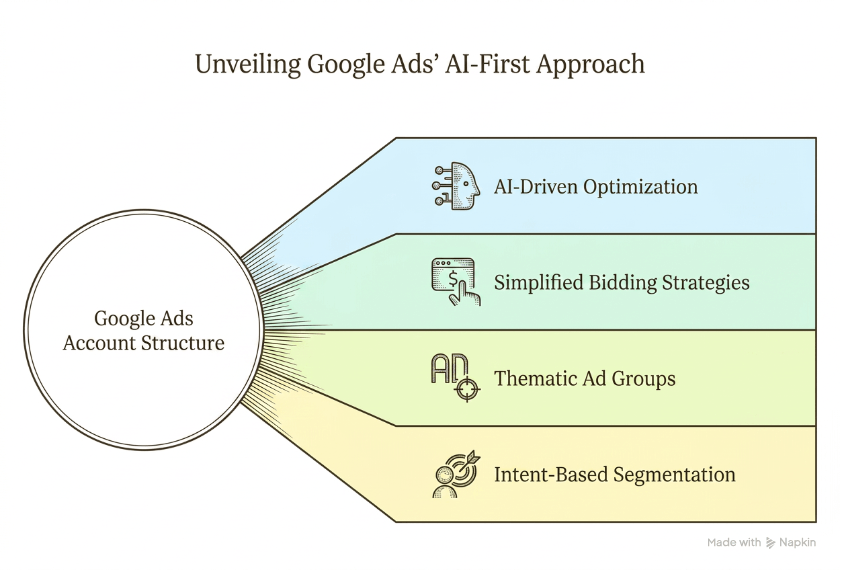
Google Ads Account Structure Best Practices – The landscape of Google Ads has fundamentally shifted in 2026, and advertisers still clinging to yesterday’s best practices are leaving significant performance gains on the table. The old debates about single keyword ad groups versus themed structures, or manual bidding versus automation, have been settled. What matters now is understanding how to build account structures that feed Google’s AI the signals it needs to optimize effectively.
The Death of Hyper-Granularity
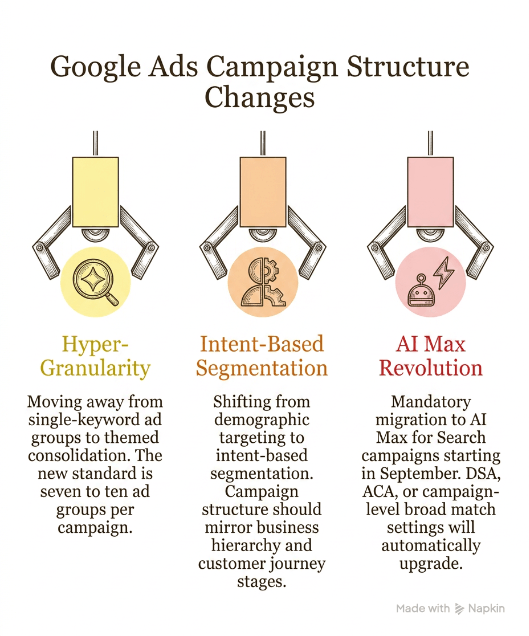
For years, conventional wisdom dictated that more granular was always better. Single Keyword Ad Groups (SKAGs) dominated strategy conversations, with advertisers building hundreds of tightly controlled ad groups to maximize Quality Scores and relevance. That era is over.
Google’s official guidance now explicitly recommends moving away from single-keyword ad groups toward themed consolidation. The platform’s machine learning capabilities have evolved to the point where they handle much of the optimization work that granular structure once enabled. The right structure today depends on your business model, budget, conversion volume, and campaign types—not a one-size-fits-all template.
The new standard for Search campaigns is seven to ten ad groups per campaign, with each ad group containing five to ten closely related keywords. This strikes the balance between relevance and machine learning efficiency. The critical constraint isn’t the number of ad groups you can create—it’s whether each generates enough conversion data for Smart Bidding to learn from. Any ad group receiving fewer than fifteen conversions per month lacks sufficient data for the algorithm to optimize effectively.
Intent-Based Segmentation Replaces Demographic Targeting
The most significant structural shift in 2026 is the move from demographic-based organization to intent-based segmentation. Google’s automation thrives on user intent signals—search queries, interaction patterns, dwell time—rather than broad demographic categories like age or gender.
Your campaign structure should mirror your business hierarchy and customer journey stages. Think of your account organization like a company org chart: clear, logical, and purpose-driven. This means separating campaigns by intent type rather than audience characteristics. Branded campaigns should be isolated from non-branded. Top-of-funnel prospecting deserves its own budget allocation separate from bottom-funnel conversion campaigns.
Branded campaigns, in particular, warrant dedicated attention from day one. Protecting your brand terms is both cost-effective and high-converting, ensuring you maintain visibility when potential customers search specifically for your business. Adding brand keywords as negatives in non-branded campaigns prevents budget cannibalization and provides cleaner performance data.
The AI Max Revolution: September 2026 Changes
One of the most consequential updates arriving in 2026 is the mandatory migration to AI Max for Search campaigns. Starting in September, all campaigns using Dynamic Search Ads (DSA), automatically created assets (ACA), or campaign-level broad match settings will automatically upgrade to AI Max.
This isn’t optional. Google will stop allowing advertisers to create new DSA campaigns through any interface—Google Ads, Ads Editor, or the API—once automatic upgrades begin. By the end of September, all eligible migrations will be complete.
The performance data supports this shift. AI Max for Search campaigns deliver an average of seven percent more conversions or conversion value at similar cost-per-acquisition or return on ad spend when using the full feature suite, which includes search term matching, text customization, and final URL expansion. These aren’t marginal gains—they represent meaningful performance improvements for advertisers who embrace the transition rather than resist it.
However, AI Max operates at the campaign level, optimizing tactics like keyword expansion and ad copy rotation. It doesn’t manage your account strategically, coordinate across campaigns, or make business-context judgment calls. The account-level architecture—your strategic framework—remains your responsibility.
Performance Max: The Cross-Channel Imperative
By early 2026, Performance Max campaigns account for forty-five percent of all Google Ads conversions. This single statistic makes Performance Max impossible to ignore for any serious paid advertising strategy. Yet success with Performance Max requires a fundamentally different approach than traditional campaign management.
The debate between Standard Shopping and Performance Max has largely been settled for eCommerce advertisers: most brands need both, running in a deliberate hierarchy. Performance Max serves as your broad reach engine, accessing all of Google’s inventory—Search, Shopping, Display, YouTube, Discover, Gmail, and Maps—through a single campaign. Standard Shopping campaigns remain essential for high-margin, high-volume products where granular control over bids, search terms, and budget allocation drives profitability.
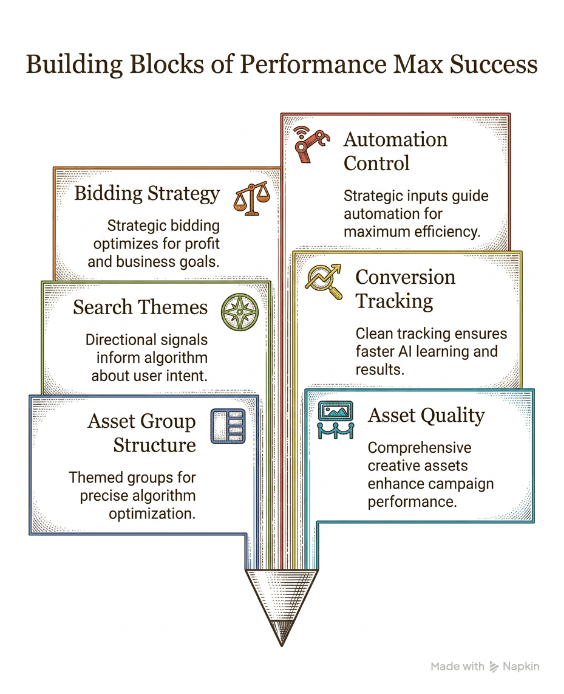
The key to Performance Max success lies in asset group structure. One of the most common mistakes is stuffing all products into a single asset group. Instead, create themed asset groups organized around product categories, customer segments, or campaign objectives. This allows Google’s algorithms to optimize with greater relevance and precision.
Asset quality and variety directly determine campaign performance. Provide the full range of creative formats—multiple headlines, descriptions, images, and critically, video assets. Campaigns with comprehensive video libraries show twenty-five to forty percent better performance compared to image-only campaigns. Google’s auto-generated videos consistently underperform custom creative by similar margins.
Search themes have expanded significantly, now allowing up to fifty themes per asset group, up from twenty-five previously. These serve as directional signals, informing the algorithm about user intent and filling gaps that landing page or feed data might miss.
Conversion Tracking: The Foundation of Everything
The most sophisticated account structure means nothing without clean conversion tracking. Google now explicitly recommends streamlining conversion setups rather than tracking multiple conflicting actions. Instead of treating phone calls, form fills, and page views as equally valuable goals, prioritize your highest-value conversions and demote the rest to secondary status.
Set your primary goal to the conversion that drives real revenue—completed purchases, qualified leads, calls lasting over sixty seconds. Assign realistic conversion values so the bidding algorithm can optimize for profit, not just volume. Use conversion value rules to differentiate between new customer acquisitions and repeat purchases.
The cleaner your conversion signal, the faster Google’s AI exits the learning period and begins delivering meaningful results. This is especially critical during the two-to-six-week learning period that Performance Max campaigns require before major optimizations should be attempted.
Smart Bidding Strategy Selection
Bidding strategy choice depends heavily on business model and account maturity. For accounts spending under two thousand dollars monthly or generating fewer than fifteen conversions per month, Manual CPC remains the safest approach. It prevents the AI from over-testing and burning limited budgets during volatile learning phases.
For eCommerce advertisers, Target ROAS is almost always the correct bidding strategy. Target CPA works for lead generation where every conversion carries roughly equal value, but in eCommerce, a fifteen-dollar phone case and a four-hundred-dollar espresso machine shouldn’t receive identical bid treatment. Target ROAS ensures Google’s algorithms factor in actual revenue value, optimizing for profit rather than conversion count.
The Automation Paradox: More Control Through Less Micromanagement
The uncomfortable truth about Google Ads in 2026 is that fighting automation is a losing strategy. The advertisers dominating Performance Max and AI Max campaigns share common characteristics: they prioritize data quality over campaign quantity, design signals strategically using customer match lists and funnel-based optimization, and control inventory intentionally through feed configurations and strategic campaign segmentation.
Success comes from understanding how to guide automation with better inputs—cleaner conversions, more targeted audience signals, stronger creative assets—rather than attempting to manually control every element. Traditional manual management operates on twenty-four to forty-eight hour optimization cycles, while AI systems optimize every fifteen to thirty minutes using live conversion data, competitive activity, and seasonal trends.
The direction is clear: Google wants AI Max and Performance Max to handle more tactical execution. Account-level strategy, cross-campaign coordination, and business-context decisions remain outside what the platform’s AI is built to do. Your role as an advertiser has shifted from tactical executor to strategic architect, building the frameworks within which automation can perform optimally.
Conclusion: Structure That Supports Intelligence
The 2026 approach to Google Ads account structure is fundamentally about designing systems that support machine learning rather than compensating for its absence. The old metrics of success—how many ad groups you have, how granular your keyword lists are, how much manual control you maintain—no longer correlate with performance.
What matters now is conversion volume per segment, signal quality feeding into Smart Bidding, asset variety and quality in Performance Max campaigns, and strategic segmentation based on business objectives rather than operational convenience. The accounts pulling ahead are those that embrace consolidation, feed quality data into automated systems, and maintain strategic oversight without tactical micromanagement.
The transition isn’t always comfortable. It requires letting go of control in some areas to gain leverage in others. But the performance data is unambiguous: properly structured, automation-friendly accounts are outperforming manually managed alternatives by margins too significant to ignore. The question for 2026 isn’t whether to adopt these practices, but how quickly you can implement them before your competitors do.