

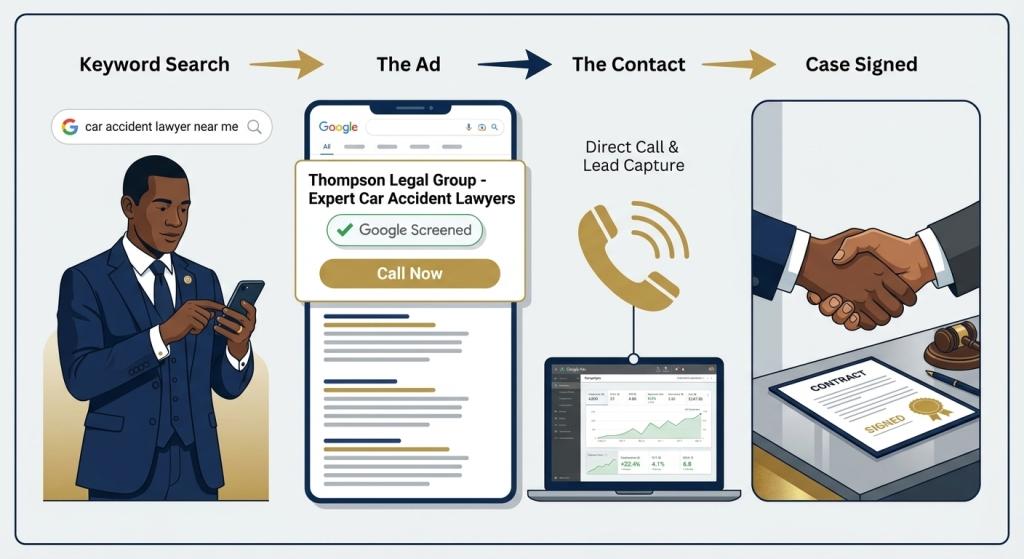
Law Firm PPC Management – Imagine someone just got hurt in a car accident. The first thing they do is grab their phone and type “car accident lawyer near me” into Google. In that moment, your law firm either shows up — or it doesn’t.
That’s exactly what law firm PPC management is all about. It puts your firm at the very top of Google search results the second someone needs legal help. And in the legal world, being first can make all the difference.
In this guide, we’ll break down how PPC works for law firms, what it costs, what strategies actually work in 2026, and how to avoid the mistakes that drain budgets fast. Whether you’re just getting started or want to improve what you already have, this article has you covered.
What Is Law Firm PPC Management?
PPC stands for Pay-Per-Click. It’s a type of online advertising where you only pay when someone clicks on your ad. When someone searches for a lawyer on Google, ads appear at the very top of the page — above all the regular (free) search results. Those are PPC ads.
Law firm PPC management is the process of setting up, running, and improving those ads so your firm gets the best possible results. It’s not just about turning ads on — it’s about making sure every dollar you spend brings in real, qualified clients.
If you’re new to online advertising, it helps to first understand the PPC basics for small businesses before diving into the specifics of legal campaigns. The foundation is the same — but legal PPC has some very important differences, which we’ll cover below.
Why Legal PPC Is Different From Every Other Industry
Here’s the honest truth: legal PPC is the most expensive and most competitive type of paid advertising in the world. That’s not an exaggeration.
High-intent legal keywords in 2026 cost between $50 and $300+ per click. Some ultra-competitive keywords — like “oil rig injury lawyer” — can cost over $740 per click. Compare that to the average cost per click across all industries, which is just $5.42.
So why would any law firm pay that much? Because the math works out. A single personal injury case can bring in $50,000 or more in revenue. When you look at it that way, paying $150 for a click that leads to a $50,000 case is actually a great deal — as long as your campaign is set up correctly.
That “as long as” part is crucial. A poorly managed campaign can burn through thousands of dollars a week without a single signed client. That’s why smart, strategic law firm PPC management is so important.
Legal PPC also has three unique challenges you won’t find in other industries:
- High costs: Legal keywords are the most expensive in all of Google Ads.
- Fast decisions: People searching for lawyers usually need help right now. They click, they call, and they decide — often in one session.
- Bar compliance rules: State bar associations have strict rules about what lawyers can and cannot say in their ads. These rules vary by state and must be followed carefully.
How Much Does Law Firm PPC Cost?
Costs vary a lot depending on your practice area and location. Here’s a general idea of what law firms are paying per click in 2026:
- Personal injury: $80 to $300+ per click
- Mass torts and class actions: $100 to $400+ per click
- Family law: $4 to $6 per click (less competitive)
- Criminal defense, immigration, bankruptcy: Varies widely by market
Most law firms spend anywhere from $3,000 to $18,000+ per month on PPC, depending on their size and goals. The key is not how much you spend — it’s how wisely you spend it. Top-performing firms aim to earn $4 to $7 back for every $1 spent on ads.
Understanding these numbers is part of good PPC Management For Small Business and applies just as much to law firms as it does to any other business.
The Best Law Firm PPC Strategies That Work in 2026
1. Separate Your Campaigns by Practice Area
One of the biggest mistakes law firms make is lumping all their services into one campaign. Personal injury, family law, criminal defense, and estate planning should each have their own separate campaign with their own keywords and ads. This keeps things focused and makes sure the right people see the right message.
2. Use Long-Tail, High-Intent Keywords
Skip broad, generic keywords like “lawyer” or “attorney.” Instead, use specific phrases that show someone is ready to hire — like “motorcycle accident attorney in [your city]” or “divorce lawyer free consultation near me.” These longer phrases cost less and attract people who are serious about getting help right now.
3. Build a Strong Negative Keyword List
Negative keywords are words you tell Google not to show your ad for. This is critical for law firms. Without them, your ad might show up for searches like “how to become a lawyer,” “free legal aid,” or “law school near me” — none of which will ever become paying clients. Common negative keywords for law firms include: “free,” “pro bono,” “jobs,” “salary,” “law school,” and “legal aid.”
4. Use Google Local Services Ads (LSAs) Too
Local Services Ads (LSAs) are different from regular Google Ads. They appear at the very top of the page — even above regular PPC ads — and they come with a “Google Screened” badge that builds instant trust with potential clients. The best part? You pay per lead, not per click. LSAs typically convert at 15–25%, compared to 5–10% for standard search ads. In 2026, any law firm not running LSAs alongside regular PPC is missing a major opportunity. You can learn more about how LSAs work through the Google Local Services Ads Help Center.
5. Create Dedicated Landing Pages for Each Practice Area
When someone clicks your ad, they should land on a page that speaks directly to their problem — not your firm’s general homepage. A person searching for a DUI lawyer should land on a page specifically about DUI defense. A page that matches what they searched for converts far better than a generic “Welcome to Our Firm” page.
6. Set Up Call Tracking
Many people who need a lawyer will call rather than fill out a form. Set up call tracking so you know which keywords and ads are actually driving phone calls. This is a game-changer for understanding what’s working and where to put more of your budget.
7. Track Signed Cases, Not Just Clicks
The goal of law firm PPC management isn’t clicks or even leads — it’s signed cases. Use offline conversion tracking to connect your Google Ads data to your intake system. When a lead becomes a signed client, you want to know which ad brought them in. This teaches Google’s AI to find more people like your best clients.
Bar Compliance: The Rule Every Law Firm Must Follow
Legal advertising has rules that no other industry deals with. State bar associations — especially in California, Texas, New York, and Florida — have detailed guidelines about what attorneys can say in ads. These rules are based on ABA Model Rules 7.1, 7.2, and 7.3, and they govern things like:
- Claims you can and cannot make (“We guarantee results” is a big no)
- How you describe your services and success rates
- Disclaimers required on certain types of ads
- Verification requirements for Local Services Ads
Every ad and every landing page should go through a compliance review before it goes live. Skipping this step can lead to ad disapprovals, account suspension, or worse — a bar complaint.
AI and Smart Bidding for Law Firm PPC
In 2026, Google’s artificial intelligence plays a big role in how ads are managed. Smart Bidding automatically adjusts how much you pay for each click based on signals like the time of day, the user’s location, their device, and how likely they are to become a client.
For law firms, Smart Bidding works best once you have solid conversion data coming in. Most experts recommend having at least 30 conversions per month before fully switching to AI-powered bidding. Before that, a strategy like “Maximize Clicks” helps build up enough data for the AI to learn from.
The key rule: use AI as a helper, not a replacement for human oversight. Check your campaigns weekly, watch for budget leaks, and make sure the system is optimizing for signed cases — not just any clicks.
Should You Hire an Agency for Law Firm PPC Management?
Solo attorneys or small firms with budgets under $3,000 per month can manage PPC themselves after proper training. But for larger budgets or multiple practice areas, working with a specialized legal PPC agency almost always pays off.
A specialized agency typically delivers 40–60% lower cost per case than a general marketing agency — because they understand bar compliance, legal keyword strategy, and how to track what actually matters.
When choosing an agency, look for these green flags:
- ✅ Experience specifically with law firm advertising
- ✅ Knowledge of bar compliance rules
- ✅ Full account ownership — you keep your Google Ads account if you leave
- ✅ Reporting focused on cost per signed case, not just clicks
- ✅ Management of both Google Ads and Local Services Ads
- ✅ Separate campaigns for each practice area
And watch out for these red flags: one-size-fits-all campaign structures, no mention of negative keywords, reporting only on clicks and impressions, and no strategy for LSAs.
Final Thoughts: Law Firm PPC Management Done Right
Law firm PPC management is one of the most powerful tools an attorney can use to grow their practice — but it’s also one of the easiest ways to waste money if it’s not done correctly. The legal advertising space is competitive, expensive, and heavily regulated. Success comes from precision: the right keywords, the right ads, the right landing pages, and the right tracking.
The firms winning in 2026 aren’t the ones with the biggest budgets. They’re the ones with the smartest strategy — focusing on signed cases over clicks, using LSAs alongside search ads, staying bar-compliant, and constantly improving their campaigns.
If you’re ready to explore what paid advertising can do for your firm, a great starting point is understanding the broader world of search engine marketing for small business — and then applying those principles with the legal-specific precision your firm deserves.