
Online advertising can feel like a mystery sometimes. You set up an ad, people start clicking, money starts leaving your account — and you’re left wondering: am I getting a good deal? Is this working? What am I actually paying for?
The answer to all of those questions starts with one simple formula. Understanding what is cost per click formula — and how to use it — is the single most important math skill any business owner or marketer needs before spending a dollar on online ads.
The good news? It’s not complicated at all. This guide will walk you through the CPC formula step by step, show you exactly how it works with real examples, and give you the tools to use it confidently for your own campaigns in 2026.
What Is Cost Per Click (CPC)?
Before we get to the formula, let’s make sure we understand what CPC actually is. Cost Per Click — or CPC — is the amount of money an advertiser pays each time someone clicks on their online ad. It’s how most digital advertising platforms charge businesses for their ads, including Google Ads, Microsoft Ads, Facebook, and Instagram.
CPC is the engine that powers PPC (Pay-Per-Click) advertising — one of the most popular and measurable forms of digital marketing available today. It’s a core part of what’s called search engine marketing for small business, which helps businesses of all sizes get found by real customers at the exact moment they’re searching online.
The beauty of CPC advertising is simple: you only pay when someone actually clicks. If your ad is shown to 500 people and nobody clicks, you pay nothing. That makes it one of the most budget-friendly advertising models available — as long as you understand how to calculate and control your costs.
What Is Cost Per Click Formula?
Here it is — the formula you came here for. It couldn’t be simpler:
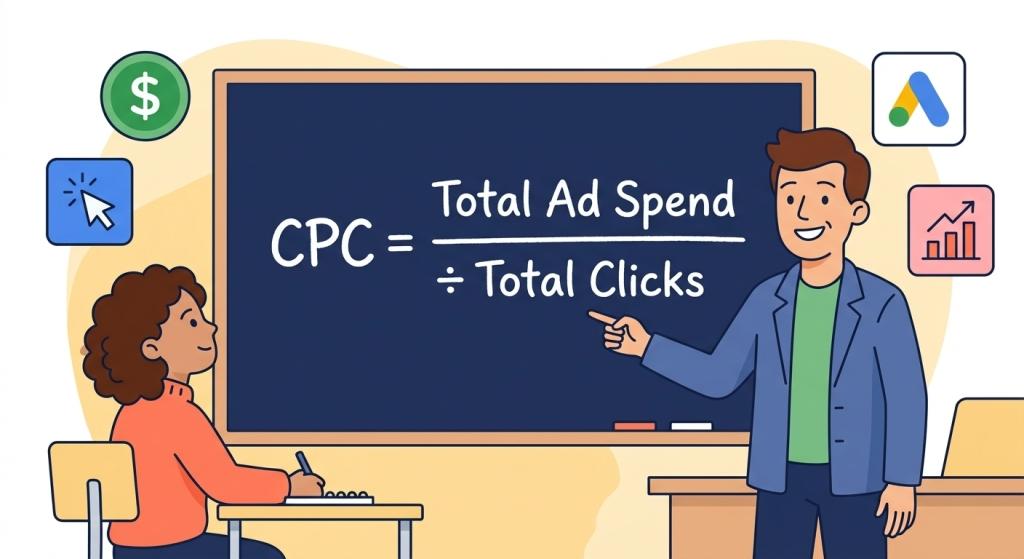
CPC = Total Ad Spend ÷ Total Number of Clicks
That’s it. You take the total amount of money you spent on your ad campaign and divide it by the total number of clicks that campaign received. The result is your Cost Per Click.
Let’s make it even clearer with a real example:
- You spend $500 on a Google Ads campaign
- Your ad receives 100 clicks
- Your CPC = $500 ÷ 100 = $5.00 per click
Every time someone clicked on your ad and visited your website, it cost you $5.00. Whether that’s a good deal or not depends entirely on what that visitor is worth to your business — which we’ll cover a little later.
The Cost Per Click Formula in Three Different Scenarios
Let’s walk through three more real-world examples so you can see how the same formula works differently depending on the business and industry.
🦷 Scenario 1: A Dental Practice
- Monthly ad spend: $4,000
- Total clicks received: 500
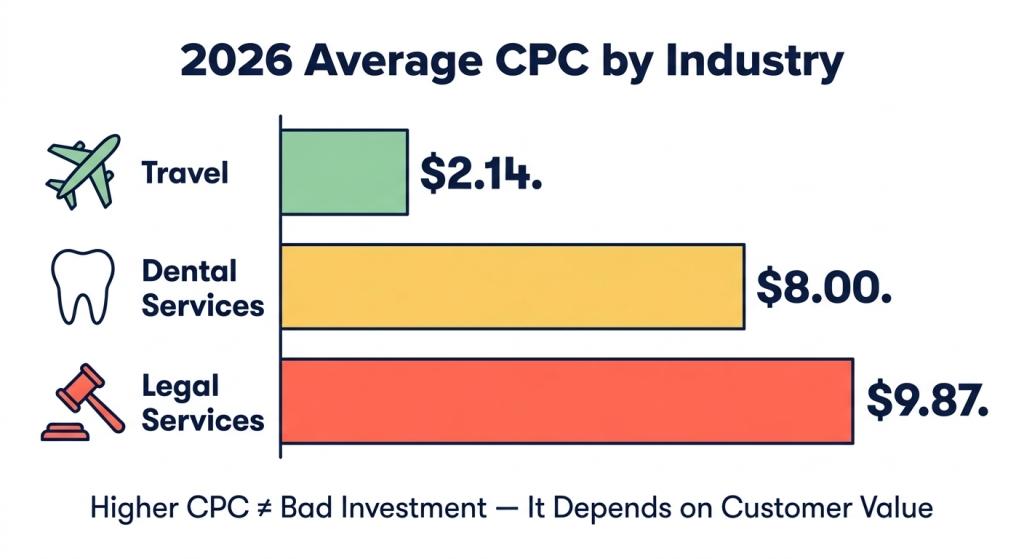
- CPC = $4,000 ÷ 500 = $8.00 per click
This lines up with the 2026 industry benchmark for Dentists and Dental Services, which averages $8.00 per click. For a dental practice where a new patient might be worth $1,200 per year or more, paying $8 per click is a very reasonable investment.
🏋️ Scenario 2: A Health and Fitness Studio
- Monthly ad spend: $1,234
- Total clicks received: 200
- CPC = $1,234 ÷ 200 = $6.17 per click
Right in line with the Health and Fitness industry average of $6.17 per click for 2026. A gym or fitness studio with a monthly membership fee of $80 needs to convert just a few of those clicks into members to see a strong return on their ad spend.
✈️ Scenario 3: A Travel Agency
- Monthly ad spend: $642
- Total clicks received: 300
- CPC = $642 ÷ 300 = $2.14 per click
Travel is one of the most affordable industries on Google Ads with an average CPC of just $2.14 — making it easier for travel businesses to drive high volumes of traffic without spending a fortune on each click.
These three scenarios show the same formula producing three completely different results — because every industry has its own competitive landscape and its own average CPC. For a deeper look at how these numbers play out across even more industries and business types, check out our full guide on cost per click example — it covers real-world CPC scenarios across more than a dozen industries with the latest 2026 benchmark data.
How Google Calculates Your Actual CPC
Here’s something interesting: the CPC formula above tells you your average CPC after the fact. But how does Google decide what you actually pay for each individual click in real time?
The answer involves something called the ad auction — a lightning-fast process that happens every single time someone types a search into Google. Here’s how your actual CPC gets determined:
Google uses this formula to calculate what you pay per click:
Your Actual CPC = Competitor’s Ad Rank ÷ Your Quality Score + $0.01
What this means in plain English: you don’t always pay your maximum bid. You pay just enough to beat the competitor below you — plus one cent. And your Quality Score plays a huge role in how much that ends up being.
Quality Score is Google’s 1–10 rating of how relevant and useful your ad, keywords, and landing page are to the person who searched. The higher your Quality Score, the less you pay per click — even if your competitors are bidding more money than you. In fact, improving your Quality Score from 5 to 8 can reduce your CPC by as much as 37%.
What Is a Good CPC in 2026?
The average CPC across all industries on Google Search in 2026 is $5.42 — more than double the $2.32 average recorded back in 2016. CPC rose approximately 15% year over year between 2025 and 2026, driven by more advertisers entering the market and Google’s AI-powered search changing how people interact with search results.
But “good” is always relative. A good CPC for your business is one where the revenue you generate from those clicks is significantly higher than what you spent to get them. Here’s a simple way to think about it:
- If your average order value is $50 and your CPC is $2 — that’s a great deal if even 1 in 10 clicks buys.
- If your average project value is $10,000 and your CPC is $50 — that’s still a fantastic deal if even 1 in 20 clicks converts.
- If your average sale is $15 and your CPC is $8 — the math gets much harder to make work.
The formula for checking your return is just as simple as the CPC formula itself:
ROAS = Revenue Generated ÷ Total Ad Spend
A ROAS of 4 means you earned $4 for every $1 spent. Google reports that the average business earns $8 for every $1 spent on Google Ads in 2026 — meaning well-managed campaigns can deliver outstanding returns even as CPCs rise.
How to Lower Your Cost Per Click
Now that you understand what is cost per click formula and how it works, the natural next question is: how do I pay less per click without sacrificing results? Here are the most effective strategies in 2026:
1. Improve Your Quality Score
As mentioned above, a higher Quality Score directly lowers your CPC. Write ads that use the exact language your customer searches for. Build dedicated landing pages that deliver exactly what the ad promises. Load fast on mobile. Make it easy to take action. These improvements feed directly into your score — and your costs drop as a result.
2. Use Long-Tail Keywords
Short, generic keywords like “plumber” or “insurance” have enormous competition and very high CPCs. Longer, more specific phrases — like “emergency water heater repair near me tonight” — have less competition and cost far less per click. They also attract people who are closer to making a decision, which means they convert better too.
3. Add Negative Keywords
Negative keywords prevent your ad from showing up for searches that will never turn into customers. When your ad stops appearing for irrelevant searches, your overall click quality improves — which means your conversion rate goes up and your effective CPC goes down. This is one of the easiest and most overlooked ways to improve campaign efficiency.
4. Use Smart Bidding Wisely
Google’s AI-powered Smart Bidding automatically adjusts your bids in real time based on signals like the searcher’s location, device, and likelihood to convert. When used correctly — with enough conversion data to guide it — Smart Bidding can help you get more clicks for the same budget. But it works best once you have at least 30 conversions per month for the AI to learn from. Jump in too early and it may actually push your CPCs higher.
5. Schedule Your Ads Strategically
Not all hours of the day — or days of the week — are equally valuable for your business. Use ad scheduling to run your ads only during the times when your customers are most likely to search and convert. Reducing spend during low-performing hours naturally brings your average CPC down across the campaign.
CPC Is Just the Beginning
Understanding what is cost per click formula is your starting point — but it’s just one number in a bigger picture. The most successful advertisers in 2026 track CPC alongside their click-through rate, conversion rate, cost per lead, and return on ad spend. Together, these numbers tell a complete story about whether your campaigns are actually working and where to focus your energy next.
If you’re just getting started with paid advertising and want to build a strong foundation before diving into the numbers, our beginner’s guide to PPC basics for small businesses is the perfect next read — covering everything from how Google Ads works to budgeting, keyword research, and setting up your first campaign the right way.
You can also build your Google Ads knowledge for free through Google Skillshop — Google’s official training platform where you can learn at your own pace and earn certifications completely free of charge.
And when you’re ready to put all of this knowledge into action with a team of experts behind you, professional PPC Management For Small Business is here to help you build smarter campaigns, lower your cost per click, and turn your ad budget into real, measurable business growth.