

ROAS in Google Ads – Imagine you put $1 into a vending machine and got $4 back every single time. You would keep putting dollars in, right? That is exactly what a strong ROAS in Google Ads feels like when your campaigns are working well. But when you don’t understand this number, it is easy to keep feeding the machine without realizing you are getting less than you put in.
ROAS in Google Ads is one of the most talked-about numbers in digital advertising — and also one of the most misunderstood. In this guide, we are going to explain exactly what it means, what good numbers look like in 2026, what major changes are happening on the platform right now, and how to use ROAS to actually grow your business. Let’s keep it simple, clear, and helpful.
What Is ROAS in Google Ads?
ROAS stands for Return on Ad Spend. It tells you how much money you made in sales for every dollar you spent on advertising. Here is the easy formula:
ROAS = Revenue from Ads ÷ Amount Spent on Ads
So if you spent $500 on Google Ads and your ads brought in $2,000 in sales, your ROAS is 4x. That means you made $4 for every $1 you spent. Simple, right?
ROAS is one of the core numbers that tells you whether your Google Ads are truly working — not just getting clicks, but actually bringing in revenue. It sits at the heart of understanding your overall Google Ads performance, and it is the number that connects your ad budget directly to your bottom line. If you want to see how ROAS fits into the full set of numbers you should be tracking, our small business guide to Google Ads KPIs gives you a clear framework — covering ROAS alongside CTR, CPA, Quality Score, and more.
What Is a Good ROAS for Google Ads in 2026?
This is the question almost every business owner asks first — and the honest answer is: it depends on your business, your industry, and your profit margins. But here is a helpful starting point.
The average ROAS across all Google Ads campaigns in 2026 is about 4.2x, meaning businesses are making roughly $4.20 for every dollar they spend on ads. The median ROAS (the middle of the pack) sits at 3.52x. Different types of campaigns perform differently:
- Search Ads: Typically achieve 6x to 8x ROAS — the highest of any format because people are actively searching for what you sell
- Shopping Ads: Average 5x to 6.5x ROAS — great for product-based businesses
- Display and YouTube Ads: Average 2.5x to 4x ROAS — lower because these ads reach people who are browsing, not actively searching
Industry makes a huge difference too. Beauty and personal care businesses lead the pack with up to 6.1x ROAS on Google, while automotive businesses average around 4.3x. Health and wellness sits at the lower end at around 1.5x due to tighter regulations and higher competition.
For eCommerce specifically, ROAS varies a lot by product type. Home goods and furniture businesses see 4x to 8x. Fashion and apparel averages 3x to 6x. Electronics typically lands between 3x and 5x due to thinner profit margins.
The Most Important ROAS Rule Most People Get Wrong
Here is something that surprises a lot of business owners: a higher ROAS is not always better. That might sound strange, but it is true — and understanding why can save you a lot of money.
Your ROAS goal should always be based on your profit margins, not on what sounds impressive. Here is a simple way to think about it:
Your Break-Even ROAS = 100 ÷ Your Profit Margin Percentage
So if your business keeps 40 cents of profit for every dollar of revenue (a 40% margin), you need at least a 2.5x ROAS just to break even on your ad spend. If your margins are 25%, you need a 4x ROAS to break even. Anything below your break-even point means your ads are losing money — even if the ROAS number looks decent on paper.
On the flip side, if your ROAS is extremely high — say 15x or 20x — it might actually mean you are spending too little. You could be missing out on a huge number of potential customers by playing it too safe with your budget. The goal is not to maximize ROAS. The goal is to find the sweet spot where you are profitable AND growing.
Why ROAS Is Declining in 2026 — And What You Can Do About It
Here is an important trend every Google advertiser needs to know about: ROAS declined by about 10% across most industries in 2026. That means the average advertiser is getting less return for the same amount of spending compared to last year.
Why is this happening? Two big reasons working together like a double punch:
First, the cost of clicks went up. Cost-per-click rose in about 87% of industries this year, with increases of 10% to 25% depending on the sector. More businesses are advertising on Google, which means more competition — and higher prices for the same clicks.
Second, conversion rates went down. Even though more people are clicking on ads, fewer of those clicks are turning into actual purchases or leads — a drop of about 9.3% across industries. This same dynamic is what’s driving cost per acquisition higher across the board at the same time. When you combine more expensive clicks with fewer conversions, your ROAS takes a hit from both directions at once.
The fix? Most experts point to the same answer: the problem is not the ads themselves — it is what happens after the click. If your website is slow, confusing, or doesn’t deliver on what the ad promised, visitors leave without buying. Improving your landing pages, page load speed, and overall website experience is often the fastest way to bring ROAS back up without spending more money on ads.
Breaking News: Major ROAS Bidding Changes in 2026
If you use automated bidding in Google Ads — especially Target ROAS — there are some very important changes happening right now that you need to know about.
New Name, Same Behavior (June 2026)
Starting in June 2026, Google simplified how bidding strategies are labeled in your account. “Maximize conversion value with a Target ROAS” is now simply called Target ROAS. Nothing about how it actually works has changed — only the label. So if you log in and see a different name, don’t panic. Everything is still running the same way.
The August 17, 2026 Bidding Change — Action Required
This one is really important. Starting August 17, 2026, Google is changing how it handles campaigns that use Target ROAS bidding and are limited by their daily budget.
Here is what that means in plain English: right now, some campaigns have been secretly outperforming the ROAS target you set. For example, maybe you told Google you wanted a 3x ROAS, but your campaign has actually been delivering 5x. Starting August 17, Google will pull that campaign back to perform closer to the 3x target you originally set — not the 5x it has been achieving.
If your campaigns have been over-delivering like this, you need to update your ROAS target before August 17 to match your actual recent performance. Otherwise, your results could get noticeably worse — automatically. Google is releasing a Bid Target Adjustment Tool on July 6, 2026 to help you review your campaigns and make the right changes in time.
New Promotion Mode for Peak Selling Periods
Google also just launched a helpful new tool in beta called Promotion Mode. This lets businesses schedule temporary ROAS adjustments and extra daily budget ahead of peak selling periods — like Black Friday, a big sale, a product launch, or the holiday season.
Instead of scrambling to manually change your settings at the last minute, you can set up Promotion Mode in advance with a start and end date. This is great news for small businesses that have predictable busy seasons and want to make the most of them without extra stress.
Smart Bidding Exploration Gets Even Smarter
Google also expanded a tool called Smart Bidding Exploration, which lets the AI look for new customers and conversions slightly outside your normal targets — within a range you control. This feature has now expanded to Performance Max campaigns, and Google reports it delivers an average 18% increase in unique search query categories and a 19% increase in overall conversions.
A Warning About ROAS Numbers — Platform Reported vs. Reality
Here is something important that most advertisers never hear about: the ROAS number you see in your Google Ads dashboard is not always the full picture.
Google’s platform attributes revenue to your ads based on who clicked. But some of that revenue might have happened anyway — from people who would have found your website through organic search, direct visits, or word of mouth. Research analyzing over $383 million in ad spend across 253 advertising studies found that true incremental ROAS (what your ads actually caused) is often 2 to 5 times lower than what Google’s platform reports.
That does not mean Google Ads are not working — they absolutely are. It just means you should not rely on ROAS alone as your only measure of success. Tracking real business outcomes like total revenue growth, new customer counts, and overall profit gives you a much more accurate picture of what your advertising is actually doing for your business.
5 Ways to Improve Your ROAS in Google Ads
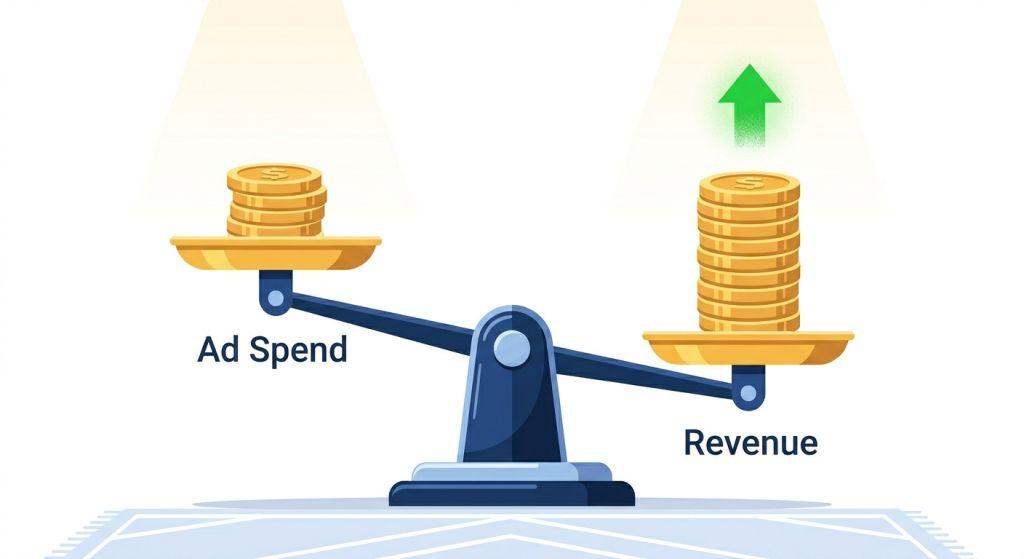
Ready to get more out of your ad budget? Here are five proven strategies that work right now in 2026:
1. Fix Your Landing Pages
This is the single most impactful change most businesses can make. If your page loads slowly, does not match your ad, or has no clear call to action, visitors will leave without buying — and your ROAS will suffer. Pages that load in under 2 seconds convert 35% better than slower ones. Make sure your page delivers exactly what your ad promised.
2. Set Realistic ROAS Targets
Do not set your Target ROAS too high right away. Google’s AI needs time to learn. Start close to your current actual ROAS, then gradually raise the target as your campaign matures and the system finds better opportunities. Setting an impossible goal from day one starves the algorithm and limits your reach.
3. Use Conversion Value, Not Just Conversions
If all your conversions are treated equally, Google cannot tell the difference between a $10 sale and a $500 sale. Setting up proper conversion value tracking — where the actual dollar amount of each sale is passed to Google — lets the AI focus on finding you the most valuable customers, not just the most frequent ones.
4. Segment Your Campaigns by Intent
Prospecting campaigns (reaching new people) will always have a lower ROAS than retargeting campaigns (reaching people who already visited your site). Do not judge both types of campaigns by the same ROAS target. Mixing them together in one report hides where your money is actually working best.
5. Get Professional Help
Managing ROAS effectively in 2026 means keeping up with constant platform changes, tracking the right data, and making smart decisions about bidding, budgets, and creative. For many small business owners, working with experts in search engine marketing for small business is the smartest investment they can make. The right team pays for itself by stopping wasted spend and maximizing what works.
ROAS and the Bigger Picture
ROAS in Google Ads is a powerful number, but it works best when you look at it alongside other important metrics. A strong ROAS starts with a strong click-through rate — because if too few people are clicking your ads, there’s not enough traffic to generate meaningful revenue. And the efficiency of your ROAS is always shaped by your underlying cost per acquisition — because spending $50 to get a $60 sale looks very different to spending $5. A business with a lower ROAS but highly loyal repeat customers who buy again and again may actually be more profitable than one with a flashy high ROAS and one-time buyers.
For more industry research and insights on how ROAS fits into the bigger picture of digital advertising, Think with Google is an excellent resource updated regularly with the latest data and trends from Google’s own research teams.
Ready to Make Every Dollar Count?
Understanding ROAS in Google Ads is one of the most valuable things you can do for your marketing budget. When you know your break-even ROAS, set realistic targets, and optimize the right parts of your campaign, you stop guessing and start growing with confidence.
Important reminder: the August 17, 2026 bidding change is coming fast. If your campaigns use Target ROAS bidding, review your settings now — especially if your campaigns have been over-delivering on their targets. Use the Bid Target Adjustment Tool available from July 6 to make updates before the deadline.
At Sheaf Media Group, we help small businesses navigate every platform update and squeeze the most value out of every advertising dollar. Our PPC Management For Small Business services are built around real results — not just impressive-looking numbers. Whether you need help calculating your break-even ROAS, setting up proper conversion tracking, or managing your campaigns through Google’s latest changes, we are ready to help you make your ads work harder than ever in 2026.