

PPC Basics for Small Businesses – Have you ever noticed those ads that show up right at the top of Google when you search for something? Maybe you typed “best pizza near me” or “plumber in my area” — and a few ads appeared before the regular search results. Those are PPC ads, and they can do the same thing for your small business.
If you’ve heard about PPC but weren’t sure what it means or how it works, you’re in the right place. This guide will walk you through the PPC basics for small businesses in simple, easy-to-understand language. No confusing jargon. No complicated charts. Just the good stuff you need to know to start growing your business online.
Let’s dive in!
What Does PPC Mean?
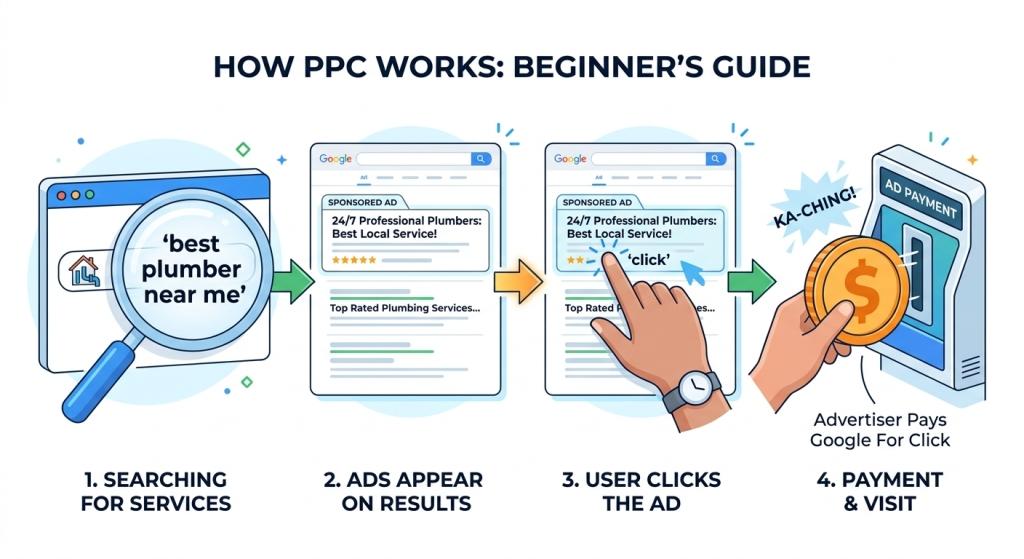
PPC stands for Pay-Per-Click. It’s a type of online advertising where you pay a small fee only when someone actually clicks on your ad. That means if 100 people see your ad but nobody clicks, you pay nothing. You only pay when someone shows interest and visits your website.
PPC is also sometimes called search engine marketing for small business, or SEM for short. You’ve probably seen these ads on Google, but they also show up on Microsoft Bing, Facebook, Instagram, and YouTube.
The most popular platform for small businesses is Google Ads. When someone searches for a product or service you offer, your ad can pop up right at the top — even if your website is brand new!
Why Should Small Businesses Care About PPC?
Great question! Here are a few big reasons why PPC is a really smart move for small businesses:
✅ It Works Right Away
Getting your website to show up in Google’s free search results (called SEO) can take months. But with PPC, your ad can appear at the very top of Google the same day you turn it on. Imagine a brand new flower shop showing up at the top of Google on their first day open — that’s the power of PPC!
✅ You Control Your Budget
One of the best things about PPC for small businesses is that you are the boss of your budget. You decide how much you want to spend per day or per month. If you only have $10 a day, that’s okay! You set the limit, and you never spend more than you planned.
✅ You Only Pay for Real Interest
Unlike putting an ad in a newspaper (where you pay whether anyone reads it or not), with PPC you only pay when someone actually clicks on your ad and visits your website. That means your money goes toward people who are already interested in what you sell.
✅ You Can See Exactly What’s Working
PPC gives you real-time data. You can see how many people saw your ad, how many clicked, and how many became customers. This makes it easy to figure out what’s working and what needs to be changed.
✅ It’s Steady and Reliable
Google’s free search results can change without warning because of algorithm updates. But PPC isn’t affected by those changes. As long as you keep your ads running, your business keeps showing up for customers.
How Does PPC Actually Work?
Think of PPC like a silent auction that happens in the blink of an eye. Every single time someone types something into Google, an auction takes place behind the scenes. Businesses that want to show their ads for that search compete in this auction.
Here’s how it works in simple steps:
- You pick keywords — These are the words or phrases you want your ad to show up for. For example, a plumber might pick “emergency plumber near me” or “pipe repair service.”
- You set a bid — This is the most you’re willing to pay for one click on your ad.
- Google runs the auction — Google looks at your bid AND how good your ad is. A great ad can sometimes beat a competitor who bids more money!
- Your ad appears — If you win the auction, your ad shows up at the top of the search results.
- Someone clicks — You pay only when they click and visit your website.
The cool part? This whole process happens in less than a second, millions of times a day.
How Much Does PPC Cost for Small Businesses?
This is one of the most common questions, and the honest answer is: it depends. But here are some real numbers to help you plan.
Most small businesses spend between $1,000 and $10,000 per month on PPC advertising. The average cost per click on Google is around $5.26, which means a $5,000 monthly budget could bring in roughly 950 clicks to your website.
Of course, you don’t have to start with $5,000. Many small businesses start with a smaller budget to learn what works, then slowly grow from there. The important thing is to start smart, track your results, and adjust as you go.
If you’re interested in getting expert help managing your budget, you can learn more about PPC Management For Small Business to see how professional management can stretch your dollars further.
PPC Basics for Small Businesses: Key Terms to Know
Before you jump in, it helps to know a few simple terms. Don’t worry — we’ll keep it easy!
- Keyword: A word or phrase people type into Google. You want your ad to show up when they search for these words.
- CPC (Cost Per Click): The amount you pay each time someone clicks your ad.
- CTR (Click-Through Rate): The percentage of people who see your ad and then click on it. A higher CTR usually means your ad is doing well.
- Conversion: When someone who clicked your ad does something valuable — like buying a product, calling you, or filling out a form.
- Landing Page: The page on your website where people go after clicking your ad. A good landing page makes it easy for visitors to become customers.
- Quality Score: Google’s rating of how relevant and useful your ad is. A higher Quality Score can help you win auctions even if you don’t have the biggest budget.
- ROAS (Return on Ad Spend): How much money you earn back for every dollar you spend on ads. For example, a ROAS of 4 means you made $4 for every $1 you spent.
Smart PPC Tips for Small Businesses in 2026
The world of PPC is always changing, and 2026 has brought some exciting new tools — especially around artificial intelligence (AI). Here are the most important tips to help your PPC campaigns work better:
1. Start With Clear Goals
Before you spend a single dollar, decide what you want your ads to do. Do you want people to call you? Fill out a contact form? Buy something online? Your goal shapes everything else about your campaign.
2. Use Tight, Specific Keywords
Big companies can afford to cast a wide net. Small businesses can’t. Instead of bidding on a broad word like “shoes,” try something like “women’s running shoes size 8 near me.” Specific keywords bring in people who are ready to buy — not just browsing.
3. Target Locally
If you run a local business, you can set your ads to only show up for people in your city, neighborhood, or even within a few miles of your store. A pizza shop, for example, can show ads only to people within a 3-mile radius. This keeps your budget focused on the customers who can actually visit you.
4. Make Sure Your Tracking Is Set Up Right
This is one of the most important steps — and one of the most overlooked. You need to track what happens after someone clicks your ad. Did they call you? Did they buy something? Set up Google Analytics 4 and make sure your “conversions” are things that really matter to your business — like a phone call or a purchase — not just a page view.
5. Use AI-Powered Smart Bidding — Carefully
Google’s AI can automatically adjust your bids in real-time based on who is searching, what device they’re on, what time it is, and how likely they are to become a customer. This is called Smart Bidding, and it can save a lot of time. But here’s the catch: AI works best when it has enough data. Most experts suggest you need at least 30 to 50 conversions per month before Smart Bidding really shines. If you’re just starting out, begin with a strategy called “Maximize Clicks” to build up your data first.
6. Don’t “Set It and Forget It”
Even with AI doing a lot of the heavy lifting, you still need to check in on your campaigns regularly. Smart businesses treat automation as a helper, not a replacement for human judgment. Check your campaigns weekly, look for budget leaks, and make sure the AI is learning from the right goals.
7. Build a Great Landing Page
Your ad gets people to click — but your landing page is what turns them into customers. Make sure the page loads fast, looks great on phones, and makes it super easy to call, buy, or sign up. A slow or confusing landing page can waste all the money you spent getting people there.
8. Try Retargeting
Retargeting lets you show ads to people who already visited your website but didn’t buy or contact you. These people already know who you are, so they’re more likely to come back and take action. It’s one of the most cost-effective PPC strategies for small businesses.
Common PPC Mistakes Small Businesses Make
Learning what not to do is just as important as learning what to do. Here are the most common mistakes to avoid:
- ❌ Not tracking conversions — If you don’t track results, you don’t know what’s working.
- ❌ Using keywords that are too broad — This wastes money on people who aren’t looking for what you sell.
- ❌ Sending traffic to a bad landing page — A slow, confusing, or generic page will lose customers fast.
- ❌ Never testing your ads — Try different headlines, images, and offers to see what people respond to best.
- ❌ Trusting AI too much without checking it — AI is powerful, but it needs a human to make sure it’s learning the right lessons.
- ❌ Giving up too soon — PPC takes a little time to warm up, especially AI-powered campaigns. Be patient and give your ads time to collect data.
What Platforms Can Small Businesses Use for PPC?
Google Ads is the most popular, but it’s not the only option. Here’s a quick look at the most common PPC platforms for small businesses:
- Google Ads: Best for reaching people who are actively searching for your product or service. Great for almost any small business.
- Microsoft Ads (Bing): Smaller audience than Google, but often cheaper clicks and less competition.
- Meta Ads (Facebook & Instagram): Great for reaching people based on their interests and demographics, even if they aren’t searching for you yet. Works especially well for visual products and local businesses.
- YouTube Ads: Video ads that can reach millions of people. A growing option now that AI tools make it easier to create video content.
For most small businesses just starting out, Google Ads is the best place to begin because it reaches people at the exact moment they’re looking for what you offer. You can learn more about how to get started through resources like Google Ads Help Center.
Is PPC Worth It for Small Businesses?
The short answer: Yes — when done right!
PPC is one of the fastest and most effective ways for small businesses to get in front of new customers. You have control over your budget, you can see exactly how your money is being spent, and you can make changes anytime to get better results.
Small businesses actually have a real edge over big companies in PPC — you can move faster, make decisions more quickly, and target your ideal customer with precision that a large corporation can’t match.
The key is to start with clear goals, target the right people, track your results carefully, and keep learning and improving. Whether you manage your PPC campaigns yourself or work with a trusted team, the basics stay the same: show the right ad to the right person at the right time.
Ready to Get Started with PPC?
Now that you know the PPC basics for small businesses, you’re already ahead of most small business owners who are still wondering what those ads at the top of Google even are.
PPC can feel a little overwhelming at first, but remember — every big campaign starts small. Start with a clear goal, pick the right keywords, set a budget you’re comfortable with, and keep an eye on your results.
And if you’d rather have a team of experts handle it for you so you can focus on running your business, that’s a great option too. Professional PPC Management For Small Business can help you get better results faster — and make sure your hard-earned money isn’t being wasted on the wrong clicks.
Have questions or want to learn more about search engine marketing for small business? We’re here to help you every step of the way.