
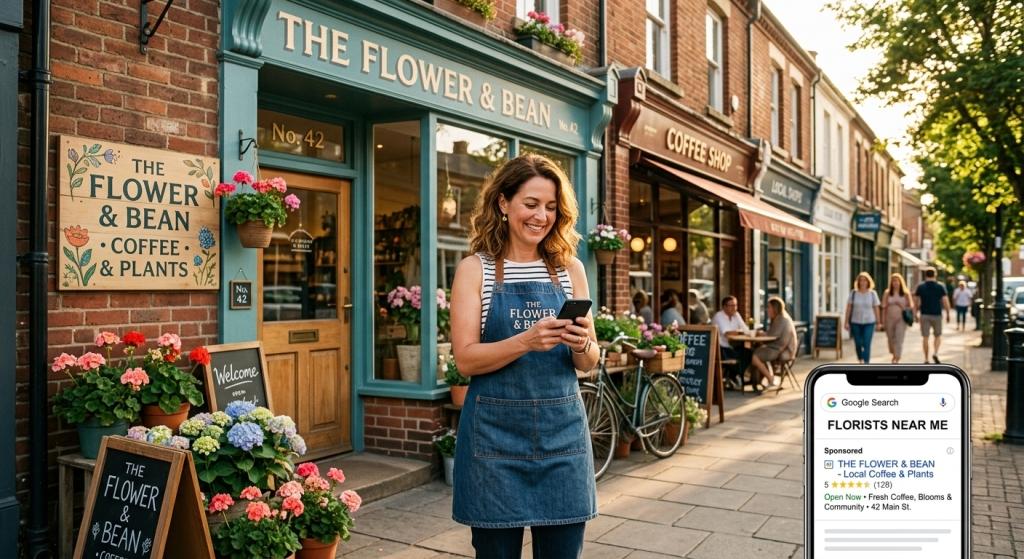
Local Business PPC – Picture this: someone in your neighborhood just searched “best plumber near me” or “hair salon open now.” In that exact moment, your business either shows up at the top of Google — or your competitor’s does.
That’s the power of local business PPC. It puts your business right in front of the people closest to you, at the very second they’re ready to spend money. Not tomorrow. Not next month. Right now.
In this guide, we’ll walk you through everything you need to know about local business PPC in 2026 — what it is, how it works, what it costs, and the smartest strategies to make every dollar count. Whether you run a plumbing company, a dental office, a restaurant, or any other local service, this guide is for you.
What Is Local Business PPC?
PPC stands for Pay-Per-Click. It’s a type of online advertising where you only pay when someone actually clicks on your ad. Local business PPC takes that concept one step further — it targets your ads specifically to people searching in your city, neighborhood, or service area.
When someone nearby searches for a service you offer, your ad appears at the very top of their Google search results — above all the regular (free) listings. And the best part? That person is not just browsing. They are ready to act. Someone typing “emergency HVAC repair near me” needs help today, not someday.
Local business PPC is a core part of what’s known as search engine marketing for small business — a strategy that uses paid ads, smart keyword targeting, and location-based settings to help local businesses get found by the right customers at exactly the right time.
Why Local Business PPC Is Different From Regular PPC
Running a local PPC campaign is not the same as running a national one — and that difference matters a lot. Here’s what makes local business PPC unique:
- Geography is everything. Targeting too broadly wastes money on clicks from people who will never visit or hire you. Targeting too narrowly limits how many people see your ad. Finding that sweet spot is the key to profitable local PPC.
- Phone calls matter more. Local customers are much more likely to call than to fill out a form. Your ads need to make it easy to call — and you need to track every single call to know what’s working.
- Speed beats SEO. Local SEO typically takes 3 to 6 months to show results. Local business PPC can generate your first leads within 1 to 7 days of launching. For a business that needs customers now, that speed is invaluable.
- Intent is sky-high. Unlike social media ads that interrupt people who weren’t thinking about your service, local PPC reaches people who are actively searching for exactly what you offer. That’s why conversion rates are consistently higher for local search ads than almost any other type of advertising.
How Much Does Local Business PPC Cost in 2026?
Let’s talk real numbers. The average cost per click on Google Ads in 2026 is $5.42 — more than double what it was a decade ago. Local PPC campaigns typically generate leads at a cost of $55 to $110 per lead, depending on your industry and location.
Compare that to local SEO, which delivers leads at $20 to $40 each — but takes 3 to 6 months to kick in. PPC costs more per lead, but it works immediately. For most local businesses, the smart move is to run both together: PPC for fast, reliable leads right now, and SEO to build long-term organic visibility over time.
What budget do you need to get started? Here’s a practical reality check: minimum budgets matter. Underfunded campaigns underperform — not because PPC doesn’t work, but because there isn’t enough data for Google’s AI to learn and optimize. Industry experts suggest giving your campaign at least 60 to 90 days before drawing any firm conclusions about its viability.
If managing all of this sounds like a lot, that’s because it can be — and that’s exactly where professional PPC Management For Small Business makes a real difference. The right management team handles the strategy, the optimization, and the tracking — so you can focus on serving your customers.
The Best Local Business PPC Strategies for 2026
1. Use Tight Geographic Targeting
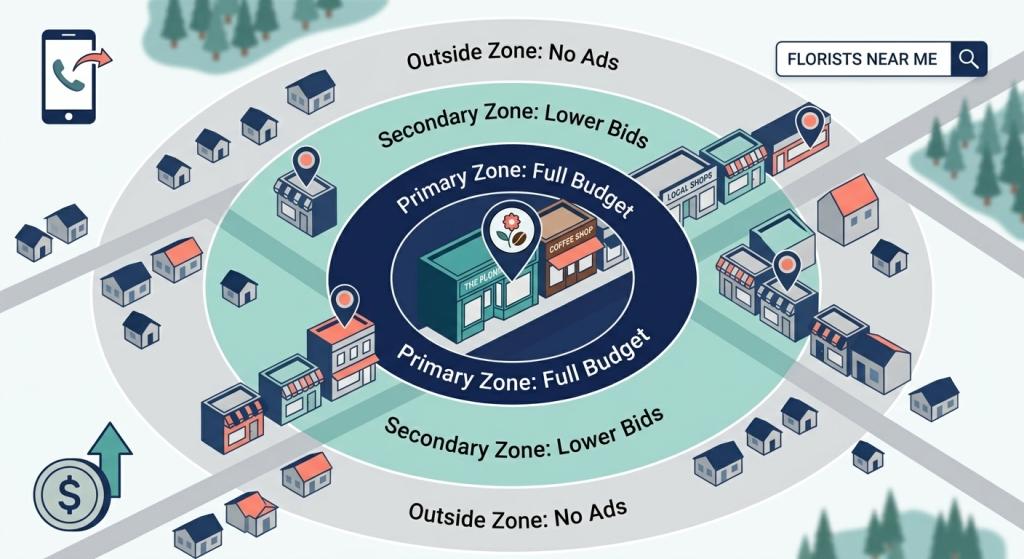
The most important setting in any local business PPC campaign is your geographic targeting. Start with a radius around your physical location or service hub — then get even more specific. Zip code targeting lets you focus your budget on the neighborhoods that actually convert. Some areas bring in great customers. Others drain your budget with clicks that never close.
A smart local strategy uses two layers: a primary zone covering the zip codes or radius where you do 80% of your business — with your full budget and most aggressive bidding — and a secondary zone for adjacent areas where you can serve customers but where competition may be less intense. You can even use geo-fencing to show ads to people near competitor locations or local events. These small geographic adjustments can make a massive difference in ROI.
2. Focus on High-Intent, Location-Specific Keywords
Broad keywords like “plumber” or “dentist” are expensive and pull in traffic from people who may not be ready to hire. Local business PPC works best when you target high-intent, location-specific phrases — the kinds of searches that show someone is ready to act right now.
Great local keywords include phrases like: “emergency electrician [your city],” “[service] near me open now,” “best [service] in [neighborhood],” and “affordable [service] [zip code].” Advertisers who target 5 to 15 of these high-intent terms consistently achieve positive ROI — while businesses that spread their budget across too many vague keywords often burn through their budget with little to show for it.
3. Build a Strong Negative Keyword List From Day One
Negative keywords are the words you tell Google to never show your ad for. For local businesses, this is critically important. Without a solid negative keyword list, your ad might show up for searches like “how to fix my own plumbing,” “free legal advice,” or “DIY roof repair” — people who will never hire you. Regular negative keyword management is one of the most effective ways to stop wasting ad spend and keep your campaign profitable.
4. Use Google Local Services Ads (LSAs)
Google Local Services Ads are a game-changer for local businesses. They appear above everything else on the search results page — even above regular PPC ads — and they come with a “Google Screened” or “Google Guaranteed” badge that instantly builds trust with potential customers. The real kicker? You pay per lead, not per click. That means you only pay when someone actually contacts you through the ad.
LSAs convert at significantly higher rates than standard search ads because of that trust badge. In 2026, any local business not running LSAs alongside their regular Google Ads campaign is leaving a significant number of qualified leads on the table.
5. Make Phone Calls Easy to Track
For local businesses, phone calls are often more valuable than form fills — because a person who picks up the phone is usually ready to book right now. Set up call tracking from day one so you know exactly which keywords and ads are generating phone calls. Use call-only ads or call extensions in your campaigns so people can call you directly from the search results page without even visiting your website. This alone can dramatically increase your lead volume from the same budget.
6. Build Landing Pages That Match Your Local Ads
Never send paid traffic from a local ad to your homepage. Build dedicated landing pages that speak directly to the service and location you’re advertising. If someone clicks an ad for “roof repair in [your city],” they should land on a page that specifically talks about roof repair in that city — with a clear headline, local reviews or credentials, and an easy way to call or book. Advertisers who use dedicated, location-specific landing pages consistently outperform those who send all traffic to a general homepage.
7. Use Smart Bidding — at the Right Time
Google’s AI-powered Smart Bidding can automatically adjust your bids in real time based on dozens of signals — including the searcher’s location, device, time of day, and how likely they are to convert. For local businesses, this is a powerful tool — but it only works well when your campaign has enough conversion data to learn from.
The recommended path for local campaigns: start with Maximize Clicks or Manual CPC to build up data, then transition to Maximize Conversions once you’re seeing at least 30 conversions per month. From there, move to Target CPA to control your cost per lead as you scale. Jumping to Smart Bidding too early — before the data is there — is one of the most common local PPC mistakes.
Common Local Business PPC Mistakes to Avoid
- ❌ Targeting too broad a geographic area — Showing your ad to people 50 miles away who will never hire a local business wastes budget fast.
- ❌ Skipping call tracking — Most local customers call instead of filling out forms. If you’re not tracking calls, you’re missing your most important data point.
- ❌ No negative keywords — Without them, irrelevant searches eat through your budget silently every single day.
- ❌ Sending traffic to your homepage — Build a local, service-specific landing page for every campaign.
- ❌ Quitting too soon — Local PPC campaigns typically need 60 to 90 days to fully optimize. Give them time and data before drawing conclusions.
- ❌ Ignoring Local Services Ads — LSAs are one of the highest-converting ad formats available for local businesses in 2026 and are still underused by many small business owners.
Is Local Business PPC Worth It?
Absolutely — when it’s done right. Local business PPC is one of the fastest and most targeted ways to bring new customers through your door or onto your schedule. It reaches people who are already looking for what you offer, in your area, right now. That combination of timing, location, and intent is something very few other marketing channels can match.
The businesses winning with local PPC in 2026 are the ones who target tightly, track everything, use Local Services Ads alongside standard Google Ads, and treat their campaigns as something that needs regular attention — not a one-time setup. To go even deeper on the strategies that work specifically for businesses like yours, explore our complete guide to PPC for local business — packed with advanced targeting tips, LSA setup guidance, and campaign structure best practices built specifically for local markets.
You can learn more about the broader world of keyword research, campaign structure, and ad strategy through Google’s free training platform at Google Skillshop — a great resource for any local business owner who wants to deepen their PPC knowledge at their own pace.
And when you’re ready to hand your campaigns over to a team that specializes in results-driven local advertising, professional PPC Management For Small Business is here to help you reach more local customers, spend smarter, and grow your business with confidence.