
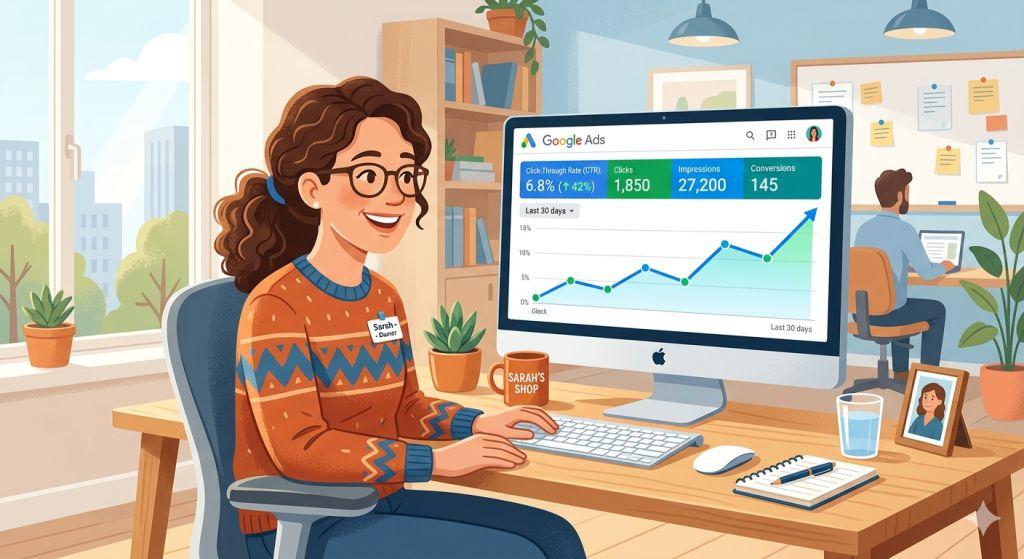
CTR Google Ads Explained – Have you ever put up a Google ad and wondered, “Why isn’t anyone clicking on it?” You’re not alone. One of the most important numbers in Google advertising is called CTR Google Ads — and understanding it can be the difference between wasting your budget and actually growing your business.
In this article, we’re going to break down exactly what CTR means, what the numbers look like in 2026, and — most importantly — what you can do to make yours better. Don’t worry, we’ll keep it simple and easy to follow!
What Does CTR Mean in Google Ads?
CTR stands for Click-Through Rate. It tells you how many people clicked on your ad out of everyone who saw it. Here’s the simple math behind it:
CTR = (Number of Clicks ÷ Number of Times Your Ad Was Shown) × 100
So if 100 people saw your ad and 6 of them clicked on it, your CTR would be 6%. That’s actually a pretty solid number! Think of CTR like raising your hand in class — if your ad is interesting and relevant, more people “raise their hand” by clicking on it. If your ad doesn’t grab attention or match what people are searching for, most people will scroll right past it.
CTR is one of the most important signals in Google Ads performance because it tells you how well your ad is connecting with the right audience. But it’s important to remember that CTR is just one piece of a much bigger picture — our small business guide to Google Ads KPIs covers all the key metrics together and shows you how CTR, CPA, ROAS, and Quality Score work as a system.
What Is a Good CTR for Google Ads in 2026?
This is one of the most common questions business owners ask — and the answer depends on what type of ad you’re running and what industry you’re in.
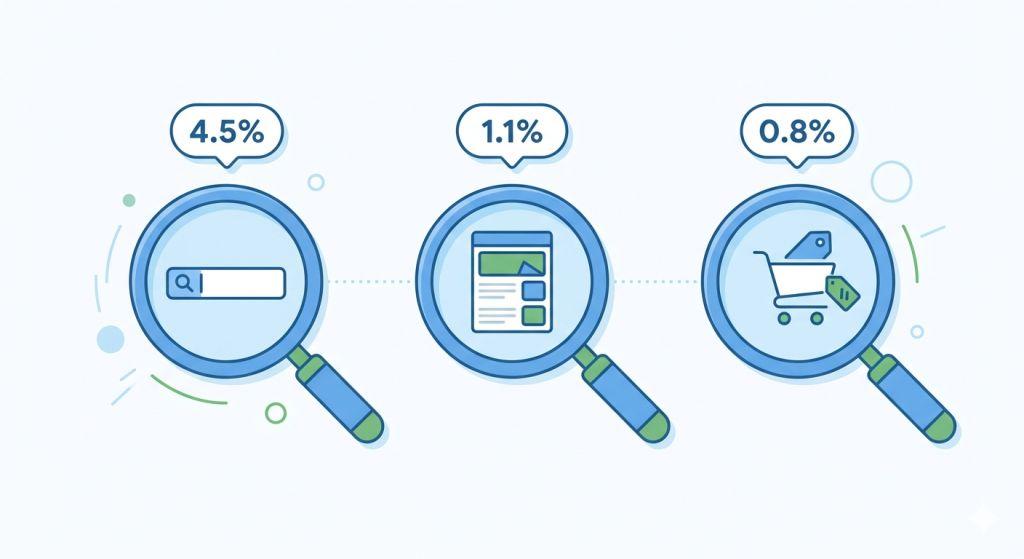
Here’s a simple breakdown of average CTR benchmarks in 2026:
- Search Ads (the text ads that appear in Google search results): Average CTR is around 6.64% across all industries
- Display Ads (banner-style ads on websites): Average CTR is much lower at around 0.46%
- Shopping Ads (product image ads): Average CTR is around 0.8% to 1.3%
- YouTube Video Ads: Average CTR is approximately 0.65%
For Search Ads specifically, some industries perform much better than others. Arts and Entertainment leads the pack at an impressive 12.75% CTR, while Finance and Insurance follows at 9.83%, and Travel comes in at 9.32%. On the lower end, Automotive Repair sits around 5.56%.
The key takeaway: always compare your CTR to your own industry — not just the overall average. A 3% CTR might be excellent in one field and below average in another.
The Big CTR Surprise of 2026
Here’s something really interesting happening right now that every advertiser needs to know: CTR is going up, but conversions are going down.
That might sound confusing, so let’s break it down. CTR rose about 7.5% compared to last year — meaning more people are clicking on ads than ever before. But at the same time, conversion rates (the percentage of those people who actually buy something or fill out a form) dropped nearly 9.3% across most industries.
What does that mean in plain English? The ads are doing a great job getting clicks, but something is going wrong after people arrive at the website. Experts call this a “landing page problem.” The ad promises one thing, but the webpage doesn’t deliver on that promise — or it loads too slowly, or it’s hard to use on a phone.
This is one of the most important lessons in running a successful ad campaign: a high CTR is great, but it only matters if those clicks turn into real customers. That’s why investing in strong PPC Management For Small Business is so valuable — the right team looks at the whole picture, not just one number.
How AI Overviews Are Changing CTR Right Now
You may have noticed something new at the top of Google search results — a big AI-generated answer block that tries to answer your question before you even click on anything. These are called AI Overviews, and they are having a major effect on CTR in 2026.
When an AI Overview appears on a search results page, fewer people click on the ads and links below it — because Google already gave them a quick answer. This has pushed some advertisers to see lower click numbers, even when their ads are well-written and targeted correctly.
The good news? Searches that don’t trigger an AI Overview are becoming more valuable. CTR on those searches has actually increased from 2.8% in early 2025 to 3.8% by early 2026. Google is also testing new ad placements inside AI responses, which could open up exciting new opportunities for advertisers soon.
For now, the smartest move is to use strong ad extensions (extra bits of information attached to your ad, like phone numbers, site links, and special offers) to stand out as much as possible — even when AI Overviews are taking up space on the page.
CTR and Quality Score: Why They’re Connected
Here’s something most people don’t realize: your CTR doesn’t just measure how well your ads are doing — it actually affects how much you pay for each click.
Google uses something called a Quality Score (rated from 1 to 10) to decide where your ad shows up and how much it costs. Your CTR is one of the biggest factors in that score, making up about 38% of the total calculation. The other factors are ad relevance (23%) and landing page experience (39%).
When your CTR is high, your Quality Score goes up. When your Quality Score goes up, Google rewards you with better ad placement and lower costs per click. In fact, improving your Quality Score from a 5 to an 8 can cut your cost per click by roughly 30%. That’s a huge saving!
On the flip side, industries with low CTRs — like legal services, insurance, and healthcare — tend to have the highest costs per click. Low CTR hurts Quality Score, and that makes every click more expensive. It becomes a cycle that’s hard to break without professional help.
Google updated how it calculates landing page quality in 2026, with page load speed now accounting for 35% of that score — up from 20% last year. Pages that load in under 2 seconds with clear, helpful content earn the best scores.
Why Does CTR Matter for Small Businesses?
For small businesses especially, every dollar spent on advertising needs to count. A strong CTR Google Ads strategy helps you get more clicks from the right people without spending more money. Here’s why it matters so much:
- Better CTR = Lower costs. Google rewards well-clicked ads with cheaper prices.
- Better CTR = More visibility. Higher Quality Scores mean your ad shows up more often and in better positions.
- Better CTR = Better data. More clicks give you better information about what’s working, so you can keep improving.
If you’re running ads for a local business, a restaurant, a service company, or an e-commerce store, keeping a close eye on your CTR is one of the smartest things you can do. Partnering with experts in search engine marketing for small business can help you understand these numbers and act on them quickly.
6 Simple Ways to Improve Your CTR Google Ads
Ready to get more people clicking on your ads? Here are six proven strategies that work in 2026:
1. Add Negative Keywords
Negative keywords are words that tell Google not to show your ad for certain searches. For example, if you sell premium shoes, you might add “cheap” or “free” as negative keywords. This stops your ad from showing up for people who aren’t likely to buy from you — and it keeps your CTR healthy by making sure only the right people see your ad.
2. Use the Right Keyword Match Types
Google lets you choose how closely a search term needs to match your keyword before your ad shows. Exact match gives you the tightest control and usually the highest CTR. Phrase match is a good middle ground. Broad match casts the widest net but can attract irrelevant clicks — use it carefully and always pair it with a strong negative keyword list.
3. Write Headlines That Grab Attention
Your headline is the first thing people see. Make it specific, clear, and focused on what the searcher actually wants. Ask a question, highlight a benefit, or include the keyword they searched for. Ads that match what someone just typed into Google feel more relevant — and relevant ads get more clicks.
4. Use All Available Ad Extensions
Ad extensions let you add extra information to your ad — like your phone number, business location, links to specific pages, or special promotions. These make your ad bigger and more informative, which naturally leads to more clicks. In 2026, with AI Overviews taking up more screen space, using every extension available helps your ad stand out.
5. Fix Your Landing Pages
Remember the 2026 problem we mentioned — high CTR but low conversions? The fix starts with your landing page. Make sure the page your ad links to matches the promise of the ad. If your ad says “Get a Free Quote Today,” the landing page should have a quote form front and center — not your general homepage. Also, make sure your page loads fast, especially on phones.
6. Let AI Help You
Google’s newer tools, like Responsive Search Ads and AI Max for Search, use artificial intelligence to test different versions of your headlines and descriptions automatically. They figure out which combinations get the most clicks and show those more often. Using these tools gives Google’s AI more to work with — and that usually means better CTR over time.
Keep an Eye on the Full Picture
CTR is a powerful number, but it’s just one piece of the puzzle. The real goal isn’t just clicks — it’s customers. So while you work to improve your CTR Google Ads, always keep an eye on what happens after the click: Are people staying on your page? Are they buying? Are they calling?
When clicks become costly without resulting in customers, the most revealing number to look at next is your cost per acquisition — it tells you exactly how much you’re spending to get each real result, and whether your campaigns are actually profitable. And if you sell products or services with varying order values, tracking your ROAS in Google Ads alongside your CTR will show you which campaigns are generating genuine revenue — not just traffic.
For a deeper look at how all these metrics fit together, the Think with Google resource hub is a fantastic place to explore the latest research on how people search and click online.
And if managing all of this feels like a lot — it is! Running effective Google Ads takes time, skill, and constant attention. That’s exactly why many small business owners turn to professionals. At Sheaf Media Group, we specialize in search engine marketing for small business, helping business owners like you get real results from every dollar spent on ads.
Whether you’re just getting started or looking to improve what you already have, our PPC Management For Small Business services are designed to help you grow smarter — not just spend more. And if you want to understand how CTR connects to your broader Google Ads performance, we’re here to walk you through it every step of the way.
In 2026, the businesses that win at Google Ads aren’t necessarily the ones with the biggest budgets. They’re the ones who understand their numbers, take action on what the data is telling them, and keep improving. Start with your CTR — and watch everything else follow.