
Google Ads Bidding Strategies – Are you trying to get more customers for your business online? If so, you’ve probably heard about Google Ads. But did you know that picking the right Google Ads bidding strategies can make a huge difference in how much money you spend and how many customers you get?
Think of bidding like an auction at school. When you want something, you raise your hand and say how much you’ll pay. Google Ads works the same way, but it happens super fast on the internet. Every time someone searches for something you sell, Google has an instant auction to decide which ads to show.
In this article, we’ll explain everything you need to know about Google Ads bidding strategies in simple terms. By the end, you’ll understand how to spend your advertising money wisely and get better results for your business.
What Are Google Ads Bidding Strategies?
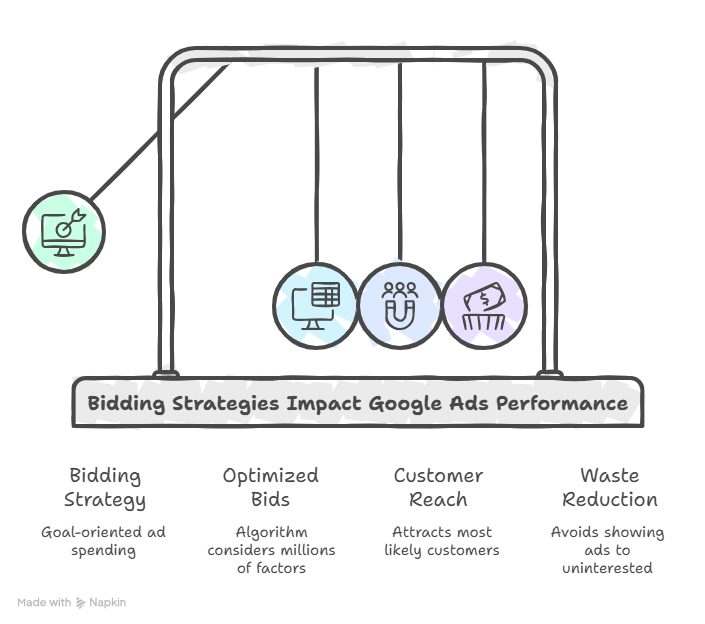
Google Ads bidding strategies are different ways to tell Google how much you want to pay when people click on your ads or see them. Instead of guessing how much to spend on every single word people search for, you can choose a goal. Then Google’s computer system (called an algorithm) does the math for you.
Here’s what makes this helpful: Google looks at millions of things happening right now to decide how much to bid. It checks what device someone is using, where they are, what time it is, and even what the weather is like. No human brain can think about all these things in less than one second, but Google’s system can.
When you pick the right bidding strategy, Google helps you reach the people who are most likely to become your customers. When you pick the wrong one, you might waste money showing ads to people who aren’t interested.
Why Google Ads Bidding Strategies Matter in 2026
Things have changed a lot in the world of online advertising. In 2026, most businesses now use automated bidding instead of doing everything by hand. In fact, 78% of all Google Ads spending now uses something called Smart Bidding or Performance Max campaigns.
What does this mean for you? It means Google’s computer system is getting smarter at finding customers for you. The system can make 50,000 tiny decisions every single day about when and how much to bid. It looks at thousands of details that would take a person years to figure out.
But here’s the important part: the computer only works well if you give it clear instructions. That’s why understanding Google Ads bidding strategies is so important. You need to tell Google what success looks like for your business.
For small businesses especially, getting this right can mean the difference between ads that lose money and ads that bring in new customers every day. If you’re just starting out with online advertising, you might want to learn more about search engine marketing for small business to build a strong foundation.
The Main Types of Google Ads Bidding Strategies
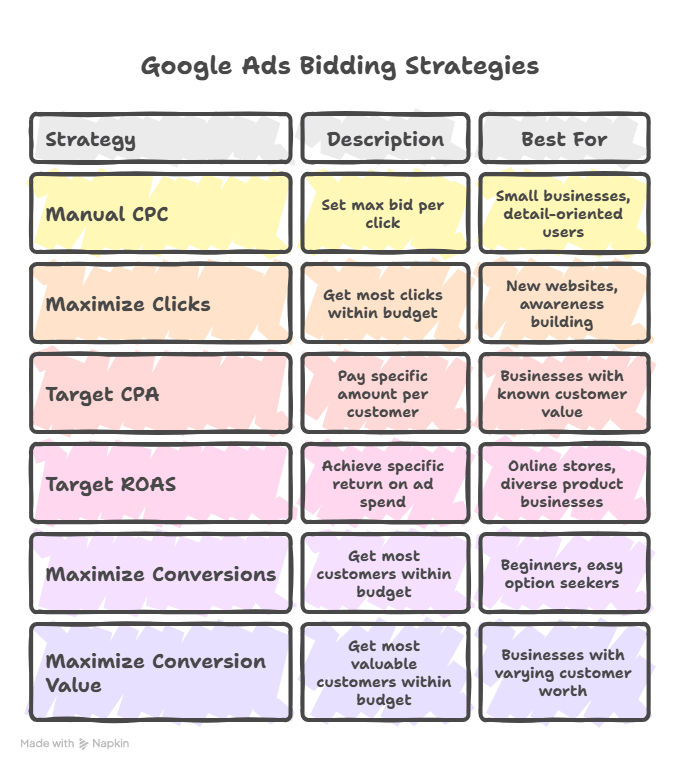
Let’s look at the most popular Google Ads bidding strategies types you can use in 2026. Each one works differently depending on what you want to achieve.
Manual CPC (Cost Per Click)
This is the old-school way of bidding. You tell Google the maximum amount you’ll pay every time someone clicks your ad. You have total control, but you also have to watch your ads all the time and keep changing your bids.
Best for: Very small businesses with just a few ads, or people who really want to control every detail.
Maximize Clicks
With this strategy, Google tries to get as many people as possible to click on your ads within your daily budget. It’s simple and good for getting more visitors to your website.
Best for: New websites that need more traffic, or businesses that want to build awareness.
Target CPA (Cost Per Acquisition)
This tells Google how much you’re willing to pay to get one customer. For example, if you sell $50 products and can afford to spend $15 to get each customer, you’d set your target at $15.
Best for: Businesses that know exactly how much a new customer is worth to them.
Target ROAS (Return on Ad Spend)
This is now the favorite strategy for 2026. Instead of just counting customers, it focuses on making money. You tell Google you want to make $5 for every $1 you spend on ads. Google then finds the customers who will probably buy more expensive items or buy more often.
Best for: Online stores, businesses with different products at different prices, or anyone who wants to maximize profit instead of just getting more customers.
Maximize Conversions
Google automatically tries to get you the most customers possible with your budget. It’s good for beginners because Google handles all the complicated math.
Best for: Businesses that are just starting with Google Ads and want an easy option.
Maximize Conversion Value
This is like Maximize Conversions, but smarter. Instead of just getting lots of customers, it tries to get the customers who will spend the most money with you.
Best for: Businesses where different customers are worth different amounts of money.
What’s New with Google Ads Bidding Strategies in 2026?
Google keeps making its bidding system better. Here are the biggest changes happening right now.
Smart Bidding Gets Smarter
The computer system now looks at more information than ever before. It can predict who will become a customer better than it could last year. The system keeps learning and getting better at its job.
One cool new feature is called Smart Bidding Exploration. Here’s how it works: Google uses about 80% of your money to find customers at your target price. But it uses the remaining 20% to test new types of customers you haven’t tried before. This helps you discover new opportunities you didn’t know existed.
Businesses using this feature are getting 18% more different types of customers and 19% more total customers overall. That’s like finding almost a fifth more customers without spending more money.
Performance Max Campaigns Take Over
Performance Max is a special type of Google Ads campaign that shows your ads everywhere Google can show them: in search results, on YouTube, in Gmail, and more. The same ad can appear in all these places automatically.
In 2026, Performance Max campaigns now handle more than 80% of the advertising money spent by big companies. Why? Because they work really well. These campaigns get 35% more customers while costing 20% less than the old way of doing things.
Even better, Google added new controls in 2026. Now you can stop your ads from showing up in certain places, add lists of words you don’t want to trigger your ads, and see exactly where your money is going.
Journey Aware Bidding (Coming Soon)
Google is testing something new called Journey Aware Bidding. This will help businesses understand that not everyone is ready to buy right away. Some people are just starting to look, while others are ready to buy today. This new system will help you spend more money on people who are closer to becoming customers.
How to Choose the Right Google Ads Bidding Strategy
Picking the best bidding strategy depends on what you want to achieve. Here’s a simple way to decide:
If you want more people to visit your website: Use Maximize Clicks. This gets as many visitors as possible.
If you want more customers at a specific price: Use Target CPA. This keeps your cost per customer steady.
If you want to make more money from your ads: Use Target ROAS. This is the most popular choice in 2026 because it focuses on profit, not just getting any customer.
If you’re just starting out: Use Maximize Conversions for the first few weeks. Let Google learn about your business. Then switch to Target ROAS once you have some data.
If you sell different products at different prices: Definitely use Target ROAS or Maximize Conversion Value. These valued based bidding strategies understand that a customer who buys a $200 item is worth more than someone who buys a $20 item.
For small businesses trying to figure all this out, getting help with PPC management for small business can save you time and money while you learn.
Important Tips for Success with Google Ads Bidding Strategies
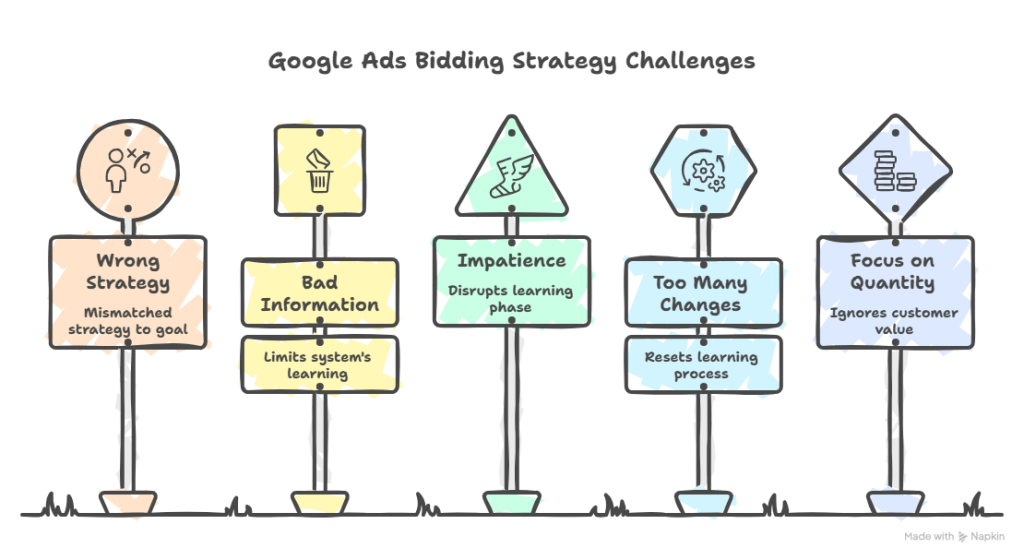
Here are some friendly tips to help you win with your bidding strategy:
Start with the right strategy from day one. Google experts now say you don’t need to start with manual bidding and then switch. Pick the automated strategy that matches your goal right away. The computer will learn as you go.
Give Google good information. The computer system is only as smart as the information you give it. Make sure you’re tracking the right things. If you sell products, tell Google how much each sale is worth. If you get leads, tell Google which leads are good and which ones aren’t.
Be patient during the learning phase. When you first start a new campaign or change your bidding strategy, Google needs about two weeks to learn. During this time, your results might go up and down. Don’t panic and don’t make big changes. Let the system learn.
Don’t make too many changes. Every time you change your budget by more than 20% or switch your strategy, Google has to start learning all over again. Make small changes and give them time to work.
Focus on quality, not just quantity. It’s better to get 10 customers who each spend $100 than 50 customers who each spend $5. The newer bidding strategies like Target ROAS understand this and will help you find the better customers.
Common Mistakes to Avoid
Even though Google Ads bidding strategies are getting easier to use, people still make some common mistakes:
Using Maximize Conversions forever. This strategy is good for starting out, but you should switch to Target CPA or Target ROAS after a few weeks. Maximize Conversions will get you customers, but it won’t care how much they cost.
Not tracking conversions properly. If you tell Google that every single person who fills out a form is valuable, but really only 1 out of 10 actually becomes a customer, you’re teaching the system the wrong thing.
Setting targets that are too strict. If you tell Google you’ll only pay $5 per customer but everyone else is paying $10, you won’t get many ads shown. Start with a realistic target and adjust from there.
Ignoring the data. Google gives you lots of information about what’s working. Look at your reports every week. If something isn’t working, make small changes and test them.
Trying to control everything. The whole point of automated bidding is to let the computer do the math. If you keep changing bids manually, you’re fighting against the system instead of working with it.
The Future of Google Ads Bidding Strategies
Looking ahead, Google Ads will keep moving toward more automation and smarter computer systems. The companies that do well will be the ones that understand how to work with the technology, not fight against it.
According to WordStream, automated bidding is becoming the standard way businesses advertise online. The businesses getting the best results are the ones providing clear goals, good information, and quality ads for the computer system to work with.
Your job isn’t to make thousands of tiny bidding decisions every day. Your job is to understand your customers, create great ads, and give Google the right instructions to find those customers for you.
Final Thoughts
Google Ads bidding strategies might seem complicated at first, but they’re actually designed to make your life easier. Instead of spending hours every day adjusting bids, you can let Google’s smart system do the heavy lifting while you focus on running your business.
The key things to remember are:
- Pick a bidding strategy that matches your goal (more visitors, more customers, or more profit)
- Give Google accurate information about what makes a good customer
- Be patient and let the system learn
- Use Target ROAS if you want to focus on making money
- Don’t be afraid to ask for help when you need it
In 2026, the businesses winning with Google Ads aren’t necessarily spending the most money. They’re the ones using Google Ads bidding strategies smartly. With the information in this article, you now have what you need to make better decisions about your advertising.
Remember, online advertising is always changing, but the basic idea stays the same: reach the right people with the right message at the right time. Google Ads bidding strategies are just tools to help you do that more efficiently.
Start small, test different strategies, and keep learning. Before you know it, you’ll be getting more customers and growing your business online.