
Have you ever wondered how some websites always show up first when you search for something online? It’s not magic or luck. These websites use something called keyword research competitor analysis. This might sound like big, complicated words, but don’t worry! By the end of this article, you’ll understand exactly what it means and why it matters.
What Is Keyword Research Competitor Analysis?
Let’s break this down into simple parts.
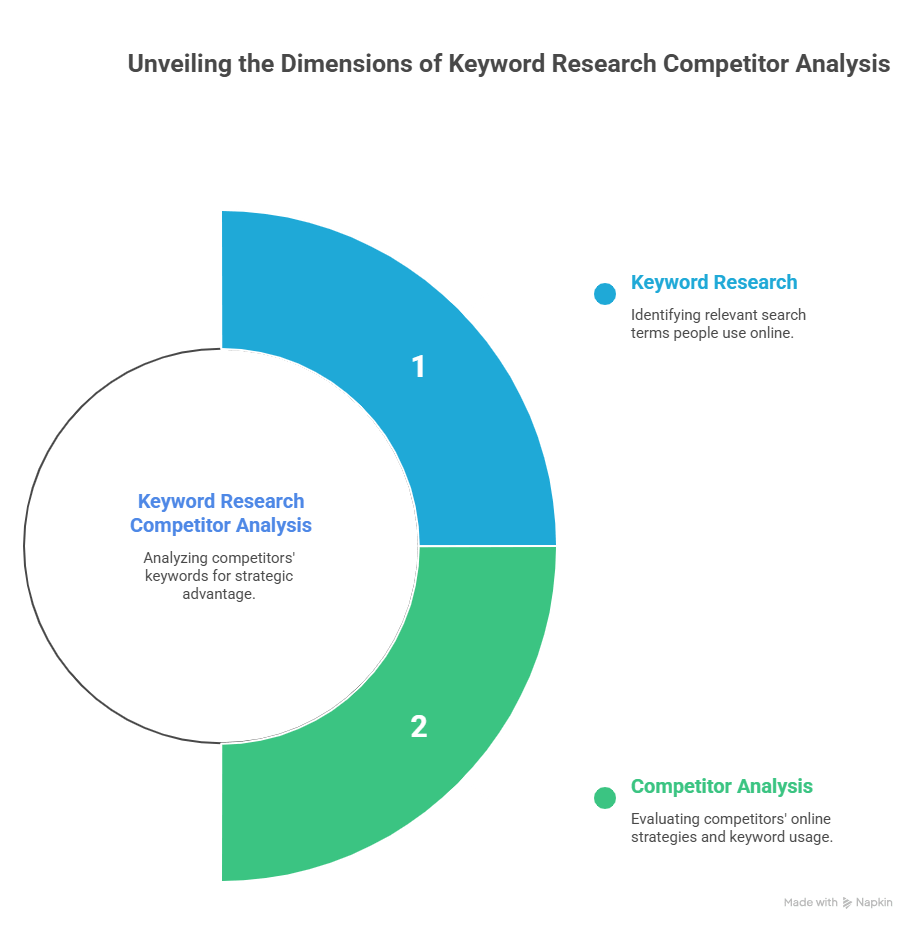
Keyword research is the process of finding out what words and phrases people type into search engines like Google. For example, if someone wants to find a pizza place near them, they might type “best pizza near me” or “pizza delivery.” These search words are called keywords.
Competitor analysis means looking at what your competitors (other businesses like yours) are doing online. You check which keywords they use and which ones help them show up in search results.
When you put these two ideas together, you get keyword research competitor analysis. This means finding out which keywords your competitors are using successfully, so you can use similar (or better) strategies for your own website.
Think of it like this: imagine you’re trying to win a race. Wouldn’t it be smart to watch the fastest runners and see what they’re doing right? That’s exactly what businesses do online!
Why Does This Matter for Your Business?
You might be thinking, “Why should I care about all this?” Here’s why it’s super important:
More People Will Find You: When you use the right keywords, your website shows up when people search for things you offer. This means more visitors to your site!
You’ll Beat Your Competition: By knowing what keywords your competitors use, you can find gaps—keywords they’re missing that you can use instead.
You’ll Save Money: Instead of guessing which keywords to use, you’ll know exactly which ones work. This saves you time and money on advertising.
You’ll Understand Your Customers Better: When you see what people are searching for, you learn what they really want and need.
According to recent research, 68% of all online experiences start with a search engine. That means if people can’t find you when they search, you’re missing out on a huge number of potential customers!
How Search Is Changing in 2026
Here’s something exciting: the way people search online is changing right now!
In the past, people would type short phrases like “running shoes” or “cheap hotels.” But in 2026, people are typing longer, more specific questions. They might type something like “What are the best running shoes for someone with flat feet under $100?”
This is happening because of something called AI (Artificial Intelligence). New AI tools like ChatGPT and Google’s AI Overviews are changing how search works. These tools try to answer your complete question instead of just showing you a list of websites.
What does this mean for you? It means you need to think about the real questions your customers are asking, not just simple keywords. In fact, those longer, more detailed phrases have their own name — long tail keywords — and learning how to do keyword research for long tail terms can give your business a major advantage over competitors who only chase broad keywords.
The Best Tools for Keyword Research in 2026
Now let’s talk about the tools that help you do keyword research. These are like special detective tools that help you discover which keywords work best.
SEMrush
This is one of the most popular tools out there. It has information about over 26 billion keywords! SEMrush can show you:
- What keywords your competitors are using
- How many people search for each keyword every month
- How hard it would be to rank for each keyword
- What ads your competitors are running
Ahrefs
Ahrefs is another powerful tool that’s really good at showing you where other websites get their visitors from. It can predict keyword trends with 94% accuracy! This tool has the biggest database of backlinks (links from other websites) in the whole industry.
The Ahrefs Content Gap tool is especially useful. It shows you keywords that your competitors rank for but you don’t. These are golden opportunities!
Google Keyword Planner
This one is completely free! Since it comes directly from Google, you get real information about what people are searching for. It’s a great place to start if you’re just beginning with keyword research.
SpyFu
SpyFu is perfect for understanding your competitors’ strategies. It has 15 years of historical data, which means you can see what keywords worked for your competitors in the past and what they’re using now.
How to Do Keyword Research Competitor Analysis (Step by Step)
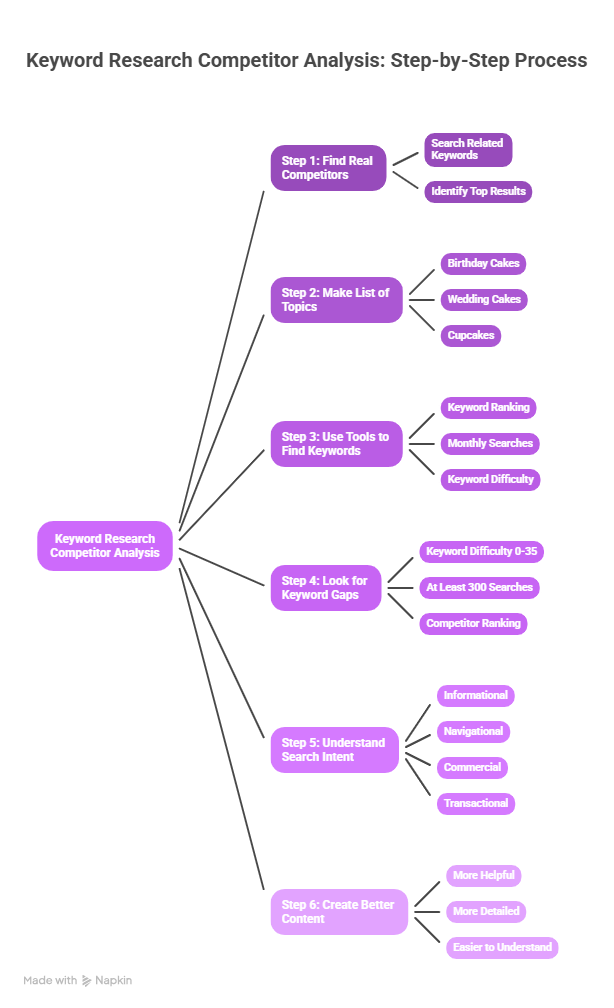
Ready to try this yourself? Here’s a simple process you can follow:
Step 1: Find Your Real Competitors
First, figure out who you’re actually competing against online. These might not be the same as your business competitors! Your SEO competitors are the websites that show up when people search for keywords related to your business.
Try searching for keywords related to what you do. The websites that appear in the top results? Those are your SEO competitors.
Step 2: Make a List of Important Topics
Think about the main topics related to your business. If you run a bakery, your topics might include:
- Birthday cakes
- Wedding cakes
- Cupcakes
- Gluten-free baking
- Custom cake designs
These topics will help you find specific keywords later.
Step 3: Use Tools to Find Keywords
Now use one of the tools we talked about earlier. Enter your competitor’s website address and see what keywords they’re ranking for. Most tools will show you:
- The keyword
- How many people search for it each month
- How difficult it is to rank for
- How much traffic it brings to their website
Step 4: Look for Keyword Gaps
This is where the magic happens! Use the keyword gap feature (available in most tools) to find keywords your competitors rank for but you don’t. These are your biggest opportunities.
Focus on keywords that have:
- A keyword difficulty score between 0 and 35 (these are easier to rank for)
- At least 300 searches per month (so there’s enough traffic)
- Keywords your competitors are already ranking for (this proves people want this information)
Step 5: Understand Search Intent
Here’s an important concept: not all searches are the same. Some people are just looking for information, while others are ready to buy something.
There are four main types of search intent:
- Informational: People want to learn something (“how to bake a cake”)
- Navigational: People are looking for a specific website (“Walmart bakery”)
- Commercial: People are researching before buying (“best birthday cake designs 2026”)
- Transactional: People are ready to buy (“order birthday cake online”)
Understanding this helps you create the right kind of content for each keyword. To see exactly how search intent applies when building out your website pages, check out this guide on keyword research for website optimization.
Step 6: Create Better Content
Once you know which keywords to target, create content that’s better than what your competitors have. Make it more helpful, more detailed, and easier to understand.
Remember, in 2026, it’s not just about using keywords. It’s about answering questions completely and becoming an expert on your topic.
How This Connects to Your Marketing Strategy
Keyword research competitor analysis isn’t something you do alone. It works best when it’s part of your bigger marketing plan.
For example, search engine marketing for small business includes both SEO (organic search) and paid advertising. When you know which keywords work best from your competitor research, you can use them in both areas.
You can also use your keyword research to improve your PPC management for small business. PPC stands for “pay-per-click,” which means you pay money each time someone clicks on your ad. By knowing which keywords actually bring in customers (not just visitors), you can spend your advertising money more wisely.
If this process sounds like a lot to take on yourself, it may be worth exploring hiring a keyword research service to do the competitor analysis for you. Professionals have access to premium tools and can often uncover opportunities in hours that would take you days to find on your own.
The AI Revolution in Search
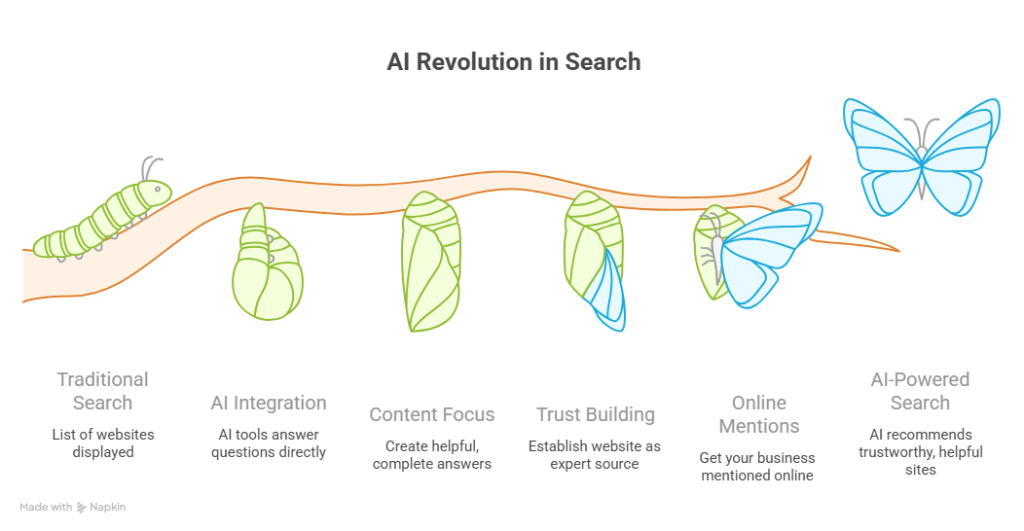
Here’s something really important happening right now: AI is changing everything about search!
In 2026, tools like ChatGPT are being used by 800 million people every week. Google’s AI Overviews reach 2 billion users every month. These AI tools answer questions directly instead of just showing a list of websites.
What does this mean for your keyword strategy?
Focus on Being Helpful: AI tools want to recommend websites that give the best, most complete answers. So create really helpful content!
Answer Complete Questions: Instead of just targeting short keywords, think about the full questions people ask.
Build Trust: Make sure your website is trustworthy and expert. AI tools are more likely to recommend websites that prove they know what they’re talking about.
Get Mentioned: Try to get your business mentioned on other websites, in reviews, and on social media. AI tools look at what people are saying about you online.
Common Mistakes to Avoid
Even experienced marketers make these mistakes. Here’s what to watch out for:
Targeting Keywords That Are Too Competitive: If you’re a new or small business, don’t go after the same keywords that huge companies use. Start with easier, more specific keywords.
Ignoring Search Intent: Just because a keyword has lots of searches doesn’t mean it’s right for you. Make sure the people searching actually want what you offer.
Only Looking at Volume: A keyword with 1,000 searches per month that brings you customers is better than a keyword with 10,000 searches that brings people who aren’t interested.
Setting It and Forgetting It: Search trends change! Check your keyword performance at least every three months and update your strategy.
Copying Competitors Exactly: Use competitor research for ideas, but don’t copy them word-for-word. Create something unique and better!
Tools Make It Easier Than Ever
The good news is that in 2026, keyword research competitor analysis is easier than it’s ever been. New AI-powered tools can:
- Automatically find keyword opportunities
- Group similar keywords together
- Predict which keywords will be popular in the future
- Show you exactly what’s working for your competitors
Many of these tools can create automatic reports, so you don’t have to spend hours doing research manually.
Taking Action Today
Now that you understand keyword research competitor analysis, what should you do next?
Start small! Pick just 3-5 of your main competitors and analyze what keywords they’re using. Look for 10-15 keyword opportunities you can target right away.
Create helpful, well-written content around those keywords. Remember to focus on answering real questions your customers have.
Track your results. See which keywords bring visitors to your site and which ones lead to actual customers or sales.
Keep learning and adjusting. Search is always changing, especially with AI becoming more important. Stay curious and keep trying new things!
Conclusion
Keyword research competitor analysis might have seemed complicated at first, but it’s really just about being smart and learning from what’s already working. By understanding which keywords your competitors use successfully, you can find opportunities to reach more customers and grow your business.
Remember these key points:
- Use tools like SEMrush, Ahrefs, or Google Keyword Planner to research keywords
- Find gaps where your competitors aren’t ranking but could
- Focus on search intent, not just search volume
- Create better, more helpful content than your competitors
- Adapt to AI search by being trustworthy and answering complete questions
- Make keyword research part of your overall marketing strategy
The businesses that succeed online in 2026 aren’t the ones with the biggest budgets. They’re the ones who understand what their customers are searching for and provide the best answers. With keyword research competitor analysis, you can be one of those successful businesses!