
Hiring Keyword Research Services – Picture this: You just opened a bakery in your neighborhood. You’re making the most amazing cupcakes anyone has ever tasted. Your customers love them! But here’s the problem – hardly anyone can find your website when they search online for cupcakes.
Meanwhile, your competitor across town (whose cupcakes aren’t even that good!) has a line out the door. Why? Because they hired a keyword research service, and now they show up every single time someone searches “cupcakes near me.”
Sound frustrating? It doesn’t have to be! Let me explain what a keyword research service actually does and how it can level the playing field for your business.
What Exactly Is a Keyword Research Service?
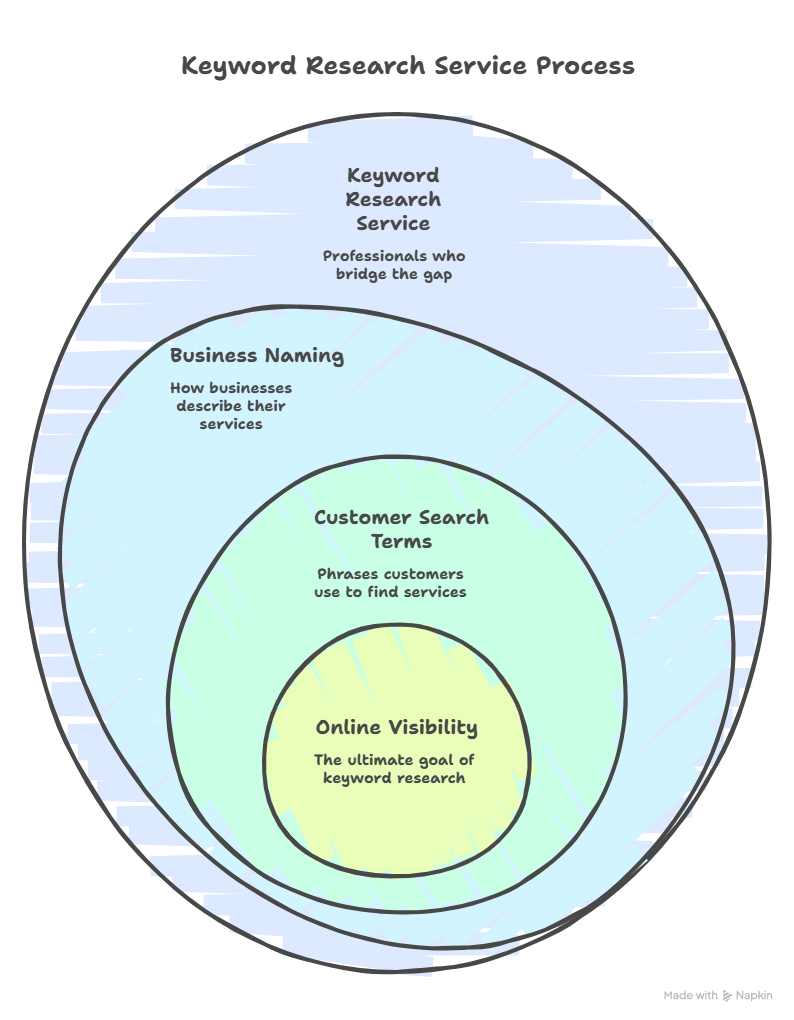
A keyword research service is when you pay professionals to discover the magic words that make your business visible online. These aren’t just any words – they’re the exact phrases your future customers are typing into search engines right this very moment.
Here’s a real example: Let’s say you’re a dog groomer. You might call your business “Premium Canine Styling Services” because it sounds fancy and professional. But guess what? Nobody searches for that!
What ARE people searching for? Things like:
- “Dog grooming near me”
- “Cheap dog haircut”
- “Mobile pet grooming”
- “Dog groomer open Saturday”
See the difference? A keyword research service figures out the gap between what YOU call things and what your CUSTOMERS are actually searching for. Then they help you bridge that gap!
The Real Problem Most Small Businesses Face
Here’s something that might surprise you: most small business owners are speaking a completely different language than their customers, and they don’t even know it!
Take Maria, who runs a fitness studio. She spent weeks writing beautiful website content about her “holistic wellness programs” and “mind-body integration sessions.” Sounds great, right?
Wrong! People in her town were searching for “yoga classes for beginners” and “affordable gym membership.” Maria’s website? Nowhere to be found because she wasn’t using the words real people type into Google.
After hiring a keyword research service, Maria discovered what her potential customers actually wanted. Within three months, her website traffic tripled. That’s the power of speaking your customer’s language!
Who Provides Keyword Research Services?
You’ve got three main options when you’re looking for help with keyword research:
Option 1: Solo Freelancers
These are individuals working independently. You’ll find them on websites like Fiverr or Upwork. They might be students trying to earn extra money, or they could be experienced SEO experts running their own businesses.
The good news? Prices can be low – sometimes as little as $50 for basic research. The bad news? Quality is all over the place. You might get someone amazing, or you might get someone who just runs your business name through a free tool and calls it a day.
Option 2: Big Marketing Agencies
These are full-service companies with teams of people. They have offices, receptionists, project managers, and all the bells and whistles.
The good news? You’re getting serious professionals who have done this hundreds of times. The bad news? You’re paying for all those offices and employees too! Expect to spend $2,500 to $5,000 or more for a complete project.
Option 3: Independent Consultants
These are experienced professionals who work alone or with small teams. They’ve got the expertise of an agency but without the huge overhead costs.
This is often the sweet spot for small businesses! You might pay $99 for a quick analysis or $500 to $1,500 for a comprehensive strategy. You get professional work without breaking the bank.
What You Actually Get When You Hire These Services
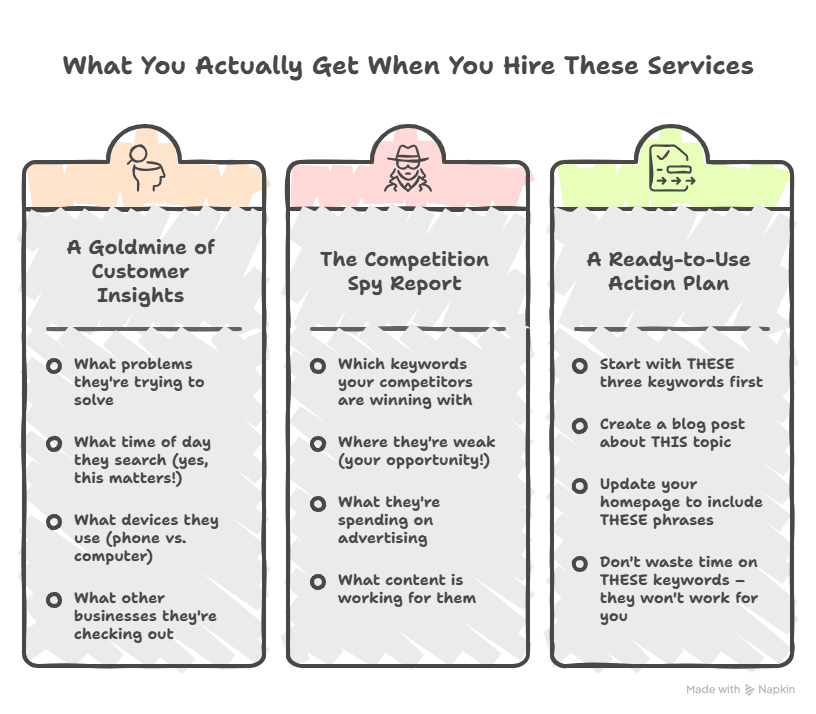
Let’s pull back the curtain and see what happens when you hire a keyword research service. Spoiler alert: it’s way more than just a list of words!
A Goldmine of Customer Insights
First, they’ll discover things about your customers you never knew. Like:
- What problems they’re trying to solve
- What time of day they search (yes, this matters!)
- What devices they use (phone vs. computer)
- What other businesses they’re checking out
One auto repair shop owner was shocked to learn that most of his customers were searching at 7 PM on weeknights after their check engine light came on during their commute home. He adjusted his website and started getting way more calls!
The Competition Spy Report
Here’s where it gets fun. A good keyword research service will snoop on your competitors (totally legal, by the way!). They’ll tell you:
- Which keywords your competitors are winning with
- Where they’re weak (your opportunity!)
- What they’re spending on advertising
- What content is working for them
It’s like having a secret agent working for your business! If you want to understand what this competitive intelligence process looks like in detail before hiring someone, read our guide on keyword research competitor analysis — it covers the exact steps professionals use to uncover keyword gaps.
A Ready-to-Use Action Plan
You won’t just get data – you’ll get a roadmap. The service will tell you:
- “Start with THESE three keywords first”
- “Create a blog post about THIS topic”
- “Update your homepage to include THESE phrases”
- “Don’t waste time on THESE keywords – they won’t work for you”
It’s like having a GPS for your website instead of just a map.
How Much Should You Really Expect to Pay?
Let’s talk money, because I know that’s what you’re wondering!
The cheapest option is around $50 to $200. Be honest with yourself – at this price, you’re getting someone to run a basic search and export some data. It might give you a starting point, but don’t expect miracles.
The middle range is $500 to $1,500. This is where most small businesses should look. You’ll get actual analysis, strategy, and recommendations from someone who knows what they’re doing.
The premium range is $2,500 to $5,000+. At this level, you’re getting comprehensive research that covers multiple locations, languages, or product lines. You’ll also get ongoing support and detailed competitive analysis.
Here’s my advice: Start in the middle range. Get professional help without overspending. If it works (and it probably will), you can always invest more later!
The Connection to Your Other Marketing
Now, here’s where keyword research services become even more valuable. The keywords you discover don’t just help with Google rankings – they help with EVERYTHING!
Remember those keywords? You can use them in:
- Your Google Ads campaigns (that’s where PPC management for small business comes in!)
- Your social media posts
- Your email subject lines
- Your YouTube video titles
- Even your business cards and flyers!
When you understand the language your customers use, every piece of marketing gets better. That’s why smart business owners see keyword research as the foundation of their entire search engine marketing for small business strategy.
Once you receive your keyword research, you’ll also need to know how to put those keywords to work across your actual website pages. Our guide on keyword research for website optimization walks you through exactly where and how to use keywords on each page for maximum impact.
The 2026 Twist: AI Changes Everything
Here’s something you need to know about 2026: search isn’t just Google anymore!
Right now, millions of people are using ChatGPT, Google’s AI summaries, and other AI tools to find businesses and information. In fact, ChatGPT alone has over 800 million users!
Old-school keyword research services just focused on Google. Modern services in 2026 help you show up in AI results too. When someone asks ChatGPT “What’s the best bakery in Portland?” – you want to be recommended, right?
That’s why you need a service that understands both traditional search AND the new AI world. Make sure to ask about this when you’re shopping around!
Five Warning Signs You’re Picking the Wrong Service
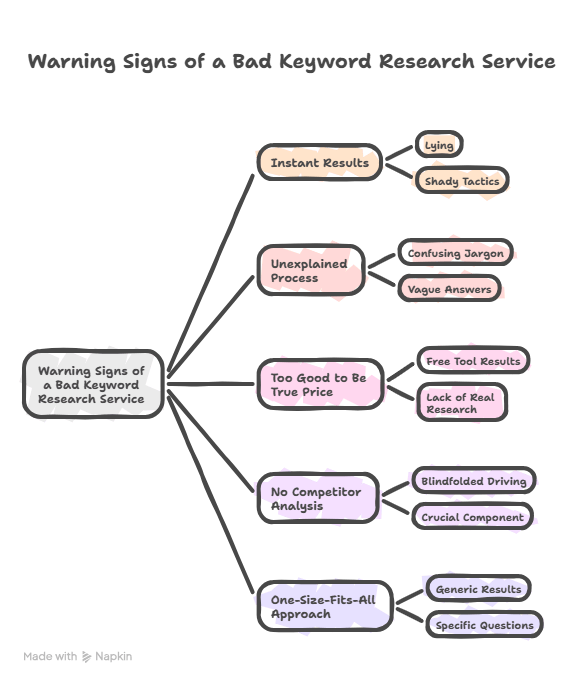
Not all keyword research services are created equal. Here’s how to spot the duds:
Warning Sign #1: They Promise Instant Results
If someone says “We’ll get you ranking #1 in two weeks!” – run away! Real keyword research takes time to show results. Anyone promising overnight success is either lying or using shady tactics that could get your website penalized.
Warning Sign #2: They Won’t Explain Their Process
Ask them: “How exactly will you find these keywords?” If they can’t give you a clear answer, or they use a bunch of confusing jargon to avoid the question, that’s a red flag. Legitimate services are happy to explain their methods!
Warning Sign #3: The Price Seems Too Good to Be True
Remember: if it seems too good to be true, it probably is. A service charging $25 for “complete keyword research” is not doing actual research. They’re running your industry through a free tool and sending you the results.
Warning Sign #4: No Competitor Analysis
If they’re not looking at what your competitors are doing, they’re only doing half the job! Competition analysis is crucial. Without it, you’re basically driving with a blindfold on.
Warning Sign #5: One-Size-Fits-All Approach
Your dentist office and a dentist office in another state need different keywords! If a service doesn’t ask specific questions about YOUR business, YOUR location, and YOUR goals, they’re giving you generic results that won’t help.
Real Stories from Real Businesses
Let me share some success stories so you can see how this works in real life:
The Plumber Who Tripled His Business
Mike runs a plumbing company in Arizona. He was ranking for “emergency plumber” but getting barely any calls. A keyword research service discovered something interesting: most people in his area were searching for very specific problems like “water heater repair Phoenix” and “toilet won’t flush help.”
Mike changed his website to target these specific problem keywords. Within four months, his phone started ringing off the hook. He had to hire two more plumbers just to keep up!
The Online Store That Stopped Wasting Money
Jennifer sells handmade jewelry online. She was spending $1,000 every month on Google Ads for keywords like “silver necklace” and “handmade jewelry.” She got clicks, but hardly any sales.
A keyword research service showed her she was targeting the wrong keywords. People searching those terms were just browsing, not buying. The service found better keywords like “unique birthday gift for mom” and “personalized anniversary necklace” – keywords that showed people were ready to purchase.
Jennifer changed her ad strategy. Same budget, but now targeting buyer keywords. Her sales jumped by 200%! This is a great example of how long tail keyword research pays off — those specific, intent-driven phrases are exactly what converts browsers into buyers.
The Restaurant That Found Its Niche
Carlos owns a Mexican restaurant. He thought his main keyword should be “Mexican food.” But that keyword was impossible to rank for – huge chains with massive budgets dominated it.
A keyword research service helped him discover opportunity keywords like “authentic Oaxacan food,” “best mole sauce near me,” and “family-style Mexican restaurant.” These were keywords with less competition that perfectly described what made his restaurant special.
His Google ranking improved dramatically, and now locals specifically seek out his restaurant because it’s known for being authentic and family-friendly.
The Tools Professional Services Use (And Why You Can’t Just Use Them Yourself)
You might be wondering: “Can’t I just buy these tools and do it myself?”
Technically, yes. But here’s the reality check:
Professional tools like SEMrush or Ahrefs cost $100 to $400 per month. And that’s just for access! You still need to know how to use them correctly.
It’s like buying a professional camera. Sure, you can buy the same camera that National Geographic photographers use. But will your photos look like theirs? Probably not! The tool is only as good as the person using it.
These services have experts who:
- Spend 40+ hours per week using these tools
- Know which data to trust and which to ignore
- Can spot patterns and opportunities you’d miss
- Understand how to turn raw data into action steps
Plus, they usually have access to MULTIPLE tools. They might use SEMrush for competitor research, Google Keyword Planner for search volume data, and specialized tools for local search or specific industries.
Questions You Should Ask Before Hiring
Ready to hire a keyword research service? Great! But first, ask them these questions:
“Can you show me examples of past work?” They should be able to share case studies or examples (with client names removed for privacy).
“What tools do you use?” They should mention professional tools, not just free ones.
“How do you handle local search?” If you’re a local business, this is crucial!
“Will you include AI search optimization?” Remember, 2026 is different – AI matters now!
“What format will the deliverables be in?” Make sure you’ll get something you can actually use!
“Is there any follow-up support?” Some services disappear after delivering the report. Others check in to see how you’re doing.
“How long will this take?” Typical timelines range from one week for basic research to four weeks for comprehensive analysis.
DIY vs. Hiring a Service: The Honest Truth
Should you do keyword research yourself or hire someone? Here’s my honest take:
Do it yourself if:
- Your budget is extremely tight (under $100)
- You genuinely enjoy learning about SEO and have the time
- Your business is very simple with just a few products/services
- You’re willing to spend 20-40 hours learning and researching
Hire a service if:
- Your time is worth more than $20-30 per hour
- You want results faster
- Your industry is competitive
- You need professional tools and expertise
- You’d rather focus on actually running your business
Most small business owners fall into the “hire a service” category. Why? Because the opportunity cost of doing it yourself is too high. Those 40 hours you spend researching keywords? You could spend them serving customers, creating products, or actually growing your business!
What Happens After You Get Your Keyword Research?
Okay, so you’ve hired a service and they’ve delivered a beautiful report full of keywords. Now what?
This is where a lot of businesses drop the ball! They pay for the research, get excited about it, and then… nothing. The report sits in a folder somewhere while their website stays exactly the same.
Don’t let that be you! Here’s what to do:
Week 1: Quick Wins
Start by updating the easy stuff:
- Your homepage title and description
- Your Google Business Profile
- Your main service pages
- Your “About” page
These changes take maybe 2-3 hours total, but they can make a big difference fast!
Weeks 2-4: Content Creation
Now start creating new content based on your keywords. Write blog posts, record videos, or create helpful guides. Even one new piece of content per week adds up!
Month 2-3: Track and Adjust
Use free tools like Google Search Console to see what’s working. Are you getting more website visitors? Are people finding you for the right keywords? If something’s not working, adjust!
Month 4-6: Scale Up
Once you see what’s working, do more of it! Double down on the keywords that are bringing you customers.
The Biggest Mistake People Make
Want to know the #1 mistake I see? People try to use ALL the keywords at once!
Your keyword research report might have 100 or 200 keywords. That’s overwhelming! Here’s what to do instead:
Pick your top 5-10 keywords to start with. Focus on those for the first three months. Once you’re ranking for those, move on to the next batch.
It’s better to rank really well for 5 keywords than to rank poorly for 100!
When Should You Review Your Keywords Again?
Keywords aren’t “set it and forget it.” Things change!
For most businesses, you should review your keyword strategy every 6 months. Why?
- New competitors pop up
- Customer search habits shift
- New products or services launch
- Seasonal trends change
Some industries move faster and need quarterly reviews. For example, if you’re in tech or fashion, trends change quickly!
Final Thoughts: Is a Keyword Research Service Worth Your Money?
Let’s be real: hiring a keyword research service costs money. Maybe a few hundred dollars, maybe a few thousand. That’s not pocket change for a small business!
But here’s how to think about it:
If the service costs $500 and it helps you get just 2-3 extra customers per month, did it pay for itself? Almost definitely! Most businesses make way more than $500 from 2-3 new customers.
Plus, good keyword research keeps working for you month after month. It’s not like an ad that stops when you stop paying. The keywords you target today can keep bringing customers for years!
According to current data, 68% of people start their buying journey with a search engine. That means if they can’t find you when they search, you’re missing out on more than half your potential customers!
Your Next Steps
Ready to get started? Here’s what I recommend:
Step 1: Decide on a realistic budget. Remember, you get what you pay for!
Step 2: Make a list of what you want to accomplish. More website visitors? More phone calls? More online sales?
Step 3: Research 3-5 different keyword research services. Don’t just pick the first one you find!
Step 4: Ask them the questions from this article. See how they respond.
Step 5: Start with a smaller project if you’re nervous. You can always expand later!
Step 6: Once you get your research, actually USE it! Set aside time to implement the recommendations.
The Bottom Line
Look, I get it. Paying someone to find words for your website might seem silly at first. Can’t you just write whatever makes sense?
But here’s the truth: what makes sense to you might not be what your customers are searching for. And in 2026, with AI search, voice search, and increasing competition, you can’t afford to guess anymore.
A professional keyword research service bridges the gap between what you know about your business and what your customers are looking for. They give you the roadmap to be found online.
Whether you choose a $200 freelancer or a $3,000 agency, the important thing is to invest in understanding your customers’ language. Because at the end of the day, that’s what keyword research really is – learning to speak your customers’ language so they can find you!
The businesses winning online in 2026 aren’t necessarily the ones with the biggest budgets or the fanciest websites. They’re the ones who show up when customers are searching. And that starts with knowing the right keywords.
Your competitors are probably already using keyword research services. The question is: will you?