
Have you ever searched for something on Google and seen those text ads at the top of the page? There’s a good chance you were looking at a responsive search ad — and there’s a reason they show up there. When they’re built the right way, they work really well.
The good news is that you don’t need to be a tech expert to do this well. You just need to understand a few key ideas. Let’s break them down together.
What Is a Responsive Search Ad, Anyway?
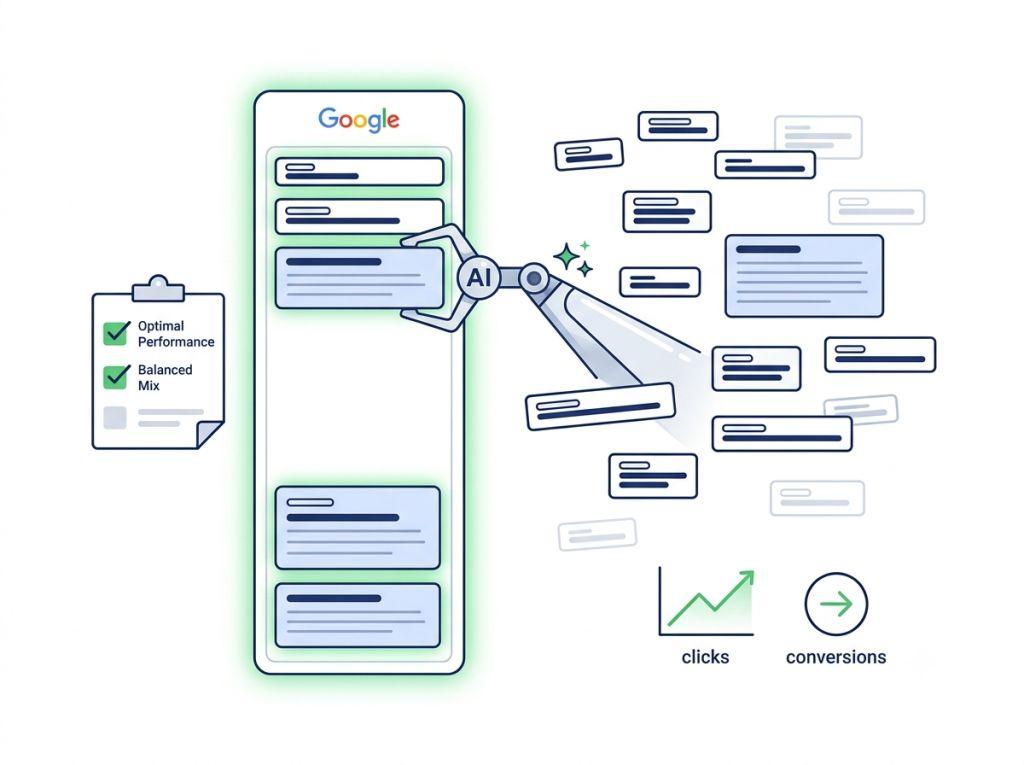
A responsive search ad (often called an RSA) is a Google ad where you write up to 15 different headlines and 4 different descriptions. Then Google’s system mixes and matches them automatically. It tries different combinations to figure out which ones get the most clicks and lead to the most customers.
Think of it like a puzzle. You give Google the puzzle pieces — your headlines and descriptions — and Google figures out which pieces fit best together for each person who sees your ad.
RSAs became the only standard search ad format in Google Ads after Google retired the older “expanded text ads.” Today, every business running search ads is using RSAs. That includes small businesses, big companies, and everyone in between.
Responsive Search Ads Best Practices You Can Start Using Today
1. Fill Up All Your Headlines and Descriptions
One of the most common mistakes advertisers make is not using all the space Google gives them. Google lets you write up to 15 headlines and 4 descriptions. Many people only write 5 or 6 headlines and call it done. That’s leaving a lot of opportunity on the table.
Why does this matter? The more headlines you give Google to work with, the more combinations it can test. More combinations = a better chance of finding the message that clicks with your future customers.
2. Cover Different Value Points in Each Headline
Each headline should tell the customer something different about your business. Here’s a simple example for a local plumber:
- Service headline: “Emergency Plumber Available 24/7”
- Trust headline: “Licensed & Insured — 20 Years Experience”
- Offer headline: “Free Estimates on All Repairs”
- Location headline: “Serving Miami and Surrounding Areas”
- Action headline: “Call Now — Same-Day Appointments”
See how each one says something different? That’s the goal. Give Google a variety of messages so it can show the right one to the right person at the right time. To see these principles applied to real businesses — including a dentist, an online clothing store, and a digital marketing agency — check out our article packed with responsive search ads examples.
3. Match Your Ads to What People Are Searching For
Your ad should feel like a direct answer to what someone typed into Google. If someone searches “affordable dog grooming near me,” your ad should mention dogs, grooming, your location, and ideally your price. The closer your ad matches the search, the more likely someone is to click it.
This is called search intent — the idea that every search has a purpose behind it. Your responsive search ads best practices should always start here: what is my customer looking for, and does my ad speak directly to that?
4. Use Keywords — But Keep It Natural
Including your main keyword in at least one or two headlines helps Google understand that your ad is relevant. It also shows the person searching that you offer exactly what they need. However, don’t stuff keywords into every headline. If it sounds awkward when you read it out loud, it’s too much. Write for humans first, then check that the keywords fit naturally.
5. Be Careful With Pinning
Pinning means forcing a specific headline to always show up in a specific spot. For example, you might pin your brand name to the first headline position so it always appears at the top of your ad.
Pinning can be helpful in certain situations — like when you need your business name visible, or when you have a legal disclaimer that must appear. But too much pinning is a problem. It takes away Google’s freedom to test different combinations. When the system can’t experiment, your ad performance suffers.
6. Write Stronger Descriptions
Descriptions appear below your headlines and give customers a little more detail about your business. You have space for 2 descriptions at a time (out of up to 4 you provide). Each description should support a different angle — one might explain your process, another might highlight customer reviews, and another might push a special offer or call to action.
Keep descriptions clear, friendly, and specific. Avoid vague phrases like “We are the best” or “Quality service you can trust.” Instead, try something like: “Book online in 60 seconds. No contracts. Cancel anytime.” That tells the customer exactly what to expect.
7. One Strong Ad Is Better Than Three Weak Ones
Google allows up to 3 RSAs per ad group, but that doesn’t mean you need 3. In most cases, one really well-built RSA performs better than three average ones. When all your data — clicks, conversions, results — goes into one ad, Google learns faster and can optimize more effectively. More ads with fewer assets each just slows things down.
8. Check Your Asset Performance Report
Google Ads now gives you reports that show how each individual headline and description is performing. This is a newer feature, and it’s incredibly useful. Look for headlines that are rated “Low” — those might need to be rewritten or replaced. Double down on the ones rated “Best.” This data tells you what your real customers actually respond to, which is far more valuable than guessing.
9. Don’t Obsess Over Ad Strength
Google shows you an “Ad Strength” score for each RSA — it might say Poor, Average, Good, or Excellent. This score is a helpful guide, but don’t chase it at the expense of good writing. The Ad Strength score doesn’t actually change based on how your ad performs in the real world. A well-written ad with a “Good” rating can outperform a checklist-perfect ad with an “Excellent” rating. Focus on writing ads that speak to real humans, and the results will follow.
10. Match Your Ad to a Great Landing Page
Your ad is only half the story. When someone clicks, they land on a page of your website. If that page doesn’t deliver on what the ad promised, the visitor will leave — and you’ll have paid for a click that went nowhere. Make sure your landing page is fast, easy to read, and closely related to what your ad said. This also helps improve your Quality Score in Google Ads, which can lower your costs over time.
What’s New With RSAs in 2025–2026?

Google has made some exciting updates recently that affect how RSAs work:
- Individual Asset Reporting: Advertisers can now see exactly how each headline and description performs on its own — not just the overall ad. This makes it much easier to improve your ads over time.
- Real-Time Policy Reviews: As of early 2026, Google now reviews your ads in near real-time as you build them, cutting wait times from hours down to seconds.
- Dynamic Asset Flexibility: Google is giving its AI even more freedom to mix and match your assets in new ways to find the best combinations.
- Call-Only Ads Are Going Away: Google retired call-only ads in early 2026. If your business relied on those, the fix is simple — use RSAs with “Call Assets” added. You get the same phone call feature with more flexibility. Our dedicated guide on responsive search ads with call assets explains exactly how to make this switch and set up call tracking correctly.
How Does This Fit Into Your Overall Marketing Strategy?
Responsive search ads don’t work in a vacuum. They’re one important piece of your bigger search engine marketing for small business strategy. To get the best results, your RSAs should work together with the right keywords, a well-organized campaign structure, and a smart bidding strategy.
If you’re still building your understanding of how to write the underlying ad copy itself, our guide on how to write effective Google Ads covers the fundamentals — from picking your goal to crafting headlines that actually get clicked.
If all of this sounds like a lot to manage, that’s completely normal. Many small business owners find that having an expert handle their PPC management for small business saves them time, reduces wasted ad spend, and leads to better results. A good PPC manager will apply exactly the responsive search ads best practices we’ve covered here — plus monitor your campaigns daily and make adjustments as data comes in.
For a deeper dive into what RSAs are and how the technology works, Google’s own Google Ads Help Center is a great resource to bookmark.
A Quick Recap: Your RSA Best Practices Checklist
- ✅ Write all 15 headlines and all 4 descriptions
- ✅ Cover different selling points in each headline
- ✅ Match your ads to what people are actually searching for
- ✅ Include keywords naturally — don’t overdo it
- ✅ Pin only when you truly need to
- ✅ Write descriptions that are specific and action-oriented
- ✅ Build one great RSA per ad group instead of three mediocre ones
- ✅ Review the asset performance report and update low performers
- ✅ Don’t live and die by the Ad Strength score — focus on real results
- ✅ Send clicks to a landing page that matches your ad’s message
The Bottom Line
Getting the most out of responsive search ads doesn’t require a marketing degree. It requires a little strategy, a lot of variety in your messaging, and a willingness to check the data and keep improving. When you follow these responsive search ads best practices, you’re giving Google the best possible ingredients — and letting its smart system do the heavy lifting for you.
Start with what you know about your customers. What do they care about? What problems do you solve for them? Write your headlines and descriptions around those answers, and you’ll already be ahead of most advertisers out there.
Ready to get more from your Google Ads?
Whether you’re just starting out or want to improve your current campaigns, we’re here to help.
Visit Sheaf Media Group’s PPC Management for Small Business to learn how we can put these best practices to work for your business — starting today.