
Google Ads Landing Page Best Practices – Running Google Ads without following landing page best practices is like filling a bucket that has holes in it. You keep pouring money in — but it keeps leaking out. Here’s how to plug the holes.
You don’t have to spend more on Google Ads to get better results. Most of the time, the biggest wins come from improving what happens after someone clicks your ad. That means fixing your landing page.
Following Google Ads landing page best practices is one of the highest-return activities a small business can do. It lowers your cost per click, improves your ad visibility, and turns more visitors into real customers — all without increasing your ad budget by a single dollar.
In this guide, we’re going to walk through every best practice you need to know. We’ll keep it simple, clear, and practical — because the goal isn’t just to understand these ideas, it’s to actually use them. If you’re newer to the concept of landing pages and want to understand what they are and why they sit at the centre of every Google Ads campaign, start with our guide on what a landing page is in digital marketing before reading on.
Why Google Ads Landing Page Best Practices Matter More Than Ever
Google doesn’t just care about your ad. It cares about what happens after the click. When someone clicks your ad and lands on a page that’s slow, confusing, or off-topic, they leave quickly. Google notices this — and it penalizes you for it through something called Quality Score.
Quality Score is made up of three things: your expected click-through rate, your ad relevance, and your landing page experience. That last one is where most small businesses lose the most ground.
Here’s what the numbers look like in practice:
- A landing page rated “Above Average” can lower your cost per click by up to 36%
- A landing page rated “Below Average” can raise your cost per click by up to 47%
- Pages that load in 1 second convert 3 times better than pages that take 5 seconds
In 2025, Google made this system even more powerful by launching an AI-based quality prediction model. This means Google now predicts whether your landing page will give visitors a good experience — before it even decides to show your ad. If your page doesn’t pass the test, your ad may not run at all.
The good news? Every single one of these best practices is something any business can act on. Let’s go through them one by one.
Best Practice #1: Match Your Landing Page to Your Ad — Every Single Time
This is the single most important rule in all of Google Ads landing page best practices. It’s called message match, and it works like this: whatever your ad promises, your landing page must deliver.
If your ad says “Get a Free Roof Inspection Today,” your landing page headline should say something like “Claim Your Free Roof Inspection.” If your ad promotes a 20% discount, that discount needs to be the first thing visible on the page.
When the message matches, visitors feel confident they’re in the right place. When it doesn’t, they feel confused or misled — and they leave. Google tracks that exit and lowers your Quality Score.
Quick tip: Open your ad and your landing page side by side. Read the ad’s headline. Then read the landing page headline. They should tell the same story. If they don’t, rewrite the landing page headline today — it’s the single fastest fix you can make.
Best Practice #2: Load Fast or Lose the Click
Speed is not a nice-to-have. It’s a requirement. Google’s data is clear: pages that load in 1 second convert 3 times better than pages taking 5 seconds. And with Google’s Core Web Vitals now baked into how ads are evaluated, a slow page directly hurts your ad performance.
The 2026 benchmark to aim for is an Interaction to Next Paint (INP) score under 200 milliseconds. That’s the technical standard Google uses to judge page responsiveness. In plain language: your page needs to feel instant when someone taps or clicks on it.
Here are the fastest wins for page speed:
- Convert all images to WebP format — it cuts file sizes by 25–35% with no visible quality loss
- Remove any unused plugins or scripts that slow down load time
- Use a fast, reliable web host — shared hosting often bottlenecks page speed
- Test your page at pagespeed.web.dev and aim for a score above 70
Best Practice #3: Design for Mobile First
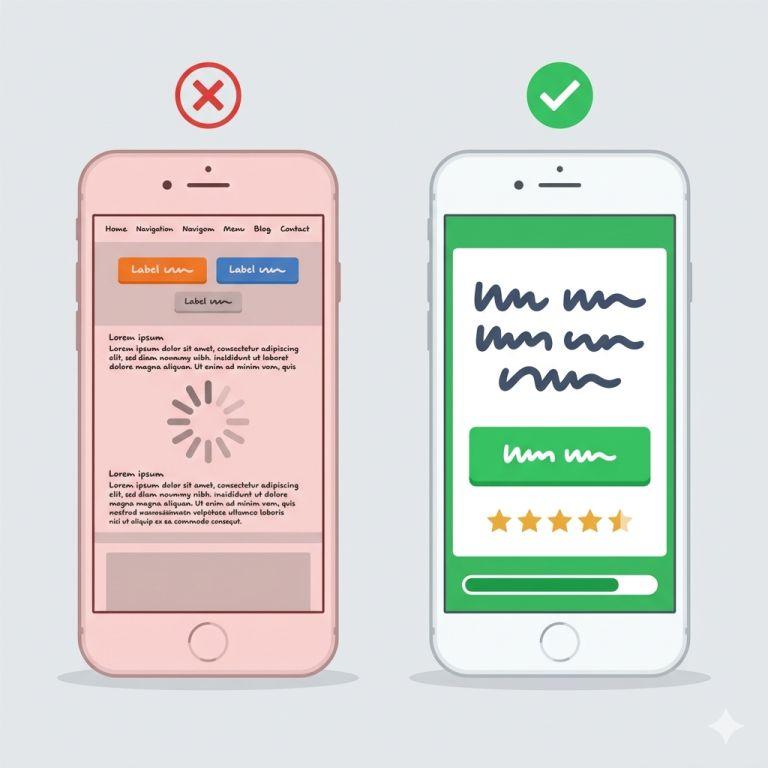
More than half of all Google Ad clicks come from mobile phones. And Google uses mobile-first indexing — meaning it looks at the mobile version of your page to decide your Quality Score, not the desktop version.
If your landing page looks great on a desktop but falls apart on a phone, you’re losing the majority of your visitors before they even read your offer.
What does a good mobile landing page look like? The headline is large and readable without zooming. The CTA button is big enough to tap with a thumb. The form has large input fields. Nothing is cut off at the edges. And the page doesn’t require sideways scrolling.
Quick tip: Pull out your own smartphone right now and load your landing page. Be honest about what you see. If anything looks broken, off-center, or hard to use, fix it before running another ad.
Best Practice #4: One Page, One Goal
Every extra option you give a visitor is a chance for them to get distracted and leave without converting. This is why the best Google Ads landing pages have one clear call to action — and nothing else competing for attention.
Remove the navigation menu. Take out the links to your blog or social media. Don’t add a pop-up asking people to subscribe to your newsletter. Every one of those things pulls the visitor away from the one action you actually want them to take.
Your CTA should be:
- Visible without scrolling — place it above the fold
- Action-oriented — use words like “Get,” “Book,” “Call,” “Start,” or “Claim”
- Repeated — show it at the top and again at the bottom for longer pages
- Visually distinct — use a contrasting color so it stands out from the rest of the page
Best Practice #5: Build Trust Quickly
When someone lands on your page from a Google Ad, they’ve never met you. They don’t know if you’re trustworthy. You have about 3 to 5 seconds to convince them to stay.
This is where trust signals do the heavy lifting. Trust signals are things on your page that prove you’re real, credible, and worth hiring or buying from.
The most effective trust signals for small business landing pages include:
- Star ratings and reviews — especially from Google or a recognizable third-party platform
- Specific numbers — “Over 500 jobs completed” is more believable than “Years of experience”
- Real photos — of your team, your work, or your product. Stock photos feel generic and reduce trust.
- Certifications and licenses — badges showing you’re licensed, insured, or accredited
- Guarantees — a simple “Satisfaction Guaranteed” or “Free Re-Service if Pests Return” removes risk for the buyer
In 2025, Google began applying its E-E-A-T framework — Experience, Expertise, Authoritativeness, and Trustworthiness — to paid ad landing pages. This means the more your page demonstrates real credibility, the better it performs in Google’s system.
Best Practice #6: Create a Separate Landing Page for Each Ad Group
One of the most common and costly mistakes in Google Ads is sending all your ad traffic to the same page. Every ad group targets a different type of customer with a different need — and each of those customers deserves a page built just for them.
For example, if you run a landscaping company and you have ad groups for “lawn mowing,” “tree trimming,” and “sprinkler installation,” each of those should have its own dedicated landing page. The lawn mowing page talks about lawn mowing. The tree trimming page talks about tree trimming. Simple, focused, effective.
This approach improves message match, raises your Quality Score, and almost always increases conversion rates — because every visitor feels like the page was made specifically for them. Because it was. To see how this plays out across different industries — from home services to e-commerce to healthcare — our Google Ads landing page examples article shows you exactly how dedicated pages look and why they outperform generic ones every time.
💡 Pro Tip: You don’t need to build entirely new pages each time. A page template with swappable headlines, images, and copy is a smart and efficient way to create multiple targeted landing pages without starting from scratch every time.
Best Practice #7: Let Google’s AI Work With You, Not Against You
In May 2025, Google launched AI Max for Search — one of the fastest-growing features in Google Ads history. This tool uses your landing page content as a signal to decide which searches your ads should match.
In plain terms: Google reads your landing page and uses what it finds to show your ad to more relevant people. A thin, generic page limits how many searches trigger your ad. A rich, detailed, helpful page gives the AI more to work with — and your ads reach more potential customers.
Advertisers using AI Max with strong landing page experience signals have seen an average 14% increase in conversions at a similar cost per acquisition. That’s real growth without spending more.
The takeaway: write your landing page for your human visitors first. But know that Google’s AI is reading it too. Clear, specific, helpful content serves both audiences at once.
Best Practice #8: Keep Improving — Your Landing Page Is Never Finished
The best landing pages in the world didn’t start out perfect. They got better over time through testing and small improvements. Even changing one word in a headline or moving a button higher on the page can make a meaningful difference in your conversion rate.
Run simple A/B tests: show half your visitors one version of the page and the other half a slightly different version. See which one converts better. Keep the winner. Test something else. Repeat.
Tools like Google Optimize, VWO, or even basic heatmap tools like Hotjar can show you exactly where visitors click, scroll, and drop off — giving you a clear map of what to fix next.
For a full breakdown of the technical standards Google uses to evaluate landing pages, Google’s Page Experience documentation is the definitive resource and worth bookmarking.
Putting It All Together
Following Google Ads landing page best practices isn’t about being perfect. It’s about being better than you were yesterday — and better than the competitor whose ad is running right next to yours.
Every practice in this guide works together. Fast speed earns more visitors. Message match keeps them on the page. A single CTA converts them. Trust signals close the deal. And dedicated pages for each ad group make the whole system more efficient.
Small businesses that treat their landing pages as seriously as their ads consistently outperform competitors who pour all their attention into the ad itself and ignore what happens after the click. The click is just the beginning. The landing page is where the money is made.
If you’ve been following these best practices but Google is still rating your landing page experience “Average” or “Below Average,” the issue may be more specific than a single fix. Our step-by-step guide on how to improve landing page experience in Google Ads walks through exactly what Google measures, why scores drop, and what timeline to expect after you make improvements.
If you’re ready to build campaigns that actually convert, our guide to Google Ads landing pages covers every detail of how Google grades your page and what you can do about it. And if you’d rather have a team of experts handle the whole thing for you, PPC management for small businesses is exactly what we do at Sheaf Media Group.
Whether you’re just getting started or looking to scale what’s already working, search engine marketing for small businesses is about making every dollar work harder — and a great landing page is always the best place to start.