
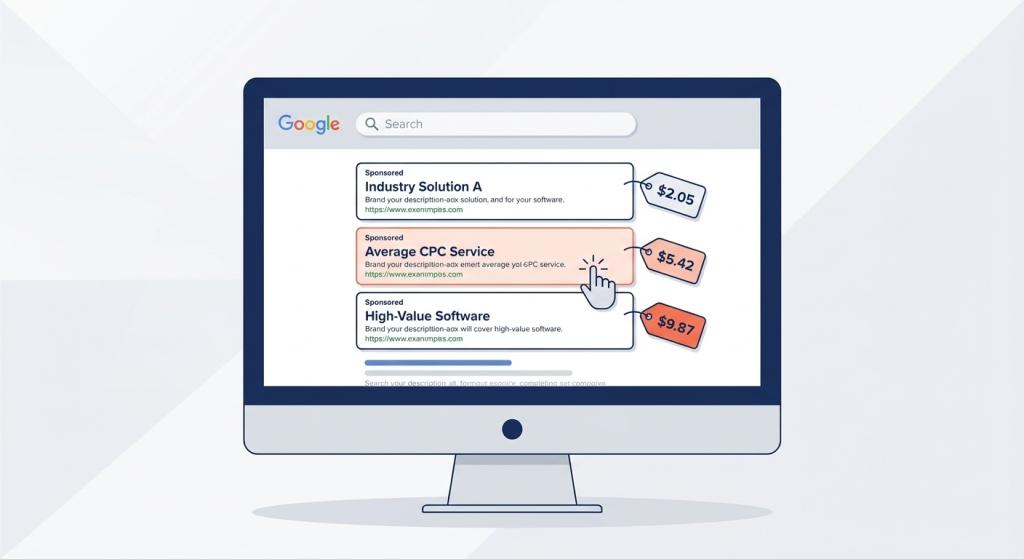
If you’ve ever wondered what happens when someone clicks on an online ad — and why that one tiny click can cost anywhere from $1 to over $100 — you’re about to find out.
Understanding cost per click is one of the most important things you can do before spending a single dollar on online advertising. It helps you plan your budget, compare your results, and figure out whether your ads are actually worth what you’re paying for them.
In this guide, we’ll walk through a clear, easy-to-understand cost per click example — and then show you exactly how CPC works in the real world across different industries. Simple language. Real 2026 numbers. Let’s go.
What Is Cost Per Click (CPC)?
Cost Per Click — or CPC — is the amount of money an advertiser pays each time someone clicks on their online ad. It’s one of the most common ways digital advertising is priced, and it’s the foundation of PPC (Pay-Per-Click) advertising on platforms like Google Ads, Microsoft Ads, Facebook, and Instagram.
The big advantage of CPC advertising is that you only pay for real interest. If your ad is shown to 1,000 people but only 10 click on it, you pay for those 10 clicks — not the 1,000 views. That makes CPC one of the most budget-friendly and measurable forms of advertising available to businesses of any size.
CPC is at the heart of what’s known as search engine marketing for small business — a strategy that helps businesses show up at the top of Google when potential customers are actively searching for what they offer.
The Cost Per Click Formula
Before we get into a cost per click example, let’s look at the simple formula behind it:
CPC = Total Cost of Clicks ÷ Total Number of Clicks
That’s it. It’s just a simple division problem. Here’s how it works in practice. If you want to go even deeper into how this formula works — including how Google calculates your actual CPC in real time during the ad auction — our detailed guide on what is cost per click formula walks you through every step with real-world scenarios and tips to lower your costs.
Cost Per Click Example: Step by Step
Let’s walk through a real, easy-to-follow cost per click example so you can see exactly how this works.
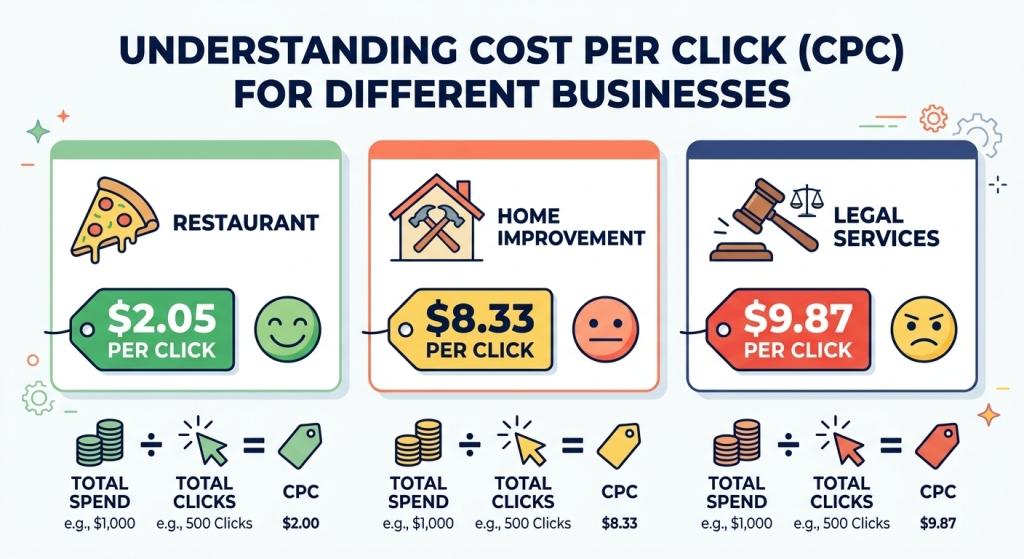
🍕 Example 1: A Local Pizza Restaurant
Imagine you own a pizza restaurant and you run a Google Ads campaign for one week. Here’s what happens:
- You spend $200 on your ad campaign
- Your ad gets clicked 100 times
- Your CPC = $200 ÷ 100 = $2.00 per click
That means every time someone clicked on your pizza ad and visited your website, it cost you $2.00. For a restaurant where an average order might be $35, that’s a very strong return — especially if even a small percentage of those visitors place an order.
🏠 Example 2: A Home Improvement Company
Now let’s look at a home improvement business running ads for kitchen remodeling:
- They spend $5,000 on ads in one month
- Their ads receive 600 clicks
- Their CPC = $5,000 ÷ 600 = $8.33 per click
That matches exactly with the 2026 industry benchmark for Home and Home Improvement — $8.33 per click. It sounds like a lot more than the pizza example, but if a single kitchen remodel brings in $15,000 in revenue, paying $8.33 to attract a potential customer makes perfect business sense.
⚖️ Example 3: A Personal Injury Law Firm
Finally, let’s look at one of the most expensive industries in all of Google Ads — legal services:
- A law firm spends $9,870 on ads in one month
- Their ads receive 1,000 clicks
- Their CPC = $9,870 ÷ 1,000 = $9.87 per click
Attorneys and Legal Services carry the highest average CPC of any industry in 2026 at $9.87 per click. But when a single personal injury case can generate $50,000 or more in revenue, even a high CPC can deliver an exceptional return on investment when campaigns are managed correctly.
These three examples show something really important: a high CPC isn’t automatically bad, and a low CPC isn’t automatically good. What matters is the value of the customer you’re acquiring compared to what you paid to get them.
What Is the Average Cost Per Click in 2026?
Here’s the big picture: the average CPC across all industries on Google Search in 2026 is $5.42 — more than double the $2.32 average recorded back in 2016. That’s a 134% increase over ten years, driven largely by more advertisers entering the auction and AI-powered search changing the landscape.
Here’s a quick look at 2026 average CPCs across the most common industries:
- 🎨 Arts & Entertainment: $1.63 (lowest)
- 🍕 Restaurants & Food: $2.05
- ✈️ Travel: $2.14
- 🚗 Automotive — For Sale: $2.27
- 🏡 Real Estate: $3.22
- 💰 Finance & Insurance: $3.39
- 👗 Apparel/Fashion & Jewelry: $4.44
- 💼 Business Services: $5.87
- 💪 Health & Fitness: $6.17
- 🧖 Personal Services: $7.17
- 🦷 Dentists & Dental Services: $8.00
- 🏠 Home & Home Improvement: $8.33
- ⚖️ Attorneys & Legal Services: $9.87 (highest)
On the Google Display Network — which shows banner and visual ads across millions of websites — the average CPC drops significantly to just $0.44, making it a much more affordable option for building brand awareness.
Why Are CPCs Rising So Fast in 2026?
If you’ve noticed your ad costs climbing, you’re not imagining it. CPC rose approximately 15% year over year between June 2025 and June 2026. There are three big reasons why:
1. More Advertisers Are Entering the Auction
Google’s AI-powered ad tools — including AI Max for Search — have made it easier than ever for new businesses to start running ads. As a result, the number of advertisers participating in search ad auctions has increased by an estimated 35% year over year. More bidders means more competition, and more competition means higher prices.
2. AI Overviews Are Pushing Organic Traffic Into Paid Ads
Google’s AI Overviews now appear at the top of search results for many queries — providing instant answers without sending users to any website. Research shows that when an AI Overview appears, organic clicks fall by 38% and the share of searches that end with no click at all jumped from 54% to 72%. This pushes more businesses to rely on paid ads for visibility, heating up the auction even further.
3. Automated Bidding Creates Upward Price Pressure
Most advertisers now use Google’s automated Smart Bidding strategies, which automatically raise bids to win auctions. When nearly every competitor is using the same AI-driven bidding logic, it creates a self-reinforcing loop — everyone’s bids go up together, driving the average CPC higher across the board.
What Makes a Good CPC? And How Can You Lower Yours?
A “good” CPC is one where the value of the customer you’re acquiring is significantly higher than what you paid to get them. A $9 click that turns into a $5,000 job is a great CPC. A $1 click that never converts is a waste of money.
Here are the most effective ways to lower your CPC in 2026:
Improve Your Quality Score
This is the single most powerful tool for reducing CPC — and it’s completely free. Google’s Quality Score rates your ad from 1 to 10 based on how relevant your ad, keywords, and landing page are to what someone searched for. Improving your Quality Score from 5 to 8 can reduce your CPC by up to 37% according to the Google Ads Help Centre. That’s a massive saving without spending a single extra dollar.
Use Specific, Long-Tail Keywords
Broad keywords like “lawyer” or “dentist” attract enormous competition and sky-high CPCs. Longer, more specific phrases — like “emergency family dentist open Saturday near me” — have far less competition and usually cost significantly less per click. They also tend to convert better because they attract people who know exactly what they want.
Build a Strong Negative Keyword List
Negative keywords stop your ad from showing up for searches that will never bring you a customer. If you’re a premium service provider, adding words like “free,” “cheap,” and “DIY” as negative keywords means you stop paying for clicks from people who aren’t your target audience — which brings your average CPC down naturally.
Build Better Landing Pages
A fast, relevant, and easy-to-use landing page improves your Quality Score — which lowers your CPC. Google rewards advertisers who deliver a great experience after the click. A dedicated landing page that matches your ad’s message is one of the fastest ways to improve your score and reduce what you pay per click.
Try Google Display Network Ads
If your search CPCs feel too high, the Google Display Network offers an average CPC of just $0.44 — a fraction of the search average. Display ads are better for brand awareness than direct-response campaigns, but they can be a cost-effective way to stay visible while keeping your overall ad spend in check.
CPC vs. Cost Per Lead: The Number That Really Matters
Here’s something important that beginners often miss: CPC is just one piece of the puzzle. The number that actually tells you whether your campaign is profitable is your Cost Per Lead (CPL) — how much you spend in total to get one real inquiry, phone call, or customer.
The average CPL across all industries in 2026 is $66.69. That means the average business spends about $67 in ad clicks to generate one qualified lead. Whether that’s a good deal depends entirely on what that lead is worth to your business.
For example: if you’re a dentist and a new patient is worth $1,200 per year, paying $67 to acquire them is an excellent investment. If you sell a $20 product with a thin margin, it might not be. That’s why understanding your own numbers — not just the industry averages — is the key to making PPC work for your specific business.
You can explore more about how cost per click fits into broader Google Ads strategy through Google’s official free training at Google Skillshop — a great resource for anyone who wants to understand the numbers behind their campaigns.
Ready to Put CPC to Work for Your Business?
Now that you understand what a cost per click example looks like in the real world — and how CPC varies dramatically from a $1.63 click for an arts business to a $9.87 click for a law firm — you’re already better equipped than most business owners to make smart decisions with your ad budget.
The key takeaways: CPC is rising across every platform in 2026, but higher click costs don’t mean PPC is broken. They mean you need to be smarter — with better Quality Scores, tighter keywords, stronger landing pages, and a clear understanding of what a customer is actually worth to your business.
If you want to dive deeper into how paid advertising works and how to build campaigns that deliver real returns, our complete guide to PPC Management For Small Business is a great next step — covering everything from campaign structure and keyword strategy to tracking, bidding, and scaling your results.