
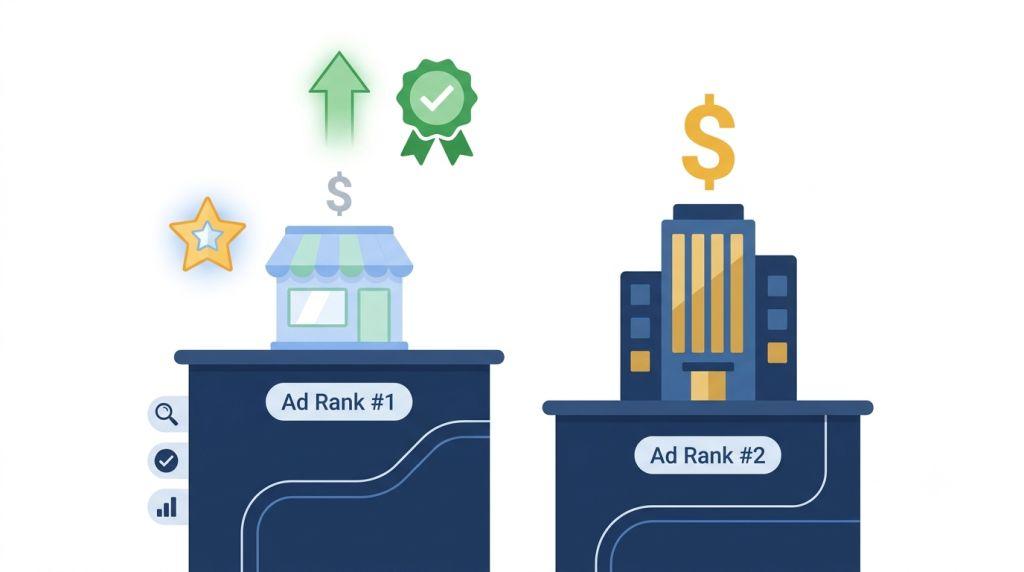
Quality Score and Ad Ran – Here’s something that surprises a lot of small business owners when they first hear it: the advertiser who bids the most money doesn’t always win in Google Ads.
That’s right. You can be outspent by a competitor and still have your ad show up higher on the page than theirs. You can pay less per click than they do — on the exact same keyword — and still beat them every single time someone searches.
How? Two words: quality score and ad rank.
These two metrics sit quietly in the background of every Google Ads account, shaping how much you pay, where your ads appear, and whether they show up at all. Most advertisers barely think about them. The ones who do? They tend to get dramatically better results for dramatically less money.
In this guide, we’re going to break both of them down in plain, simple English. We’ll explain what they are, how they work together, why they matter more than ever in 2026, and exactly what you can do to improve them — starting today.
What Is Quality Score?
Let’s start with the basics. Quality Score is a number from 1 to 10 that Google gives to every keyword in your Google Ads account. Think of it like a grade on a test. A 10 is an A+. A 1 is, well, not great.
But here’s the important part: Google isn’t grading how much money you’re spending. It’s grading how relevant and helpful your ad is to the person who searched for that keyword.
Google cares deeply about this. Their whole business depends on showing people ads that actually match what they were looking for. If someone searches “best running shoes for flat feet” and Google shows them an ad for car insurance, that’s a terrible experience. Google doesn’t want that — and neither does the advertiser paying for that click.
So Google created Quality Score as a way to measure and reward relevance. The more relevant your ad is to what someone searched, the higher your Quality Score — and the better things get for you across the board.
One important thing to understand: Quality Score is a diagnostic tool, not a direct auction input. Google has confirmed this officially. The visible 1–10 number tells you how your ads, keywords, and landing pages compare to competitors on the same search. The underlying signals it measures, however, are very much part of how Google evaluates your ads in every single auction.
The Three Things That Make Up Your Quality Score
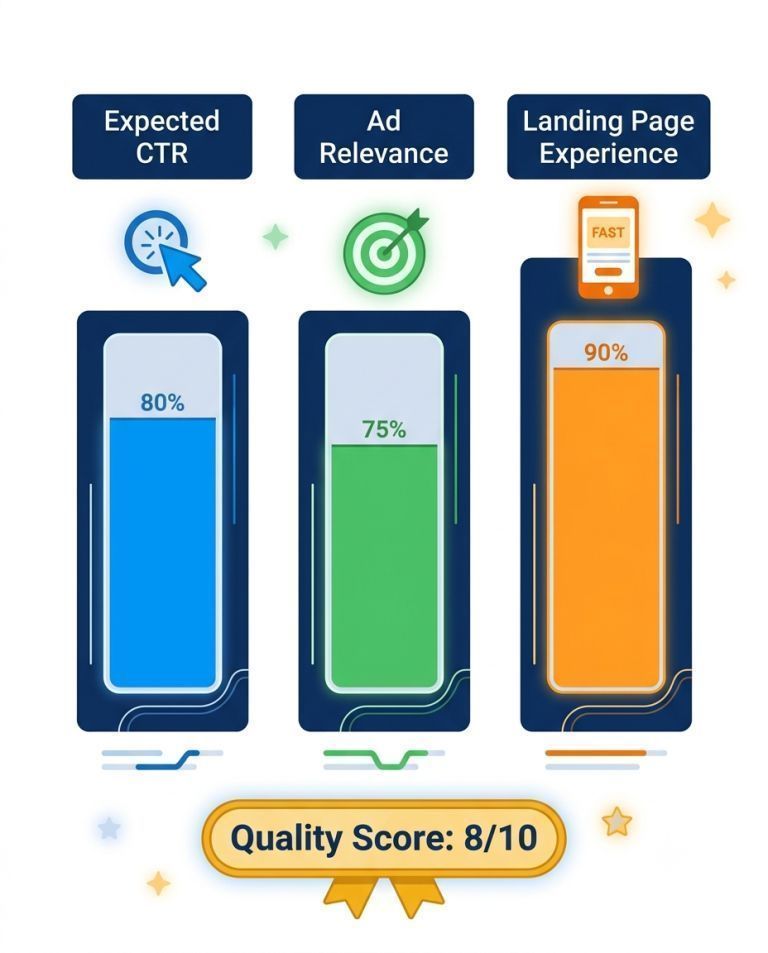
Google calculates your Quality Score based on three specific things. Each one is rated as above average, average, or below average compared to other advertisers who showed ads for that exact same search over the past 90 days.
1. Expected Click-Through Rate (CTR)
This is Google’s prediction of how likely someone is to click your ad when it shows up for a certain keyword. Google looks at your historical performance and compares it to other advertisers targeting the same keyword. If people click your ad more often than average, that’s a good sign. It tells Google your ad is relevant and appealing to searchers.
You improve your expected CTR by writing better ad copy — headlines and descriptions that speak directly to what the person was searching for, include the keyword naturally, and give a clear reason to click right now.
2. Ad Relevance
This measures how closely your ad matches the intent behind the search. If someone searches for “emergency plumber near me” and your ad talks about general home repair services, your ad relevance score will suffer. The tighter the connection between the keyword and your ad’s message, the better.
You improve ad relevance by organizing your campaigns into tightly themed ad groups, where each group targets a specific set of closely related keywords and the ads in that group speak directly to those keywords.
3. Landing Page Experience
This is the big one — and it’s only gotten more important in 2026. When someone clicks your ad, where do they land? Is that page fast? Is it easy to use on a phone? Does it actually deliver what the ad promised?
Google’s data shows that a one-second delay in mobile page load time can reduce conversions by up to 20%. A slow, confusing, or irrelevant landing page doesn’t just hurt your Quality Score — it costs you customers. Landing page experience now directly influences how AI Max and Smart Bidding target your ads, making it the single most important quality signal in today’s Google Ads environment.
What Is Ad Rank — and How Does It Work?
Now let’s talk about ad rank — the number that actually decides where your ad shows up on the page.
Every single time someone does a Google search, Google runs a lightning-fast auction in the background. In milliseconds, it looks at every advertiser who wants to show an ad for that search and decides who shows up, in what order, and how much each person pays. This happens billions of times a day.
Your Ad Rank is calculated using this formula:
Ad Rank = Max CPC Bid × Quality Score × Expected Impact of Ad Assets + Ad Rank Threshold
Let’s break that down into plain English:
- Max CPC Bid — the maximum amount you’re willing to pay for a click
- Quality Score — how relevant and useful Google thinks your ad is
- Expected Impact of Ad Assets — the boost your sitelinks, callouts, images, and other ad extras are expected to contribute
- Ad Rank Threshold — a minimum standard Google sets to ensure only quality ads show up
Here’s what makes this so powerful for advertisers who pay attention: because Quality Score is multiplied through the formula, a high Quality Score can compensate for a lower bid. In other words, you don’t have to outspend your competitors to outrank them. You just have to be more relevant.
This is also why Ad Rank is not static. Google recalculates it for every single search. Your ad might rank first for one search and third for another — even on the same keyword — because the context around each search (the device, location, time of day, and the specific words used) affects the calculation every time.
In 2026, Google’s machine learning now processes over 200 contextual signals in real time for every auction. This is why manual bid adjustments are becoming less effective, and why Smart Bidding strategies that can respond to all these signals automatically are becoming the standard approach.
The Real Cost of a Low Quality Score
Here’s something that should get your attention if you’re running Google Ads right now: a keyword with a Quality Score of 1–3 can cost you up to 400% more per click than a keyword at the average score of 5.
And on the flip side, a keyword at Quality Score 10 can unlock up to a 50% discount on your cost per click.
Think about what that means for your budget. If you’re spending $2,000 a month on Google Ads and your Quality Scores are low, you might be paying twice what you should for every single click. Fix your Quality Scores, and you could be getting twice as many clicks for the same budget — without changing your bids at all.
One real-world example: an advertiser was paying the equivalent of about $50 per click on a competitive keyword. After fixing their landing page experience and tightening their ad group themes, the same keyword dropped to around $28 per click. Same keyword. Same bids. The Quality Score was the bottleneck the whole time.
According to WordStream’s analysis of over 15,000 Google Ads accounts, the average Quality Score across most advertisers sits at just 5–6 out of 10. That means most advertisers are overpaying for their clicks. Getting to a 7 or above puts you ahead of the majority of your competitors — and saves you real money every single day.
If you’ve ever wondered why Google Ads feels so complicated, this is one of the big reasons. There are hidden levers — like Quality Score — that have a massive impact on your results but aren’t always obvious at first glance.
Does Quality Score Still Matter in the Age of AI and Smart Bidding?
This is one of the most debated questions in digital advertising right now — and the answer matters a lot for how you manage your campaigns.
Some advertisers assume that because Google has moved toward automation and Smart Bidding, Quality Score has become less important. The data says the opposite is true.
Yes, the visible 1–10 number on your dashboard is a diagnostic tool, not a direct auction input. Google has confirmed this. But the underlying signals that make up your Quality Score — expected CTR, ad relevance, and landing page experience — are very much baked into every auction, including auctions run by Smart Bidding.
Here’s the key insight for 2026: Smart Bidding amplifies quality differences, it doesn’t smooth them over. If your landing page converts at 4% and a competitor’s converts at 9%, Smart Bidding learns this faster than a manual bidding account ever would — and adjusts accordingly. Poor quality doesn’t get hidden by automation. It gets penalized more efficiently.
Landing page experience has become especially critical. Google’s AI Max — which automatically matches your ads to search queries by reading your website and landing page content — uses landing page signals as a core matching signal. A poor landing page doesn’t just hurt your Quality Score anymore. It directly limits the reach of your AI-powered campaigns.
The bottom line: obsessing over the 1–10 number is less useful than it used to be. But obsessing over the three things it measures — your click-through rate, your ad relevance, and your landing page experience — is more important than ever.
How Quality Score Connects to Your Google Search Optimization Score
While we’re talking about scores, this is a good moment to clear up one of the most common points of confusion in Google Ads: the difference between Quality Score and your Google search optimization score.
They sound similar. They both have the word “score” in the name. But they measure completely different things.
Your Quality Score (1–10) measures the relevance and expected performance of individual keywords, ads, and landing pages. It tells you how Google views the quality of your advertising at a very specific level.
Your Google search optimization score (0–100%) measures how well your overall account follows Google’s general best practices. It lives in the Recommendations tab and comes with a list of suggestions — like adding ad assets, adjusting bidding strategies, or trying new campaign types. Each suggestion tells you how much your score would go up if you applied it.
These two scores don’t calculate each other. Improving your optimization score doesn’t automatically improve your Quality Score, and vice versa. But they’re both pointing at the same goal: helping you run better, more efficient ads.
A common question is what is a good optimization score for Google Ads? Most experienced advertisers aim for somewhere between 70% and 85% — not 100%. Reaching 100% means accepting every recommendation Google makes, and some of those recommendations won’t be right for your specific business. Dismissed recommendations are removed from your score calculation, so making thoughtful decisions won’t hurt your number.
And as for does Google Ads optimization score matter? Yes — as a health signal and a way to spot issues in your account. But it’s not the most important number in your dashboard. Your Quality Score components, your conversion rate, and your return on ad spend are the metrics that tell you whether your campaigns are actually making money. You can read more about how to use your score effectively on our Google Ads optimization score guide.
How to Actually Improve Your Quality Score and Ad Rank
Enough theory — here’s what to actually do. These are the moves that make the biggest difference, backed by real account data from 2025 and 2026.
Start with your landing pages. This is the highest-leverage improvement you can make right now. Audit your top 20–50 most important keywords. For each one, trace the journey: someone types a search, sees your ad, clicks, and lands on a page. Ask yourself honestly — does that page deliver exactly what the ad promised? Is it fast on mobile? Is it easy to navigate? If the answer to any of these is no, that’s your first priority. Landing page experience now feeds directly into AI Max routing, Smart Bidding efficiency, and your visible Quality Score all at once.
Tighten up your ad groups. One of the most reliable ways to improve ad relevance is to make sure each ad group contains only tightly related keywords — and that your ads in that group speak directly to those keywords. If you have an ad group with 50 different keywords covering a wide range of topics, your ad relevance will almost always suffer. Smaller, tighter, more focused ad groups consistently outperform sprawling ones.
Write ads that earn the click. Your expected CTR improves when people actually want to click your ad. That means headlines that match the searcher’s intent, descriptions that highlight a clear benefit or offer, and a reason to act now rather than keep scrolling. Test different variations. Let the data show you which messages connect with your audience.
Add and optimize your ad assets. Sitelinks, callout extensions, structured snippets, image assets — these are all free to add and they boost your Ad Rank directly by increasing the expected impact of your ad. They also give searchers more information and more reasons to click. Missing ad assets are one of the most common reasons both Quality Scores and Ad Rank underperform.
Fix your negative keywords. In 2026, broad match and AI Max are expanding query matching more aggressively than ever before. That means your ads are potentially showing up for searches that have nothing to do with your business. These irrelevant impressions drag down your expected CTR — and your Quality Score along with it. A well-maintained negative keyword list is one of the most important maintenance tasks in any Google Ads account right now.
Make sure your conversion tracking is solid. Smart Bidding uses your conversion data to make decisions. If that data is incomplete, broken, or inaccurate, the algorithm is working with bad information — which means bad decisions. Accurate conversion tracking is the foundation everything else is built on.
What’s Changing in 2026 — and Why It Makes This More Important Than Ever
Google Ads is changing fast, and 2026 is bringing some of the biggest shifts in years.
Starting in September 2026, Google will automatically migrate all Dynamic Search Ads, campaigns using automatically created assets, and campaign-level broad match campaigns to AI Max — their newest AI-powered campaign type. This is not optional. If you’re running any of those campaign types, they’re going to AI Max whether you choose it or not.
AI Max uses your landing pages and website content as core signals to decide which searches to target. This means your landing page quality isn’t just a Quality Score factor anymore — it’s the engine driving your AI-powered targeting. A great landing page opens up more reach. A poor one restricts it.
At the same time, Google Ads CPCs rose 10–25% across most industries in 2026, the steepest increase since 2021. More advertisers are competing, AI-driven matching is expanding auction density, and clicks simply cost more than they used to. In that environment, the difference between a Quality Score of 4 and a Quality Score of 7 on your most important keywords isn’t just meaningful — it’s the difference between a profitable campaign and one that drains your budget.
The advertisers who are winning right now are the ones who’ve invested in quality — better ads, better landing pages, better relevance — and are letting Google’s AI do the heavy lifting from that strong foundation. The ones who are struggling are often the ones who handed everything to automation without doing the foundational work first.
Working with a specialist who understands both sides — the human strategy and the AI systems — can make a significant difference. If you’re a small business owner managing your own campaigns, it may be time to explore what search engine marketing for small business looks like with the right support behind you.
Final Thoughts
Quality score and ad rank are two of the most powerful levers in all of Google Ads — and most advertisers aren’t using them to their full potential.
Quality Score tells you how Google views the relevance of your keywords, ads, and landing pages. Ad Rank determines where you show up and how much you pay. Together, they create a system where the best advertisers win — not just the biggest spenders.
In 2026, with AI Max expanding, CPCs rising, and Smart Bidding handling more decisions than ever, the underlying quality of your advertising matters more than it ever has. Landing page experience, ad relevance, and expected click-through rate — the three components of Quality Score — are now baked into the AI systems that run your campaigns automatically.
If you’re ready to get serious about improving your Quality Score and Ad Rank, start with your landing pages, tighten your ad groups, and build a strong negative keyword list. And if you want professional help doing it right, PPC Management for Small Business from a team that lives and breathes this stuff is always an option worth exploring.
For the official, up-to-date explanation of how Google calculates Quality Score and Ad Rank directly from the source, Google’s own Ad Rank documentation is always a reliable reference.
The platform is getting more automated. But the advertisers who understand the fundamentals — relevance, quality, and user experience — will always have the edge.