
Types of Bidding Strategies in Google Ads – Imagine walking into a candy store with $20 in your pocket. You could buy one expensive chocolate bar, twenty small candies, or something in between. The choice you make depends on what you want – quality, quantity, or a mix of both.
That’s exactly what happens when you advertise on Google. Every day, you’re making choices about how to spend your advertising money. The types of bidding strategies in Google Ads are like different shopping plans. Each one helps you spend your money in a different way to get different results.
The good news? You don’t need to be a computer genius or marketing expert to understand these strategies. By the time you finish reading this article, you’ll know all 12 types of bidding strategies, when to use each one, and which mistakes to avoid. Whether you’re spending $50 a month or $5,000, this knowledge will help you get better results from every dollar.
Understanding Bidding Strategies: The Basics
Let’s start with a simple question: What is a bidding strategy?
Think of it as your game plan for competing against other businesses. Every time someone types something into Google, an instant auction happens. Businesses compete to show their ads. Your bidding strategy tells Google how you want to play this game.
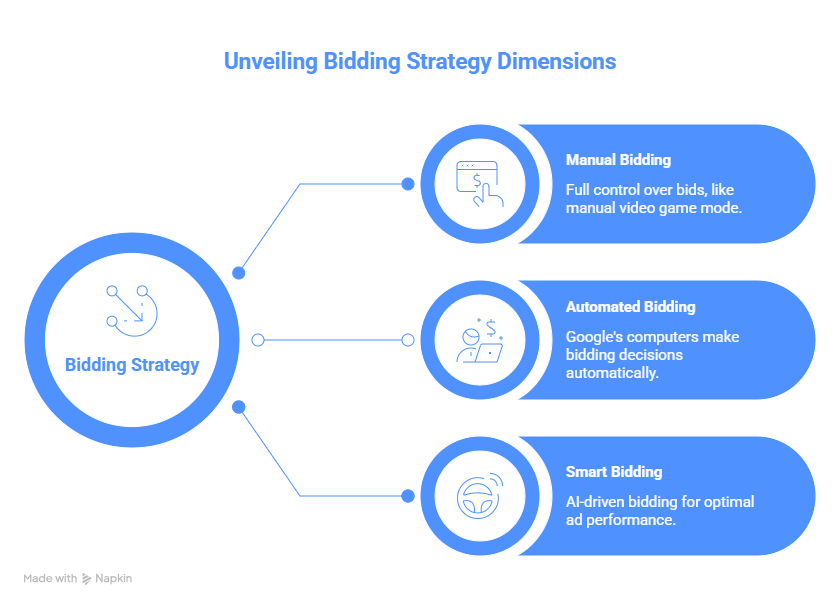
Some strategies let you control everything yourself, like playing a video game on manual mode. Other strategies let Google’s super-smart computers make decisions for you, like turning on autopilot. Neither way is better – they’re just different tools for different situations.
In 2026, Google offers three main families of strategies with 12 specific options. Let’s explore each family and see what they can do for your business.
Family One: Manual Bidding – You’re in the Driver’s Seat
Manual bidding means you control everything. You decide how much to pay for each click, and you can change your mind whenever you want.
Manual CPC: Taking Control of Every Click
Manual Cost Per Click (CPC) is where most people start their Google Ads journey. Here’s how it works: you pick the highest price you’ll pay when someone clicks your ad. That’s it.
Let’s say you sell homemade cookies. You decide you’ll pay up to $2.00 every time someone clicks on your ad. Google then enters auctions on your behalf, but never pays more than $2.00 per click (and usually pays less).
Here’s the big 2026 news: For years, Google made this option hard to find, trying to push everyone toward automated choices. But they changed their mind! Now Manual CPC is right there in the main menu, easy to select.
This works best when:
- You’re brand new and want to understand how everything works
- You’re getting fewer than 30 new customers per month
- Every dollar counts and you can’t afford surprises
- Your business is unusual or highly specialized
The reality check: Manual bidding is like cooking every meal from scratch. It works great, but you need to spend time on it almost every day. For busy business owners, this can feel overwhelming.
Learning to manage your advertising effectively is part of successful search engine marketing for small business strategies.
Family Two: Automated Bidding – Google Becomes Your Helper
Automated strategies mean Google makes adjustments for you based on goals you set. You’re still the boss, but you have a tireless assistant doing the math.
Maximize Clicks: Getting Traffic Fast
This is the “keep it simple” option. You tell Google your daily budget, and it tries to bring as many people as possible to your website.
Imagine you’re opening a new bakery. You don’t care as much about making sales today – you just want people to know you exist and check out what you offer. Maximize Clicks brings those curious visitors.
Best situations for this strategy:
- Brand new website that needs visitors
- Building awareness for a new product
- Testing to see what kind of interest exists
The warning sign: Lots of clicks doesn’t always mean lots of money. Someone might click, glance at your site for three seconds, and leave. You still paid for that click.
Target Impression Share: Making Sure People See You
Sometimes the goal isn’t clicks – it’s visibility. Target Impression Share focuses on making your ad appear in searches, whether people click or not.
You can aim for the very top spot, anywhere on the top half of the page, or just somewhere on page one. Google adjusts your bids automatically to keep you in that position.
This makes sense when:
- Protecting your brand name from competitors
- Making sure you appear next to competitor names
- Building brand recognition matters more than immediate sales
The expensive truth: Premium positions cost premium prices. This strategy can drain your budget quickly if you’re not careful.
CPM and Target CPM: Paying for Attention
Cost Per Thousand Impressions means you pay based on how many times your ad appears, not how many times people click it. You pay for every 1,000 times your ad shows up on YouTube or partner websites.
This works for:
- Video advertising campaigns
- Brand awareness pushes
- Visual storytelling
CPV: Video’s Special Strategy
Cost Per View is designed specifically for video ads. You pay when someone watches your video for at least 30 seconds (or the whole thing if it’s shorter).
Perfect for:
- Product demonstrations
- YouTube advertising
- Teaching people about complex products
Family Three: Smart Bidding – AI Takes the Wheel
Smart Bidding strategies use artificial intelligence to make thousands of decisions every single day. They’re called “smart” because they learn and improve over time, like a chess computer that gets better with practice.
Here’s something incredible: over 80% of Google advertisers now use Smart Bidding. Why the huge popularity? Because once you give it enough information to learn from, it often beats what humans can do manually.
Target CPA: Keeping Customer Costs Steady
Target Cost Per Acquisition is like telling Google, “Here’s how much I can afford to pay for each new customer. Make it happen.”
Let’s say you run a house cleaning service. You know that if you pay $60 to get a new customer, you’ll still make money because they’ll book multiple cleanings. So you set your Target CPA at $60.
Google’s AI then examines every single search. It looks at the time of day, what device the person is using, their location, their search history, and hundreds of other signals. Then it decides: “Is this person likely to become a customer? If yes, bid higher. If no, bid lower or skip this auction.”
You’ll need: At least 30 conversions (customers) in the past month for this to work properly. Less than that, and Google doesn’t have enough information to make smart decisions.
This shines when:
- Your customers are all worth about the same amount
- You provide services with standard pricing
- Predictable costs matter for your budget planning
Target ROAS: Chasing Profit, Not Just Customers
Return On Ad Spend is the champion strategy of 2026, and here’s why: it understands that not all customers are equal.
Instead of just counting customers, Target ROAS focuses on how much money they spend. You tell Google something like, “I want to make $6 for every $1 I spend on ads.”
Imagine you run an online electronics store. You sell both $15 phone cases and $1,500 laptops. Target CPA might bring you tons of people buying phone cases because they’re easy sales. But Target ROAS hunts for the laptop buyers because that’s where your real profit lives.
You’ll need: At least 30 conversions with dollar values assigned in the last month.
This excels when:
- You sell products with different prices
- Some customers naturally spend more than others
- Maximizing revenue matters more than just getting lots of sales
For deeper insight into when each strategy makes the most sense, explore these resources on Google Ads bidding strategies.
Maximize Conversions: Going All-In for Volume
This strategy has one simple mission: turn your entire daily budget into as many customers as possible, whatever the cost.
It’s like telling Google, “I have $200 today. Get me as many customers as you possibly can with that money. I don’t care what each one costs.”
The 2026 twist: You can now add an optional Target CPA. When you do this, it essentially becomes Target CPA bidding.
Best used when:
- You’re collecting data and learning
- Testing a new market or product
- Volume matters more than cost right now
Maximize Conversion Value: Quality Over Quantity
This is the sophisticated version of Maximize Conversions. Instead of chasing any customer, it chases your most valuable customers (value based bidding).
If you could get three $40 sales or one $150 sale, this strategy goes for the $150 sale every time.
The 2026 update: You can add an optional Target ROAS, turning this into Target ROAS bidding.
This performs best when:
- Different customers have very different values
- A few big sales beat many small ones
- You want Google prioritizing your most profitable items
Enhanced CPC: The Retired Strategy
Enhanced Cost Per Click used to be a popular middle ground between manual and automated bidding. It would slightly adjust your manual bids up or down based on whether a click seemed likely to turn into a sale.
Critical 2026 information: Google officially ended this as a standalone option in March 2025. If you were using it, you need to pick a different strategy. The technology still exists inside other Smart Bidding approaches, but you can’t choose it directly anymore.
Breaking Down the Three Families
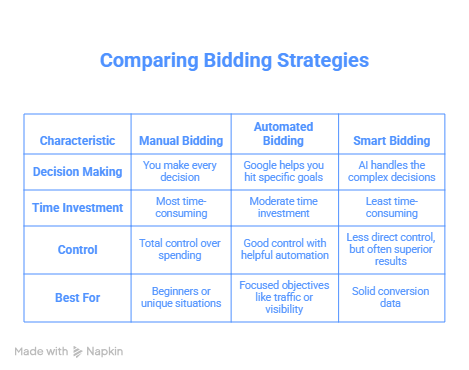
Let’s make the differences crystal clear:
Manual Bidding:
- You make every decision
- Most time-consuming
- Total control over spending
- Best for beginners or unique situations
Automated Bidding:
- Google helps you hit specific goals
- Moderate time investment
- Good control with helpful automation
- Best for focused objectives like traffic or visibility
Smart Bidding:
- AI handles the complex decisions
- Least time-consuming
- Less direct control, but often superior results
- Best when you have solid conversion data
Choosing Your Strategy: A Practical Framework
Picking from 12 options seems overwhelming, but it’s actually straightforward when you break it down:
Question 1: How Many Customers Did You Get Last Month?
- Under 30? Stick with Manual CPC or Maximize Clicks
- 30 to 50? You can experiment with Target CPA or Maximize Conversions
- Over 50? You’re ready for Target ROAS or Maximize Conversion Value
Question 2: What Does Your Business Sell?
- One main product or service with standard pricing? → Target CPA
- Multiple products with different prices? → Target ROAS
- Just need people to visit your website? → Maximize Clicks
- Want visibility more than clicks? → Target Impression Share
Question 3: How Much Time Can You Invest?
- Can monitor daily? → Manual could work
- Check weekly? → Automated is smarter
- Barely any free time? → Smart Bidding saves you
Question 4: What’s Your Experience Level?
- Complete beginner? → Start with Manual CPC for a month to learn
- Some advertising experience? → Jump into Smart Bidding if you have the data
- Seasoned advertiser? → Mix different strategies across campaigns
If handling all these decisions sounds like too much work, professional PPC Management for Small Business services can manage everything while you focus on your actual business.
The Learning Phase: What to Expect
Here’s something really important about Smart Bidding: it needs time to get smart.
When you first activate a Smart Bidding strategy, Google’s AI enters a “learning period” that lasts about two weeks. During this time, it’s figuring out patterns:
- When are your customers most active?
- Which locations produce the best results?
- What devices do your customers use?
- Which search terms lead to actual sales?
- How much should it bid in different situations?
Your results will probably bounce around during this period. Monday might look fantastic. Wednesday might look awful. Friday could be somewhere in between. This is totally normal!
The biggest mistake? Panicking after five days and switching to a different strategy. That just resets everything and starts the learning period over. Give it at least 30 days before making any judgments.
Five Expensive Mistakes to Avoid
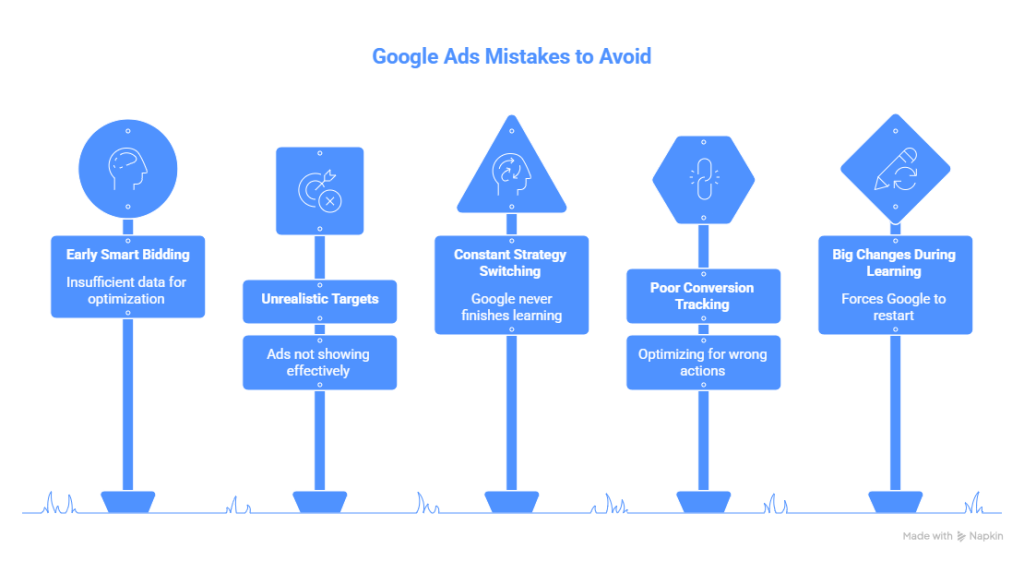
Even with amazing technology, people still waste money on Google Ads. Here are the traps to avoid:
Mistake 1: Jumping to Smart Bidding Too Early If you’re only getting 8 customers per month, Smart Bidding doesn’t have enough information to work properly. Start simpler until your volume grows.
Mistake 2: Unrealistic Target Setting If competitors pay $50 per customer but you tell Google you’ll only pay $15, your ads won’t show much. Start with realistic numbers.
Mistake 3: Constant Strategy Switching Changing strategies every week means Google never finishes learning. Pick one, give it 30 days, then evaluate.
Mistake 4: Poor Conversion Tracking If you track the wrong actions or track them incorrectly, Smart Bidding optimizes for the wrong things. Fix your tracking before anything else.
Mistake 5: Making Big Changes During Learning Major budget changes or campaign restructuring during the learning period forces Google to start over. Make changes gradually.
What’s Different in 2026
The Google Ads world never stops evolving. Here’s what changed this year:
Manual CPC returned to prominence: After hiding it for years, Google made it easily accessible again because advertisers demanded it.
Enhanced CPC disappeared: This hybrid option was officially discontinued, pushing users toward either full manual or full Smart Bidding.
Smart Bidding intelligence increased: The AI now processes even more signals and makes more accurate predictions than ever before.
Better campaign coordination: Multiple campaign types now work together instead of competing, preventing you from bidding against yourself.
According to Google Ads Help, the platform keeps advancing toward automation while maintaining options for those who need manual control.
Taking Your First Steps
You now understand all the types of bidding strategies in Google Ads and when each one makes sense. Here’s how to move forward:
Step One: Count your conversions from last month and check your monthly budget.
Step Two: Use the framework above to pick your starting strategy.
Step Three: Set it up and commit to 30 days without major changes.
Step Four: Monitor weekly but resist the urge to constantly tinker.
Step Five: After 30 days, evaluate results and decide whether to adjust or graduate to a more advanced strategy.
Remember this crucial truth: successful advertisers don’t find one perfect strategy and stick with it forever. They start at their current level, gather data, learn what works, and evolve their approach as their business grows.
The types of bidding strategies in Google Ads exist to match different business situations, goals, and experience levels. Start where you are, use what makes sense now, and level up as you go. Your advertising success story begins with picking the right strategy for today and being willing to adapt for tomorrow!