
Have you ever wished your Google Ads could tell the difference between a customer who spends $10 and one who spends $1,000? That’s exactly what value based bidding Google Ads can do for your business.
Think of it like this: imagine you’re selling lemonade. Would you rather have ten people who each buy one small cup, or two people who buy the jumbo size and come back every week? Value based bidding helps Google Ads find those jumbo-sized, loyal customers for you.
What Is Value Based Bidding Google Ads?
Value based bidding is a smart way to run your Google Ads campaigns. Instead of treating every customer click the same way, it teaches Google which customers are worth more to your business.
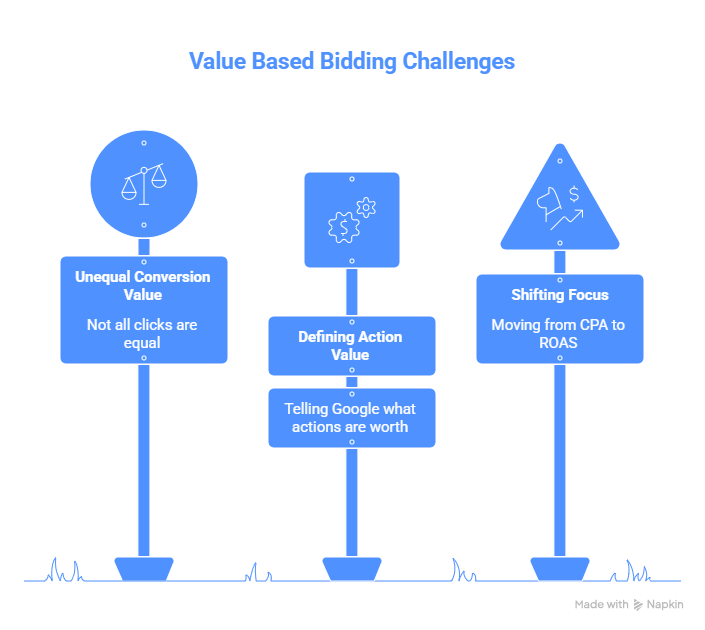
Here’s how regular advertising works: You pay for clicks, and Google tries to get you as many conversions as possible. But not all conversions are equal! A newsletter signup isn’t worth the same as someone buying your most expensive product.
Value based bidding fixes this problem. You tell Google what each action is worth to your business. Then Google’s smart computers work harder to find the people most likely to bring you real money.
This isn’t just a small improvement. Value based bidding shifts the focus from cost per acquisition to return on ad spend, letting you tell Google to find conversions that return $5 for every $1 spent.
Why Value Based Bidding Google Ads Matters Right Now
Google just made some big changes in 2026 that make value based bidding more important than ever.
First, Google announced journey-aware bidding in beta, which helps campaigns learn from both online and offline conversion goals. This means Google can now understand your whole customer journey, not just what happens on your website.
Second, Google Ads has moved away from target CPA (cost per acquisition) as the default and now prefers target ROAS (return on ad spend) for accounts with good conversion data.
What does this mean for you? Google’s advertising system is getting smarter, but only if you feed it the right information. That information is conversion values.
If you’re running search engine marketing for small business, this is crucial. Your advertising dollars need to work harder, and value based bidding helps make that happen.
How Value Based Bidding Google Ads Actually Works
Let’s break this down into simple steps.
Step 1: Assign Values to Your Conversions
You need to tell Google what different customer actions are worth. For example:
- Someone downloads a free guide: $5
- Someone signs up for your email list: $15
- Someone requests a quote: $100
- Someone makes a purchase: $500
These numbers should reflect what each action actually means for your business profits.
Step 2: Google’s Smart Computers Learn
Once you set up these values, Google’s artificial intelligence starts learning. It looks at thousands of signals like what device people use, what time they search, where they’re located, and what words they typed.
The system figures out which combinations lead to high-value conversions. Then it automatically adjusts how much you bid to win those valuable clicks.
Step 3: Your Ads Find Better Customers
Over time, Google gets better at finding people who will bring you more money. You might get fewer total conversions, but the ones you get are worth more.
Think of it like fishing. Would you rather catch 50 small fish or 10 big ones? Value based bidding helps you catch the big fish.
Two Main Types of Value Based Bidding Google Ads
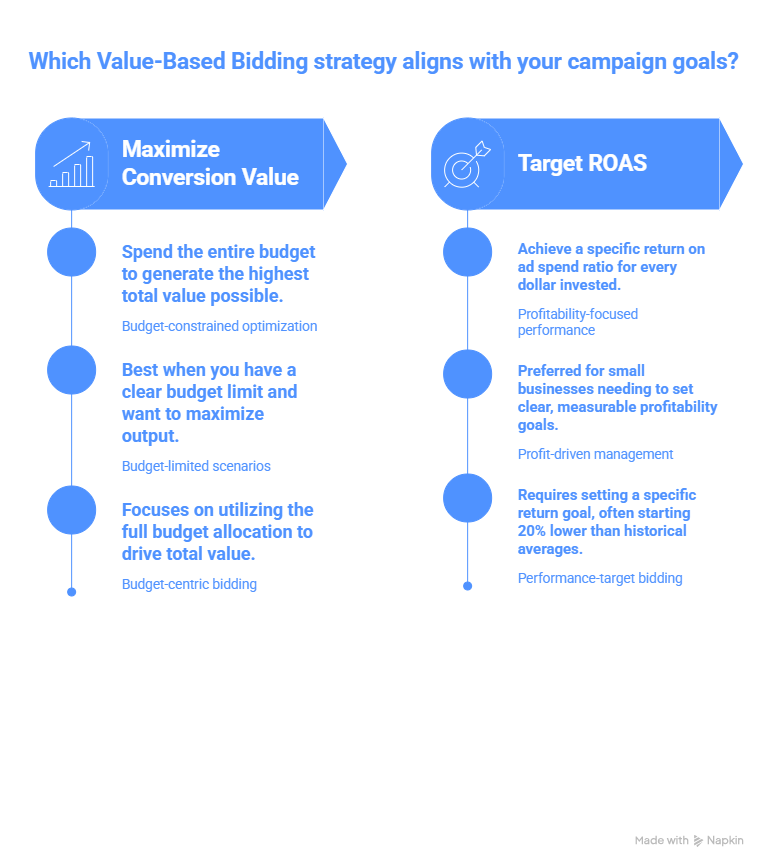
There are two main strategies you can use:
Maximize Conversion Value
This strategy tells Google: “Spend my budget to get the highest total value possible.” You set your budget, and Google works to maximize what you earn within that budget.
This works great when you have a clear budget limit but want to squeeze every dollar of value from it.
Target ROAS (Return on Ad Spend)
This strategy tells Google: “I want to make $4 for every $1 I spend.” You set a specific return goal, and Google adjusts your bids to hit that target.
Google recommends setting your target ROAS about 20% lower than your historical average when you first start. This gives the system room to learn without being too restrictive.
For businesses focused on PPC management for small business, target ROAS often makes the most sense because you can set clear profitability goals.
What You Need to Get Started
Before you can use value based bidding Google Ads, you need a few things in place:
Conversion Tracking
You must track conversions properly in Google Ads. This means adding special code to your website that tells Google when someone completes an important action.
At Least Two Different Conversion Values
You need at least two unique conversion values assigned to distinct conversion goals. If everything has the same value, there’s nothing for Google to optimize.
Enough Conversion Data
Google’s smart system needs data to learn from. For Demand Gen campaigns, you need at least 50 conversions with value within the past 35 days, including a minimum of 10 within the past seven days.
Different campaign types have different requirements, but the basic idea is the same: more data helps Google learn faster.
Realistic Values
Your conversion values should reflect real business economics. Don’t just make up numbers. Work with your team to calculate proxy values using this formula: Close Rate × Average Customer Value × Profit Margin × Stage Probability.
Special Tips for B2B Companies
If you sell to other businesses instead of regular consumers, value based bidding Google Ads is especially powerful.
Why? Because B2B sales usually have longer, more complicated customer journeys. Someone might download a white paper, attend a webinar, request a demo, and talk to sales before buying.
Assigning tiered values to each funnel stage teaches Google which conversions actually lead to sales, allowing the system to optimize for revenue instead of just collecting low-quality leads.
For example, you might assign:
- White paper download: $50
- Webinar attendance: $200
- Demo request: $800
- Sales call booked: $2,000
- Deal closed: $10,000
This tells Google that one closed deal is worth 200 white paper downloads. The system will work harder to find people likely to become actual customers.
Common Mistakes to Avoid
Mistake #1: Setting Targets Too High
Many businesses set their target ROAS based on what they hope to achieve instead of realistic numbers. Setting targets based on historical averages rather than the economics of profitable growth is the most common implementation error.
Start conservative and tighten gradually.
Mistake #2: Not Having Enough Budget
Value based bidding needs flexibility to find valuable customers. If your budget is too tight, Google can’t make the smart bidding decisions that drive results.
Mistake #3: Changing Targets Too Often
Making multiple ROAS target changes within a single conversion cycle can impede performance because the system receives multiple desired outcomes. Give your campaigns time to learn.
Mistake #4: Treating All Revenue Equally
A $100 sale of a product with 20% margin shouldn’t get the same weight as a $100 sale with 60% margin. Feed Google actual profit data, not just revenue numbers.
The Future: Journey-Aware Bidding
Google’s newest innovation makes value based bidding Google Ads even more powerful.
Journey-aware bidding optimizes towards the full lead-to-sale journey instead of relying mostly on front-end conversion actions like form fills. This beta feature is currently rolling out for search campaigns.
What makes this special? Secondary conversion actions can influence the bidding algorithm without actually counting as conversions. It’s like giving Google a complete map of your customer journey so it can make smarter decisions.
This is particularly exciting for businesses with complex sales processes. Google can now consider phone calls, email signups, and consultation bookings when deciding how much to bid.
How to Choose the Right Strategy
Wondering which approach fits your business? Here’s a simple guide:
Use Maximize Conversion Value if:
- You have a fixed monthly advertising budget
- You want the highest possible return within that budget
- You’re not sure what ROAS to target yet
Use Target ROAS if:
- You know what return you need to be profitable
- You want consistent, predictable results
- You have flexibility to increase spending if performance is good
Both strategies are forms of value based bidding Google Ads. The choice depends on how you prefer to manage your business finances.
Many successful businesses using Google Ads bidding strategies start with Maximize Conversion Value to gather data, then switch to Target ROAS once they understand their numbers.
Making the Switch to Value Based Bidding
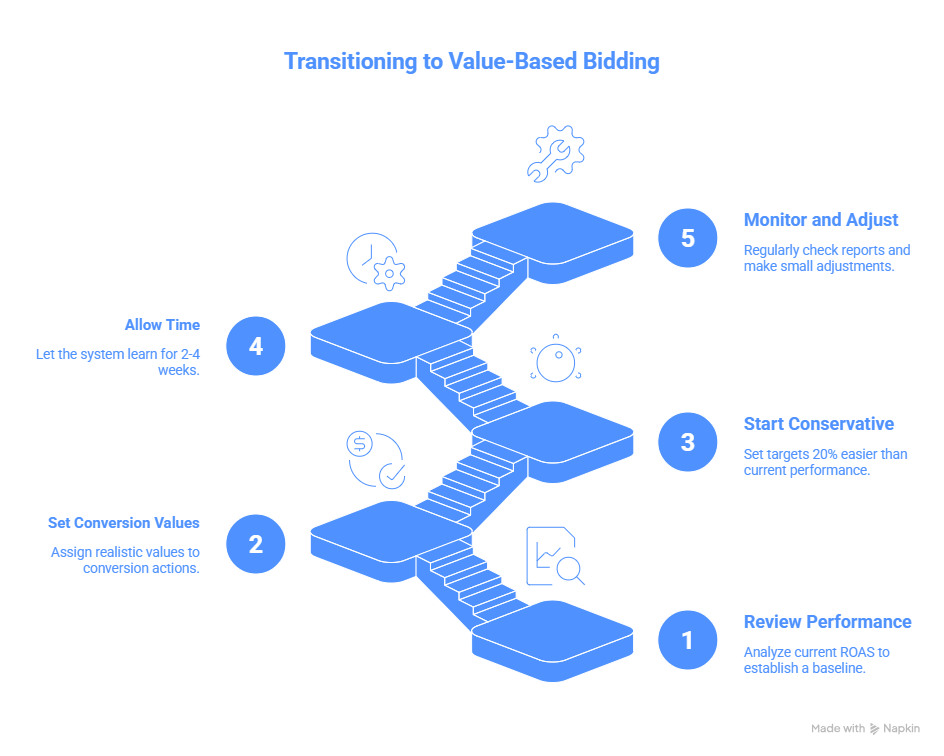
Ready to try value based bidding Google Ads? Here’s how to start:
- Review your current performance – Look at your last 30 days of data to understand your baseline ROAS
- Set up proper conversion values – Assign realistic values to each conversion action
- Start conservative – Set targets 20% easier than your current performance
- Give it time – Allow at least 2-4 weeks for the system to learn
- Monitor and adjust – Check your Bid Strategy Report regularly and make small adjustments
Remember, according to Search Engine Journal, Google has made over 20 improvements to search and shopping bid strategies since 2025. The platform keeps getting smarter, but you need to provide quality data.
The Bottom Line
Value based bidding Google Ads helps your advertising dollars work smarter, not just harder. By teaching Google which customers are most valuable, you can get better results from the same budget.
In 2026, the smartest bidding strategy is one that’s tied directly to your revenue outcomes. That means moving beyond simple conversion counting to true value optimization.
Whether you’re just starting with online advertising or looking to improve your current campaigns, value based bidding gives you a powerful edge. It’s not magic, but it is the closest thing to having a super-smart assistant who works 24/7 to find your best customers.
Start small, test carefully, and watch your return on ad spend improve. Your future self (and your bank account) will thank you.