
The explosion of artificial intelligence tools has brought us amazing capabilities that seem too good to be true. When you see “free” plastered across AI websites, you might wonder: Are free AI websites actually free? The answer is more complex than a simple yes or no. While many AI platforms offer legitimate free tiers, understanding what you’re really getting—and potentially giving up—is crucial for making informed decisions about which tools to use.
In this comprehensive guide, we’ll expose the hidden costs lurking behind “free” AI services, reveal which platforms deliver genuine value without charge, and help you navigate the increasingly complex landscape of AI pricing models. Whether you’re a student, freelancer, or business owner, understanding these nuances can save you from unexpected bills and privacy concerns down the road.
What ‘Free’ Really Means for AI Websites
Before diving into specific platforms and their pricing structures, it’s essential to understand what companies mean when they advertise their AI tools as “free.” The term itself has evolved significantly in the digital age, especially within the AI industry where computational costs run high.
The Freemium Business Model Explained
Most AI websites operate on what’s known as the freemium model—a portmanteau of “free” and “premium.” This business strategy offers basic features at no cost while charging for advanced functionality, higher usage limits, or priority access. It’s a win-win approach in theory: users get to test the service without financial commitment, while companies build a user base and convert a percentage to paying customers.
The freemium model in AI differs from traditional software in several key ways. First, AI services require significant computational resources for every interaction. When you generate text, create images, or analyze data, powerful servers process your requests in real-time. These operations cost money—sometimes substantial amounts—which companies must recoup somehow.
Second, AI models require continuous improvement and updates. Unlike traditional software that might receive quarterly updates, AI systems need constant refinement based on user feedback and emerging capabilities. This ongoing development represents a major expense that free users indirectly help fund through their usage data and eventual conversions to paid tiers.
Common Misconceptions About Free AI Tools
Many users approach free AI platforms with misconceptions that can lead to frustration or unexpected costs. The most prevalent myth is that “free” means unlimited access to all features. In reality, free tiers almost always come with restrictions designed to prevent abuse and encourage upgrades.
Another widespread misconception involves data privacy. Users often assume that free AI tools handle their data the same way paid versions do. However, some platforms may use free tier data differently, potentially for training their models or targeted advertising. While not all free AI services engage in these practices, it’s crucial to read privacy policies carefully.
People also frequently underestimate how quickly they’ll hit usage limits. What seems like generous allowances—say, 100 queries per day—can evaporate rapidly when you’re actively working on a project. This leads to the common experience of starting with a free tool, becoming dependent on it, and then facing the choice of upgrading or switching platforms mid-project.
Are Free AI Websites Actually Free? The Truth About Hidden Costs
Now we arrive at the heart of the matter. When evaluating whether Are free AI websites actually free, we must look beyond the absence of upfront charges to understand the full spectrum of costs—both obvious and hidden—that users encounter.
Usage Limits and Quotas
The most transparent limitation of free AI tools is usage quotas. These restrictions take various forms across different platforms, but they all serve the same purpose: preventing excessive resource consumption while encouraging upgrades. Common types of usage limits include daily or monthly query caps, character or word limits per request, and restrictions on the number of projects or documents you can create.
For casual users, these limits might seem reasonable at first. However, they often become constraining faster than expected. Consider a content creator using an AI writing assistant. With a limit of 10,000 words per month, they might burn through their quota drafting just a few blog posts. Similarly, a designer experimenting with AI image generation could exhaust their daily allowance within minutes of creative exploration.
Rate limiting presents another challenge. Even if you haven’t hit your monthly quota, many free AI platforms throttle request speeds during peak hours. This means waiting longer between queries or facing timeout errors when the service is busy. For anyone trying to maintain productivity, these delays represent a hidden time cost that can significantly impact workflow efficiency.
Feature Restrictions
Beyond simple usage limits, free AI tiers typically restrict access to premium features that many users eventually find essential. These limitations vary by platform but often include reduced model quality, limited output formats, restricted API access, no collaboration features, and disabled advanced settings.
The quality difference between free and paid AI models can be substantial. While free versions might handle basic tasks adequately, they often struggle with complex requests requiring nuanced understanding or specialized knowledge. This quality gap becomes particularly apparent in professional contexts where accuracy and sophistication matter.
Export restrictions create another pain point. Many free AI tools limit how you can save or share your work. You might be able to view results in the web interface but find yourself unable to use files in your preferred format or integrate outputs into other applications. These restrictions effectively lock your work within the platform’s ecosystem.
Data and Privacy Trade-offs
Perhaps the most concerning hidden cost of free AI websites involves data privacy. When you’re not paying with money, you’re often paying with information. This doesn’t necessarily mean platforms are nefariously harvesting your data, but free users typically receive different privacy protections than paying customers.
Many AI platforms explicitly state that they may use free tier interactions to improve their models. Every prompt you enter, every output you generate, and every piece of feedback you provide potentially becomes training data. While this helps enhance the AI’s capabilities, it also means your creative work or sensitive information could influence future model outputs.
Some free AI services also engage in behavioral tracking for advertising purposes. They might analyze your usage patterns, topics of interest, and interaction frequency to build user profiles. This information could be shared with third parties or used for targeted marketing, representing a privacy cost that many users don’t fully consider.
Additionally, free accounts often lack important security features like encrypted storage, secure API tokens, or compliance certifications. For businesses or professionals handling sensitive information, these missing protections could pose serious risks, potentially violating client confidentiality agreements or industry regulations.
7 Popular ‘Free’ AI Platforms and Their Real Costs
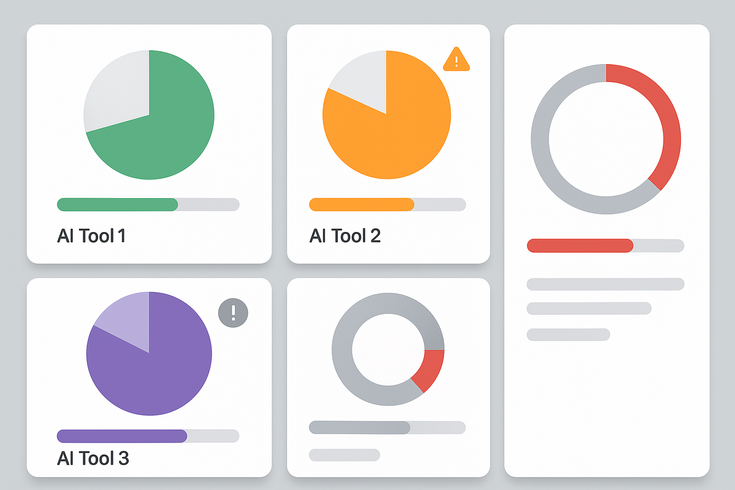
To understand whether Are free AI websites actually free in practice, let’s examine some of the most popular AI platforms and uncover what their “free” tiers really offer—and what they withhold.
ChatGPT Free vs Plus
OpenAI’s ChatGPT arguably sparked the current AI revolution, and its free tier remains one of the most generous in the industry. Free users get access to the GPT-3.5 model with no hard message limits during normal operation. However, several limitations make the paid Plus subscription increasingly attractive for regular users.
During peak times, free ChatGPT users face significant wait times or complete inability to access the service. The dreaded “ChatGPT is at capacity right now” message has frustrated countless users trying to complete time-sensitive work. Plus subscribers skip these queues entirely, ensuring consistent access regardless of demand.
Model quality represents another major difference. While GPT-3.5 handles many tasks competently, GPT-4 available to Plus subscribers offers dramatically improved reasoning, creativity, and accuracy. The newer model excels at complex tasks like coding, mathematical problem-solving, and nuanced writing that often stump its predecessor.
Free users also miss out on plugins and web browsing capabilities that extend ChatGPT’s functionality beyond text generation. These features transform the AI from a conversational partner into a research assistant capable of accessing current information and integrating with external services. For professionals relying on up-to-date data or specialized tools, this limitation alone might justify the upgrade cost.
Claude Free Tier Analysis
Anthropic’s Claude offers a compelling free tier that many users find sufficient for light to moderate use. The platform provides access to Claude 2 with reasonable daily limits and maintains consistent performance without the severe throttling some competitors impose. However, understanding its limitations helps illustrate the broader pattern across AI platforms.
Claude’s free tier restricts conversation length and complexity. While you can engage in multiple exchanges, lengthy documents or extensive contextual discussions may hit barriers that interrupt your workflow. The platform also limits file uploads and analysis capabilities, features that become essential for research or professional documentation tasks.
Privacy-conscious users should note that Claude’s free tier, like many others, may use conversations for model improvement. While Anthropic maintains strong ethical standards, the distinction between free and paid data handling remains important for sensitive applications.
Other Major AI Platforms
The landscape of AI platforms extends far beyond just ChatGPT and Claude. Image generation tools like Midjourney and DALL-E operate on credit systems where free tiers provide limited generations before requiring payment. These credits often deplete rapidly for users exploring creative possibilities or iterating on designs.
Writing assistants such as Jasper and Copy.ai offer free trials or limited free tiers that severely restrict output length and quality. Users frequently discover that creating even one complete blog post exhausts their monthly allowance, forcing difficult decisions about upgrading or abandoning half-finished projects.
Code assistance platforms like GitHub Copilot provide free access to students and open-source contributors but charge others monthly fees. While these targeted free offerings benefit specific communities, they highlight how “free” often comes with eligibility requirements that exclude many potential users.
Voice and audio AI tools follow similar patterns. Platforms offering voice cloning or text-to-speech services might provide a few minutes of free generation monthly—enough to test the service but insufficient for any substantial project. Music generation AIs often limit track length, use quality, or commercial usage rights in their free tiers.
When Free AI Websites Actually Free Becomes Paid
Understanding when and why users transition from free to paid tiers helps answer whether Are free AI websites actually free for your specific needs. This transition point varies greatly depending on individual usage patterns and requirements.
Common Upgrade Triggers
Several scenarios commonly push users toward paid subscriptions. The most obvious trigger is hitting usage limits repeatedly. When you find yourself rationing queries or waiting for monthly resets, the time lost often exceeds the monetary cost of upgrading. This calculation becomes especially clear for professionals whose hourly rate makes subscription fees trivial compared to productivity gains.
Quality requirements drive many upgrades. Users might start with free tiers for casual experimentation but discover that professional work demands higher-quality outputs. Whether it’s more coherent writing, better image resolution, or more accurate code suggestions, the jump in quality between free and paid tiers often justifies the expense for serious applications.
Collaboration needs frequently necessitate upgrades. Free tiers typically limit sharing and teamwork features, making them unsuitable for group projects or client work. When you need to share access, maintain version history, or coordinate with colleagues, paid plans become essential infrastructure rather than optional luxuries.
Integration requirements also push users toward paid tiers. Free versions rarely include API access or third-party integrations that enable workflow automation. For users wanting to connect AI capabilities to existing tools and processes, upgrade costs become investments in efficiency.
Calculating Your True AI Costs
Determining whether free AI tools actually save money requires honest assessment of both direct and indirect costs. Start by tracking time spent working around limitations—waiting for access, splitting tasks to fit within limits, or recreating lost work. Multiply these hours by your effective hourly rate to quantify productivity losses.
Consider quality costs as well. If free tier outputs require significant editing or revision, factor in that additional effort. Similarly, if limitations force you to use multiple free tools instead of one comprehensive paid solution, account for the complexity and context-switching overhead.
Don’t forget opportunity costs. Projects delayed or abandoned due to free tier limitations represent lost potential income or advancement opportunities. While harder to quantify precisely, these impacts often dwarf direct subscription costs for active users.
Business vs Personal Use
The calculation of whether Are free AI websites actually free shifts dramatically between personal and business contexts. Individual users experimenting with AI for learning or hobby projects might find free tiers perfectly adequate. The limitations that frustrate professionals barely impact casual exploration.
Businesses face different considerations entirely. Beyond productivity concerns, they must evaluate compliance requirements, data security, and service reliability. Free tiers rarely include service level agreements, dedicated support, or enterprise security features that businesses require. What appears free initially can become expensive when considering risk management and operational requirements.
Freelancers and solopreneurs occupy a middle ground. They need professional capabilities but might lack the budget for enterprise plans. For this group, carefully chosen paid subscriptions often provide the best value—investing in one or two essential tools while leveraging free tiers for supplementary needs.
Best Truly Free AI Alternatives in 2026
Despite the limitations we’ve discussed, genuinely free AI options do exist for users willing to accept certain trade-offs. Understanding these alternatives helps answer whether Are free AI websites actually free by providing concrete examples of no-cost solutions.
Open Source AI Options
The open-source community has created impressive AI tools that users can run without any subscription fees. These solutions shift costs from ongoing subscriptions to initial setup and computational resources. While not “free” in terms of effort or hardware requirements, they eliminate vendor lock-in and usage restrictions.
Local language models like LLaMA, Alpaca, and Vicuna offer ChatGPT-like capabilities on personal hardware. With sufficient GPU power, these models provide unlimited usage without privacy concerns or API limits. The trade-off comes in technical complexity—users must handle installation, updates, and troubleshooting independently.
Stable Diffusion revolutionized AI image generation by releasing open-source models anyone can run. While commercial services built on Stable Diffusion charge for convenience and computational power, the underlying technology remains free for those willing to manage their own installations. Communities have developed user-friendly interfaces like Automatic1111 that make local deployment accessible to non-technical users.
Open-source alternatives exist for specialized tasks too. WhisperAI provides free speech recognition, while projects like Tortoise-TTS offer voice synthesis without usage limits. These tools might lack the polish of commercial alternatives but deliver core functionality without ongoing costs.
Community-Driven Platforms
Some platforms maintain generous free tiers through community support and alternative funding models. These services demonstrate that Are free AI websites actually free can have a positive answer when aligned with different business incentives.
Perplexity AI offers a capable free tier for AI-powered search without the severe restrictions found elsewhere. While paid subscriptions provide additional features, the free version remains useful for regular research and information gathering. The platform’s focus on search advertising rather than subscription revenue enables this generosity.
Hugging Face stands out as a community platform hosting thousands of AI models available for free use. While computational costs still apply for intensive usage, the platform provides generous free tiers and enables users to run models locally after downloading. This approach fosters innovation while keeping AI accessible to researchers and developers regardless of budget.
Educational platforms sometimes offer perpetually free access for learning purposes. Google Colab provides free GPU access for running AI models, making it invaluable for students and researchers. While limitations exist on session duration and resource allocation, these constraints rarely impact educational use cases.
Limited But Genuinely Free Tools
Some AI tools embrace simplicity and specialization to offer genuinely free services without hidden catches. These platforms typically focus on specific use cases rather than trying to be comprehensive AI solutions.
Grammar and writing aids like the basic version of Grammarly provide valuable AI assistance without charge. While advanced features require payment, the free tier offers substantial value for everyday writing improvement. Similarly, tools like Hemingway Editor use AI to enhance writing clarity without usage restrictions.
Simple AI chatbots for specific domains often remain free by limiting scope rather than usage. Customer service bots, educational assistants, and specialized calculators can provide unlimited interactions within their narrow focus areas. These tools prove that Are free AI websites actually free when expectations align with capabilities.
Browser extensions leveraging AI for translation, summarization, or productivity enhancement frequently offer robust free tiers. By processing data locally or using efficient models, these tools avoid the high computational costs that force other platforms toward paid models.
Making Smart Choices About AI Tools
As we’ve explored throughout this article, the question “Are free AI websites actually free” doesn’t have a simple answer. The reality depends entirely on your specific needs, usage patterns, and willingness to accept various trade-offs. However, armed with understanding of how these platforms operate, you can make informed decisions that maximize value while minimizing unexpected costs.
For casual users exploring AI capabilities, free tiers provide excellent starting points. They allow experimentation without financial commitment and help identify which tools provide real value for your workflow. The key is approaching them with realistic expectations about limitations and being prepared to either accept those constraints or budget for upgrades when needed.
Professional users should view free AI tiers as trials rather than long-term solutions. While they might suffice initially, growing dependence on AI tools almost invariably leads to upgrade needs. Planning for these costs from the beginning prevents disruption when free allowances no longer suffice. Consider starting with free options to evaluate different platforms, but budget for subscriptions to the tools that prove essential.
Privacy-conscious users must carefully evaluate the true cost of “free” services. If data security and confidentiality are paramount, paid tiers or self-hosted solutions often provide better protection than free alternatives. The peace of mind from knowing your data remains private might justify subscription costs regardless of usage levels.
Looking toward the future, the landscape of free AI tools will continue evolving. Competition between platforms benefits users by pushing companies to offer more generous free tiers. Simultaneously, advancing technology reduces computational costs, potentially enabling more features within free offerings. However, the fundamental tension between providing value and generating revenue means truly unlimited free AI will remain rare.
The emergence of specialized AI tools might offer the best path forward for cost-conscious users. Rather than seeking one platform that does everything, combining multiple focused free tools can create powerful workflows without subscription fees. This approach requires more setup and coordination but maximizes the value extracted from free tiers across different services.
Ultimately, whether Are free AI websites actually free depends on your definition of “free” and willingness to navigate limitations. They’re free in monetary terms for users who stay within constraints, but costs emerge through time, features, privacy, or eventual upgrades for most active users. Understanding these dynamics helps you approach AI tools strategically, extracting maximum value while avoiding unwelcome surprises.
As AI becomes increasingly integrated into daily work and life, treating these tools as investments rather than expenses shifts the conversation productively. Whether you choose free tiers, paid subscriptions, or open-source alternatives, the key lies in aligning your choice with your needs and values. The best AI tool isn’t necessarily the one with the most features or the lowest price—it’s the one that enhances your capabilities without creating new problems.
For those still wondering about specific AI website creation capabilities, you might want to explore whether you can Can ChatGPT build me a website? The intersection of AI capabilities and web development continues expanding, offering new possibilities for creators and businesses alike.
Similarly, if you’re specifically interested in website creation tools, investigating options where Is there a free AI that creates a website? can help you understand the current landscape of AI-powered web development platforms and their pricing models.
Conclusion: The Real Cost of Free AI
After examining the complex landscape of AI pricing models, limitations, and alternatives, we can definitively say that while Are free AI websites actually free in the strictest monetary sense for basic usage, they come with various hidden costs that users must carefully consider. These costs manifest as time limitations, feature restrictions, privacy trade-offs, and eventual upgrade pressures that transform “free” users into paying customers.
The key to navigating this landscape successfully lies not in avoiding all costs but in understanding them upfront and making intentional choices. Free AI tiers serve valuable purposes—they democratize access to advanced technology, enable experimentation, and help users identify which tools truly enhance their productivity. However, approaching them with unrealistic expectations of unlimited free access leads to frustration and disrupted workflows.
For 2026 and beyond, the most successful AI users will be those who view these tools pragmatically. They’ll leverage free tiers for exploration and light usage while budgeting for paid subscriptions where AI provides significant value. They’ll also stay informed about open-source alternatives and community platforms that offer different value propositions than commercial services.
Remember that the question isn’t simply whether AI websites are free, but whether they provide value proportionate to their total cost—monetary and otherwise. By understanding these dynamics, you can harness AI’s transformative potential without falling into the traps that catch unwary users. The future belongs to those who can effectively integrate AI into their workflows, whether through free tiers, paid subscriptions, or alternative solutions.
As AI technology continues advancing and competition intensifies among providers, we may see more generous free offerings and innovative pricing models. However, the fundamental economics of providing computationally intensive services means truly unlimited free AI will remain the exception rather than the rule. Plan accordingly, and you’ll find that whether free or paid, the right AI tools can dramatically enhance your capabilities and productivity in ways that justify their costs—hidden or otherwise.