
Keyword Research Long Tail – Picture yourself at an ice cream shop. You could ask for “ice cream” and hope the worker guesses what you want. Or you could say “a double scoop of mint chocolate chip in a waffle cone with extra sprinkles.” Which request is more likely to get you exactly what you want?
That’s the difference between regular keywords and long tail keywords! And in 2026, understanding keyword research long tail is like having a secret map that leads customers straight to your door.
What Are Long Tail Keywords Anyway?
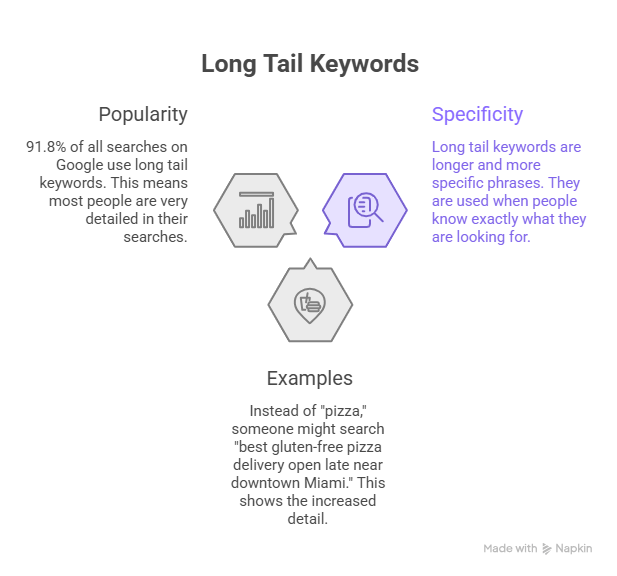
Long tail keywords are longer, more specific phrases that people type into search engines when they know exactly what they’re looking for.
Instead of searching “pizza,” someone might search:
- “Best gluten-free pizza delivery open late near downtown Miami”
- “How to make pepperoni pizza without an oven”
- “Wood-fired pizza restaurants with outdoor seating in Brooklyn”
See how much more specific those are? That’s what makes them “long tail” – they’re longer phrases that get really detailed about what someone wants!
Here’s a cool fact: 91.8% of ALL searches on Google use long tail keywords! That means out of every 100 searches, more than 91 are these longer, specific phrases. Almost everyone searching online is being very detailed about what they want!
Why Long Tail Keywords Are Like Magic for Your Website
Now you might be thinking, “If long tail keywords are so specific, won’t fewer people search for them?” You’re absolutely right! But here’s the amazing part – that’s actually a good thing!
Let me explain with a story:
Sarah’s Struggle Sarah owns a bakery and tried to rank her website for “bakery.” Guess what happened? NOTHING! Big national chains like Dunkin’ and Panera completely dominated that keyword. Sarah’s little website never stood a chance.
Sarah’s Success Then Sarah discovered keyword research long tail. She changed her strategy and started targeting:
- “Custom birthday cakes for kids Boston”
- “Vegan wedding cupcakes delivery Massachusetts”
- “Allergy-friendly bakery near Fenway Park”
Within three months, her phone started ringing! People searching these specific terms were finding her website and actually placing orders. Why? Because she was giving them EXACTLY what they were looking for!
Here’s why long tail keywords work so well:
Less Competition, Easier to Win: Instead of fighting against huge companies, you’re targeting phrases that fewer websites care about. This means your small business website can actually show up on the first page of Google!
People Are Ready to Buy: Someone searching “shoes” is just browsing. But someone searching “best waterproof hiking boots for women with wide feet size 9” has their credit card ready! Long tail searches come from people who know what they want and are ready to take action.
2.5 Times Better Results: Studies show that long tail keywords convert 2.5 times better than short keywords. That means if 100 people find you through a short keyword and 10 buy something, then 100 people finding you through a long tail keyword means 25 will buy! Same traffic, way more customers!
The Three Types of Long Tail Keywords You Need to Know
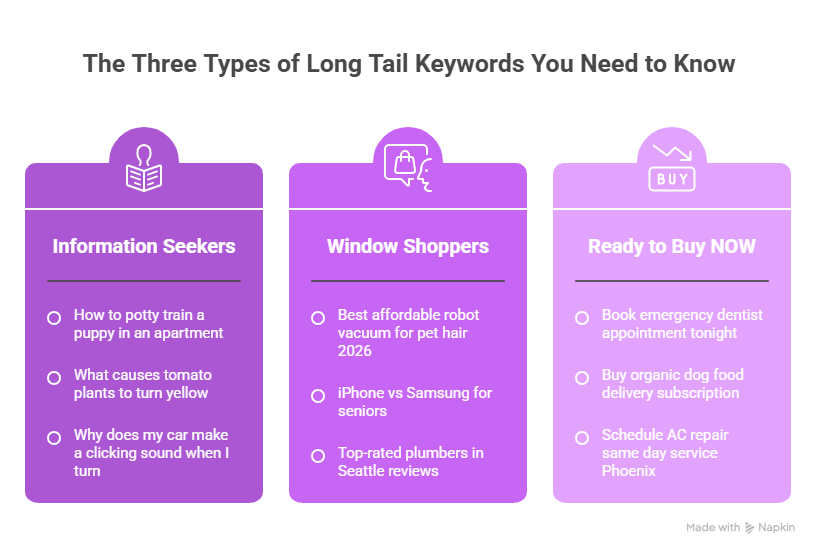
Not all long tail keywords are created equal. They come in three flavors, and each one serves a different purpose:
Type 1: Information Seekers
These are people who want to learn something. They’re asking questions like:
- “How to potty train a puppy in an apartment”
- “What causes tomato plants to turn yellow”
- “Why does my car make a clicking sound when I turn”
These folks aren’t ready to buy yet. They’re just learning. For these keywords, you’d create helpful blog posts, guides, or how-to videos.
Type 2: Window Shoppers
These people are doing research before they buy. They’re comparing options:
- “Best affordable robot vacuum for pet hair 2026”
- “iPhone vs Samsung for seniors”
- “Top-rated plumbers in Seattle reviews”
They’re getting close to buying! For these keywords, create comparison pages, review content, or “best of” lists.
Type 3: Ready to Buy NOW
These are your favorite people! They’re ready to open their wallets:
- “Book emergency dentist appointment tonight”
- “Buy organic dog food delivery subscription”
- “Schedule AC repair same day service Phoenix”
For these keywords, you want product pages, service pages, and booking systems ready to go!
How to Find Amazing Long Tail Keywords (Step by Step)
Ready to discover long tail gold? Here’s how to do keyword research long tail the easy way:
Step 1: Start With What You Know
Write down the main things your business does. If you’re a dog trainer, you might write:
- Puppy training
- Dog obedience
- Aggressive dog behavior
- Leash pulling
These are your starting points, not your final keywords!
Step 2: Let Google Help You (It’s Free!)
Here’s a super easy trick: Go to Google and start typing your topic. Don’t press enter! Just watch what Google suggests. Those suggestions are REAL searches that REAL people are typing!
Type “puppy training” and Google might suggest:
- puppy training near me
- puppy training tips for first time owners
- puppy training schedule by age
- puppy training classes cost
Every single one of these is a potential long tail keyword!
Step 3: Scroll to the Bottom
After you do search, scroll all the way to the bottom of Google’s results. You’ll see “Related searches” – these are more long tail keywords handed to you on a silver platter!
Step 4: Check “People Also Ask”
Those expandable question boxes on Google? Pure gold! They show you the exact questions people are typing about your topic. Screenshot them and add them to your list.
Step 5: Look at Your Own Website
If you already have a website, use Google Search Console (it’s free!). It shows you which searches are already bringing people to your site. You might discover you’re accidentally ranking for long tail keywords you didn’t even know about!
Step 6: Look at What Your Competitors Are Ranking For
One of the best sources of long tail keyword ideas is your competition. By studying which specific phrases drive traffic to their pages, you can find untapped opportunities for your own site. Our guide on keyword research competitor analysis walks you through exactly how to do this — including the tools and techniques professionals use to uncover competitor keyword gaps.
The Secret Clustering Strategy
Here’s something really important that most people get wrong: DON’T create a separate page for every single long tail keyword!
Instead, group similar keywords together. This is called “clustering,” and it’s super powerful.
For example, all these keywords want the same information:
- “How to stop dog from barking at night”
- “Why does my dog bark when I leave”
- “Training dog not to bark at strangers”
- “Stop excessive dog barking tips”
Create ONE awesome page about stopping dog barking that covers all these questions. This page will rank for ALL of these keywords, not just one!
Think of it like this: instead of writing five short, boring essays, you write one really good, complete essay that answers everything. Google loves complete, helpful content!
Where to Use Your Long Tail Keywords
Once you’ve found your perfect long tail keywords, here’s where to put them:
In Your Page Title: Make it natural and interesting! “How to Stop Your Dog From Barking: 7 Proven Methods That Work” is way better than “Dog Barking Stop Tips.”
In Your URL: Instead of “mysite.com/page1,” use “mysite.com/stop-dog-barking-at-night”
In Your First Paragraph: Mention your keyword naturally in the first 100 words.
In Your Headings: Use your long tail keyword and variations throughout your article in the H2 and H3 headings.
Throughout Your Content: Sprinkle it naturally as you write. If you’re forcing it or it sounds weird, you’re doing it wrong!
For a deeper look at exactly where and how keywords should appear across different types of pages, our guide on keyword research for website optimization covers all of this in detail — including page titles, URLs, headings, and image alt text.
Important Rule: NEVER stuff keywords! Write like you’re explaining something to a friend. If it sounds natural when you read it out loud, you’re doing it right!
The Big 2026 Change: AI Search Loves Long Tail
Here’s something exciting happening right now: AI tools like ChatGPT and Google’s AI summaries are taking over search!
And guess what? These AI tools LOVE long tail keywords! Why? Because people talk to AI like they’re having a conversation. Nobody says “pizza” to ChatGPT. They say “What’s the best pizza place near me that’s open late and has gluten-free options?”
Studies show that websites appearing in AI-generated answers get 15-20% more traffic than websites that don’t. So doing keyword research long tail isn’t just good for Google anymore – it’s essential for showing up in AI search results too!
How Long Tail Connects to Everything Else You Do
When you master keyword research with a focus on long tail keywords, amazing things start happening across all your marketing:
Your search engine marketing for small business gets way better because you understand exactly what your customers are searching for.
Your PPC management for small business becomes more profitable! Instead of bidding on expensive broad keywords that don’t convert, you bid on specific long tail keywords that bring you actual customers. You spend less money and make more sales!
You can also use these keywords in:
- Your YouTube video titles
- Your social media posts
- Your email subject lines
- Your product descriptions
- Your Google Business Profile
Everything becomes more targeted and more effective! And if you’d rather have an expert handle the long tail research for you, professional keyword research services can find the most valuable specific phrases for your industry and hand you a prioritized list ready to implement.
Common Mistakes to Avoid
Don’t fall into these traps:
Mistake 1: Thinking Long = Long Tail “Best web developer” is three words but it’s NOT a long tail keyword. It’s super competitive! A real long tail keyword would be “affordable web developer for small restaurants in Austin Texas.” It’s about being SPECIFIC, not just long.
Mistake 2: Only Targeting High Volume Sure, “running shoes” gets 500,000 searches per month. But “best running shoes for flat feet women size 8 under $100” only gets 50. Which one do you think converts better? The specific one! Those 50 people know EXACTLY what they want and are ready to buy.
Mistake 3: Creating Too Many Pages Remember the clustering strategy! One great page beats ten thin pages every single time.
Mistake 4: Ignoring Intent Make sure your content matches what people actually want. If the long tail keyword is a question, answer the question! If it’s someone looking to buy, show them your products!
Real Results From Real Businesses
Let me share some quick success stories:
The Furniture Store: Stopped targeting “furniture” and started targeting “mid-century modern dining table reclaimed wood Seattle.” Their organic traffic tripled in four months!
The Yoga Instructor: Changed from “yoga classes” to “prenatal yoga classes for beginners Sunday mornings Portland.” Her class went from 3 students to fully booked in six weeks!
The Car Repair Shop: Switched from “auto repair” to “Honda Civic transmission repair same day service Phoenix under $500.” Their phone started ringing off the hook!
All of these businesses discovered the power of keyword research long tail and it transformed their results.
Your Action Plan Starting Today
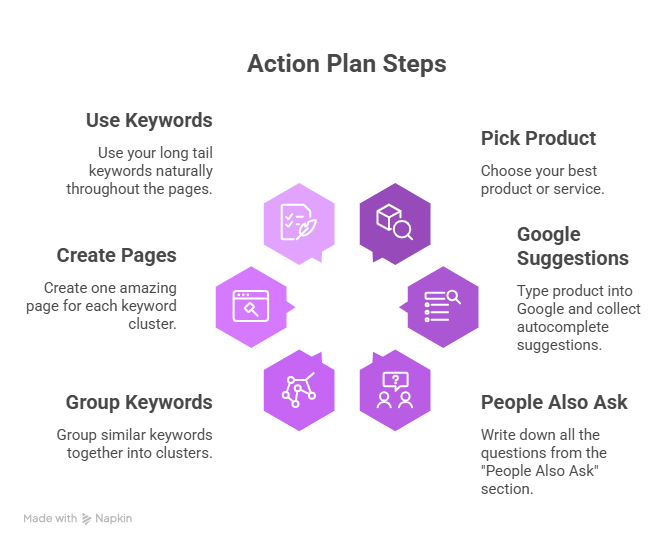
Ready to get started? Here’s what to do right now:
- Pick your top product or service
- Type it into Google and collect all the autocomplete suggestions
- Write down all the “People Also Ask” questions
- Group similar keywords together into clusters
- Create one amazing page for each cluster
- Use your long tail keywords naturally throughout
Don’t try to do everything at once! Start with just ONE cluster. Make it awesome. Then move to the next one.
The Bottom Line
Keyword research long tail isn’t complicated – it’s just about understanding how real people search when they know what they want.
While your competitors fight over broad keywords like “pizza” or “plumber,” you can swoop in and capture all those specific searches like “emergency plumber 24 hour service for burst pipe Minneapolis” and “authentic Neapolitan pizza wood fired oven gluten free crust delivery.”
Remember these key points:
- Long tail keywords are specific phrases (usually 4+ words)
- They make up 91.8% of all searches
- They convert 2.5 times better than short keywords
- Less competition means you can actually rank
- Cluster similar keywords into one page
- Write naturally for humans, not robots
- AI search loves long tail keywords
The businesses winning online in 2026 aren’t the ones with the biggest budgets. They’re the ones who understand that keyword research long tail is the secret weapon for getting found by people who are actually ready to become customers!
Start today, stay focused, and watch your traffic grow!