
What Is a Good Conversion Rate for Google Ads? – You’ve set up your Google Ads, people are clicking, and the traffic is coming in. But then you look at your conversion rate and wonder — is this number actually good? Are you winning, losing, or somewhere in the middle?
If you’ve been asking yourself “what is a good conversion rate for Google Ads,” you’re asking exactly the right question. And the honest answer is: it depends. But don’t worry — by the end of this article, you’ll know exactly what to compare your numbers against, why conversion rates are shifting in 2026, and what to do if yours needs some work.
Let’s dig in.
What Is a Conversion Rate in Google Ads?
Before we get to the benchmarks, let’s make sure we’re on the same page about what a conversion rate actually is.
Your conversion rate is the percentage of people who click your ad and then do something valuable — like buy a product, fill out a form, or call your business. It’s calculated simply: take the number of conversions and divide by the number of clicks, then multiply by 100.
So if 100 people click your ad and 4 of them buy something or fill out your contact form, your conversion rate is 4%. Simple as that.
A high conversion rate means your ads are sending the right people to a page that convinces them to take action. A low conversion rate can mean different things — and figuring out which one is the whole game.
What Is a Good Conversion Rate for Google Ads in 2026?
Here’s where it gets interesting. There are actually two different numbers you’ll see quoted, and both are correct — they just measure different things.
The broader average — which includes lead generation businesses like law firms, healthcare providers, and service companies that count a form submission as a conversion — is 8.18% across all industries in 2026, based on data from thousands of campaigns tracked by WordStream by LocaliQ.
The stricter average — which focuses more on actual purchases and transactions — sits at 3.75% to 4.40% for Search Ads in 2026.
A simple way to think about it:
- Below 2% = needs attention, likely a landing page problem
- 2%–5% = average, room to grow
- 5%–8% = above average, solid performance
- 8%+ = excellent, you’re outperforming most advertisers
One thing worth knowing right away: conversion rates for Search Ads are much higher than for Display Ads. The average Display Ad conversion rate is just 0.77%. That’s not a bad number for Display — it just reflects the fact that people aren’t actively searching when they see a banner ad. Don’t compare your Display results to your Search results.
Conversion Rate Benchmarks by Industry (2026)
The single most important thing to understand about conversion rates is this: your industry matters enormously. A 3% conversion rate can be amazing in one business and disappointing in another.
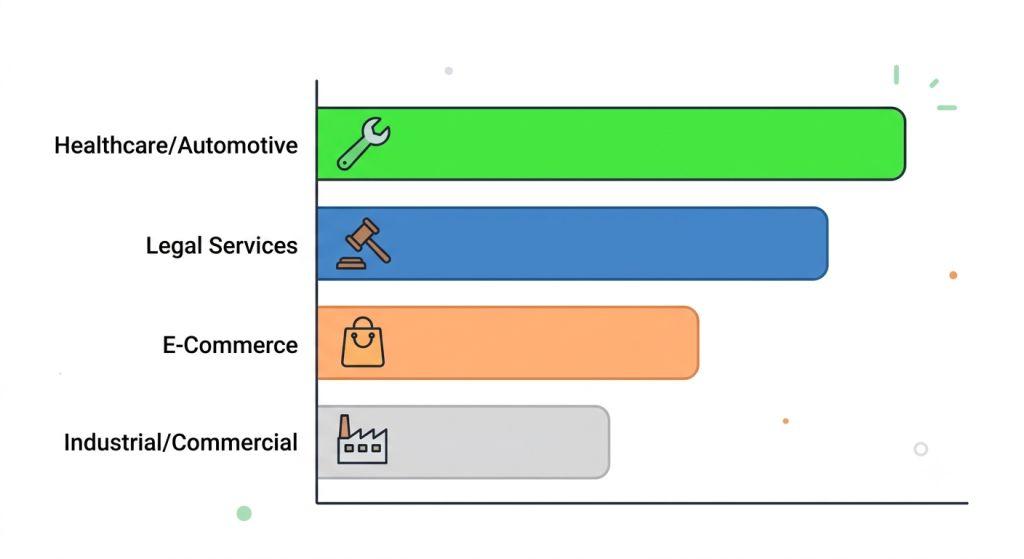
Here’s how the numbers break down across major industries in 2026:
| Industry | Average Conversion Rate |
|---|---|
| Animals & Pets | 16.22% |
| Automotive Repair | 14.67%–15.51% |
| Healthcare | up to 24.3% |
| Legal Services | 6.98%–12.7% |
| Finance & Insurance | 5.10% |
| Arts & Entertainment | 4.10% |
| Real Estate | 2.47% |
| E-Commerce | 2.81% |
| Technology / B2B SaaS | 2.04%–4.0% |
| Industrial / Commercial | 0.83% |
Why such big differences? It comes down to urgency and how people buy. Emergency services like automotive repair and healthcare convert high because people need help right now — they’re not shopping around. E-commerce and technology convert lower because buyers take their time, compare options, and do research before deciding.
The takeaway: always compare your conversion rate to businesses in your own industry, not to a general average. A 3% conversion rate in B2B tech is right on target. A 3% conversion rate for an emergency plumber is a sign something’s wrong.
The Biggest 2026 Story: Ads Are Getting Better, Landing Pages Are Getting Worse
Here’s the most surprising — and important — trend happening in Google Ads right now.
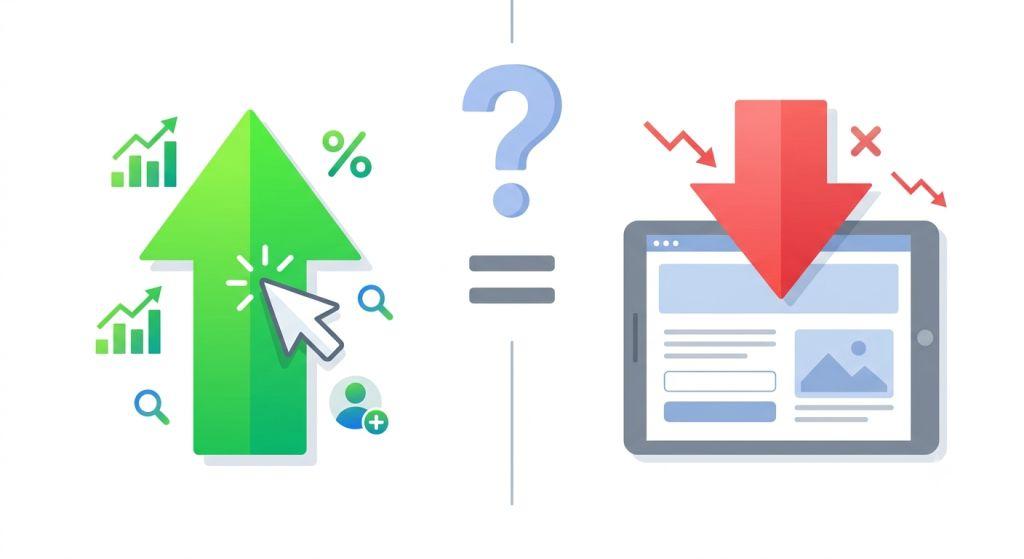
In 2026, click-through rates went up by 7.49% across the board. People are clicking ads more than ever. But at the same time, conversion rates went down by 9.28%, and they fell in 13 out of 14 industries tracked.
Read that again: more clicks, fewer conversions.
What does that tell us? The ads themselves are improving — Google’s AI is getting better at matching ads to the right people, and more people are engaging. But once those people arrive on a business’s website, something is breaking down. They’re clicking, looking around, and leaving without taking action.
This means if your conversion rate is below your industry benchmark, the problem is almost certainly not your ad. It’s your landing page. Common reasons include:
- Message mismatch: Your ad promises one thing, but your landing page talks about something else entirely
- Slow load time: If your page takes more than 3 seconds to load, a huge percentage of visitors will leave before they even see your offer
- Poor mobile experience: Mobile devices now account for 65% of all Google Ads clicks, but only 47% of conversions — meaning mobile visitors are clicking and then struggling to use the site
- Too much friction: Long forms, confusing layouts, or unclear next steps all kill conversions
- Generic pages: Sending everyone to your homepage instead of a specific page that matches what they searched for
If your CTR is healthy but your conversion rate is low, start with your landing page — not your ads.
The Mobile Gap Is a Major Opportunity
Speaking of mobile — this is one of the biggest hidden opportunities for small businesses in 2026.
Mobile CPCs (cost per click) are 24% cheaper than desktop. But mobile conversion rates are 35% lower than desktop. That’s a massive gap, and it’s almost entirely a landing page problem.
Advertisers who build mobile-friendly landing pages — fast loading, easy to read on a small screen, simple one-tap forms, and clear call-to-action buttons — are seeing more than double the mobile return on ad spend compared to businesses using the same page for all devices.
If you haven’t looked at your website on a phone recently, pull it up right now. Can you read it easily? Can you fill out the form with one thumb? Is it fast? If the answer to any of those is “no,” you’ve found your conversion rate problem.
Small Business Reality Check
If you’re a smaller business spending under $5,000 a month on Google Ads, here’s something important to know: smaller accounts tend to see 18% higher costs per click and 31% lower conversion rates than larger accounts on average.
This isn’t because your business is less competitive. It’s because Google’s AI bidding systems work better with more data. Bigger accounts have more clicks, more conversions, and more history for the algorithm to learn from. Smaller accounts are still catching up.
This doesn’t mean Google Ads doesn’t work for small businesses — it absolutely does. But it does mean that tracking every conversion carefully, setting up your campaigns correctly from the start, and being patient while the system learns are all especially important when you’re working with a tighter budget.
How to Improve Your Conversion Rate Without Spending More
Here are the most effective ways to raise your conversion rate in 2026 — none of which require increasing your ad budget:
Match your landing page to your ad. Every ad should point to a page that feels like a direct answer to what the person searched for. If someone searches “emergency roof repair” and clicks your ad, they should land on a page specifically about emergency roof repair — not your general homepage.
Speed up your website. Page speed is one of the fastest ways to lift conversions. Google’s free PageSpeed Insights tool shows you exactly what’s slowing your site down and how to fix it.
Simplify your forms. The fewer fields you ask for, the more people will fill it out. Start by only asking for what you truly need — usually just a name, email, and phone number.
Use Smart Bidding with accurate data. AI bidding strategies like Target CPA and Target ROAS can deliver 22% lower cost per conversion compared to manual bidding — but only when they have accurate conversion data to learn from. Make sure your conversion tracking is set up correctly first.
Beat your own history. The most important benchmark isn’t the industry average — it’s your own last month. Focus on steady, consistent improvement over time rather than chasing someone else’s number.
The Bottom Line
So, what is a good conversion rate for Google Ads? It’s whatever beats your industry average and keeps improving over time. For most businesses, landing somewhere between 3% and 8% on Search Ads is a strong result. For some industries like healthcare and automotive repair, double-digit conversion rates are realistic goals.
But the most important insight from 2026 is this: if your clicks are strong but your conversions are weak, stop looking at your ads and start looking at your landing page. That’s where the real opportunity is hiding right now.
If any of this sounds like a lot to manage — especially when Google Ads is already so complicated — you’re not alone. Getting conversion rates right takes the right setup, the right strategy, and consistent attention over time.
That’s why working with a team that specializes in search engine marketing for small business can make such a big difference. And if you’re ready for hands-on help turning your clicks into real customers, expert PPC Management For Small Business gives you the strategy and the tracking to actually know what’s working.
For a deeper look at the full 2026 benchmark data across every industry, WordStream’s annual Search Advertising Benchmarks Report is the most trusted free resource available and well worth bookmarking.