
If you’ve ever looked at your Google Ads dashboard and asked yourself, “what is a good CTR for Google Ads?” — you’re in great company. Almost every business owner who runs Google Ads asks this exact question. And honestly, the answer is a little more interesting than a simple number.
In this article, we’re going to break down what a good CTR for Google Ads actually looks like in 2026, why it changes depending on your industry, and what the latest trends mean for your business. No confusing jargon, no guesswork — just clear, friendly answers.
What Is CTR in Google Ads?
Let’s start from the very beginning. CTR stands for click-through rate. It’s a simple math equation: out of everyone who sees your ad, how many people actually click on it?
For example, if 100 people see your ad and 5 of them click it, your CTR is 5%. Easy, right?
CTR shows up everywhere inside your Google Ads account — at the campaign, ad group, keyword, and even individual ad level. It’s one of the first numbers people look at when trying to figure out if their ads are doing their job.
But here’s the thing: a CTR number by itself doesn’t tell you much. You have to know what kind of ad you’re looking at and what industry you’re in before you can say whether your number is good, bad, or right on track.
What Is a Good CTR for Google Ads in 2026?
Based on data from more than 13,000 Google Ads campaigns studied between April 2025 and March 2026, the overall average CTR for Search Ads across all industries is 6.64%. That means if your Search Ad CTR is above 6.64%, you’re doing better than most advertisers.
But here’s where it gets more nuanced. Different sources track this number slightly differently, and you’ll see ranges like 3.17% to 6.64% quoted across industry reports. A safe and practical way to think about it:
- 3%–5% CTR = solid and respectable
- 5%–7% CTR = above average, you’re doing well
- 7%–10%+ CTR = excellent, your ads are really connecting with people
The good news? Average CTR on Search Ads is actually going up — rising about 7.5% year over year. Part of that is thanks to Google’s AI tools getting better at matching ads to the right searches.
Good CTR for Google Ads by Ad Type
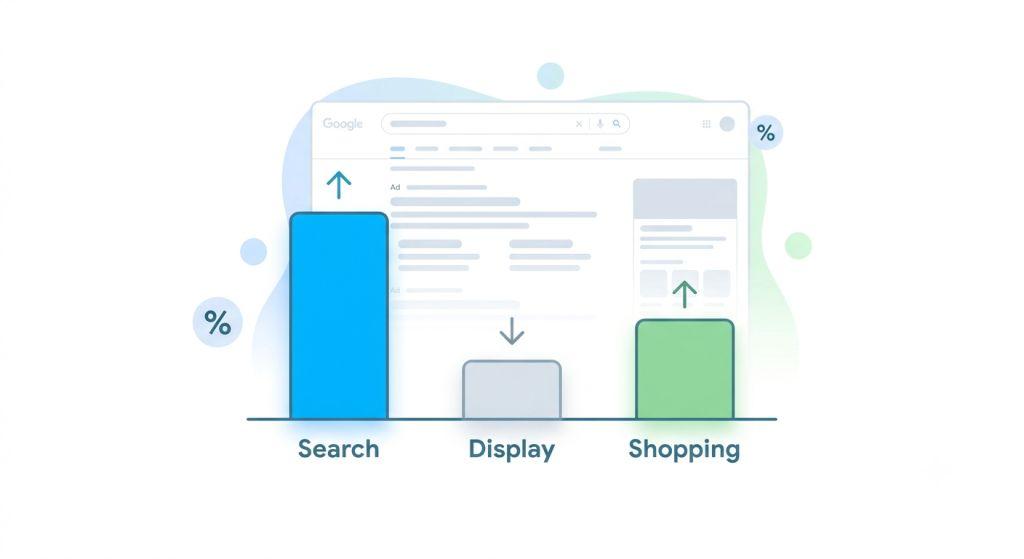
One of the biggest mistakes people make is comparing their CTR to the wrong benchmark. A Search Ad and a Display Ad are completely different, and their click-through rates reflect that.
Here’s a quick breakdown by ad type:
Search Ads are the text ads that show up when someone types something into Google. Because the person is actively searching, they’re more likely to click. Average CTR: around 3%–6.64% depending on the industry.
Display Ads are the banner-style ads that show up on websites across the internet. People aren’t searching — they’re just browsing, so they’re less likely to click. Average CTR: around 0.46%. That’s not a bad number for Display — it’s just how that ad type works.
Shopping Ads are the product image ads you see at the top of Google. Average CTR: around 0.86%.
YouTube Ads run before or during videos. Average CTR: around 0.65%.
The point is: never compare your Display Ad CTR to your Search Ad CTR. They live in completely different worlds, and mixing them up will just give you a headache.
Google Ads CTR Benchmarks by Industry (2026)
Here’s one of the most important things to understand about CTR: what counts as “good” depends heavily on what kind of business you run.
Some industries naturally get more clicks because people searching in that space are excited, ready to buy, or really engaged. Others have more careful, slow-moving buyers who research for a long time before clicking on anything.
Here’s how some industries compared in 2026:
| Industry | Average CTR |
|---|---|
| Arts & Entertainment | up to 12.75% |
| Real Estate | 4.23%–6.19% |
| Automotive Repair | 4.68%–6.10% |
| Finance & Insurance | 2.91%–3.20% |
| Technology & B2B | 2.09%–3.50% |
So if you run a technology company and your CTR is 3%, that’s actually right on target for your industry. Don’t panic if someone tells you the “average” is 6% — your average is different, and that’s completely normal.
The bottom line: always compare your CTR to businesses in your same industry, not to a one-size-fits-all number.
A High CTR Doesn’t Always Mean Your Ads Are Working
This might be the most surprising thing in this entire article, and it’s something even experienced advertisers miss.
In 2026, a very clear pattern has emerged: CTR numbers are going up across the board, but conversion rates — meaning the percentage of people who click and then actually buy something or fill out a form — are going down in most industries.
What does that tell us? People are clicking ads more than ever, but then landing on websites that aren’t convincing them to take the next step.
A high CTR is a sign that your ad is doing its job — getting attention and earning the click. But if your website or landing page isn’t clear, fast, or compelling, that click goes nowhere. Think of it this way: the ad is the invitation to the party, but the landing page is the party itself. If the party is boring, people leave.
So when you look at your CTR, always look at your conversion rate right alongside it. If your CTR is strong but your conversions are weak, the fix isn’t in your ad — it’s on your website.
How AI Overviews Are Changing Google Ads CTR in 2026
Here’s something brand new that’s affecting every Google advertiser right now, and it’s one of the biggest shifts in search advertising in years.
Google now shows AI-generated answers at the very top of many search results pages — called AI Overviews. These summaries answer the user’s question right there on the page, which means a lot of people never need to click anything at all.
This has had a major impact on click-through rates. When an AI Overview appears on a search results page, paid ad CTR drops from around 19.70% all the way down to 6.34%. That’s a massive difference.
However — and this is important — there’s a silver lining. When a brand gets mentioned or cited inside the AI Overview itself, that brand’s paid CTR is up to 91% higher than brands that aren’t cited. This means that building a strong, trusted brand online is more valuable than ever — not just for SEO, but for your paid ads too.
The other good news: after CTR on AI Overview pages hit a low point in late 2025, it started bouncing back — climbing 85% in just two months heading into early 2026. The dust is settling, and smart advertisers are already adapting.
How to Improve Your Google Ads CTR
If your CTR is below your industry benchmark, don’t panic. There are a few simple things to check first.
Check your Search Terms report. This report shows you exactly what people were searching when your ad appeared. You’ll often find searches that have nothing to do with your business — and those irrelevant impressions drag your CTR down. Adding negative keywords to block those searches can lift your CTR quickly and sometimes even triple your conversion rate.
Look at your ad copy. Does your headline directly match what the person was searching for? The more relevant your ad feels to the searcher, the more likely they are to click.
Check your Quality Score. Google grades your ads on a scale of 1 to 10. A score of 7 or above is considered good. Improving your Quality Score from a 5 to an 8 can cut your cost-per-click by about 30% — and better scores tend to come with better ad placement, which leads to higher CTR naturally.
Match your landing page to your ad. If someone clicks an ad about “affordable roof repair” and lands on a generic homepage, they’ll leave immediately. Every ad should point to a page that feels like a direct answer to what the person searched for.
What Is a Good CTR for Google Ads? The Bottom Line
Here’s a simple summary to take with you:
- For Search Ads, aim for a CTR of 3%–5% as a solid baseline, with anything above 6.64% putting you ahead of most advertisers
- For Display, Shopping, and YouTube, much lower CTR numbers are completely normal — don’t compare them to Search
- Always benchmark against your own industry, not a general average
- A high CTR only matters if it leads to conversions — check both numbers together
- AI Overviews are reshaping CTR right now, but brands with strong online presence are actually benefiting
Understanding your CTR is important, but it’s only one number in a much bigger story. The real goal of Google Ads isn’t clicks — it’s customers. A 3% CTR that leads to lots of sales beats a 10% CTR that leads to none.
If managing all of this feels like a lot to keep up with — especially with all the AI changes happening right now — you’re not imagining it. Google Ads is genuinely complicated, and the platform keeps evolving faster than most business owners can track on their own.
That’s why many small businesses get the best results by working with people who do this every day. A team that specializes in search engine marketing for small business can help you understand what your numbers actually mean and what to do about them. And if you’re ready to stop guessing and start growing, expert PPC Management For Small Business puts the right strategy behind your ad spend so every click has a better chance of turning into a real customer.
For the latest industry benchmarks and deeper data, WordStream’s annual Google Ads Benchmark Report is one of the most trusted free resources available and a great place to compare your numbers any time of year.